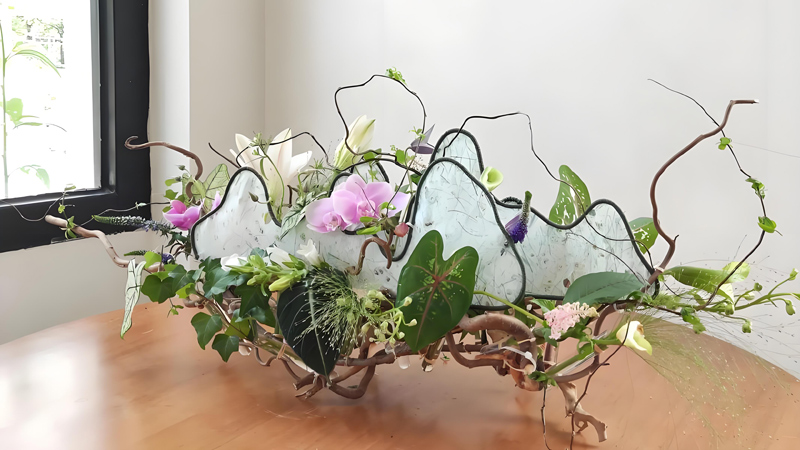
In a quiet studio filled with the scent of fresh foliage, a group of students gathers around Master Ying (应老师), eager to learn the ancient art of Eastern flower arrangement. Today's focus is on three-dimensional structures, a technique often misunderstood as solely Western. Master Ying begins by challenging this notion, explaining that Eastern methods have their own rich history and aesthetic principles. He emphasizes that this isn't about rigid rules but about capturing the essence of nature through balance and space.
As he speaks, the students handle branches and test tubes, realizing that traditional flower art is more accessible and profound than they imagined. This session promises to blend timeless wisdom with hands-on creativity, offering a fresh perspective on how simple materials can transform into elegant designs.
Eastern Principles
Master Ying delves into the core of Eastern aesthetics, highlighting how it differs from Western styles. While Western flower arrangement often prioritizes symmetry and bold patterns, Eastern approaches, like the Song Yun (宋韵) style, embrace asymmetry to achieve harmony. He uses the analogy of a window frame: just as people enjoy viewing a landscape through a pane, Eastern designs use "frames" to create focused, poetic scenes. This method isn't about randomness; it's a deliberate use of triangular forms to build depth and movement. By avoiding perfect symmetry, the arrangements feel alive and dynamic, mirroring the irregular beauty found in nature.
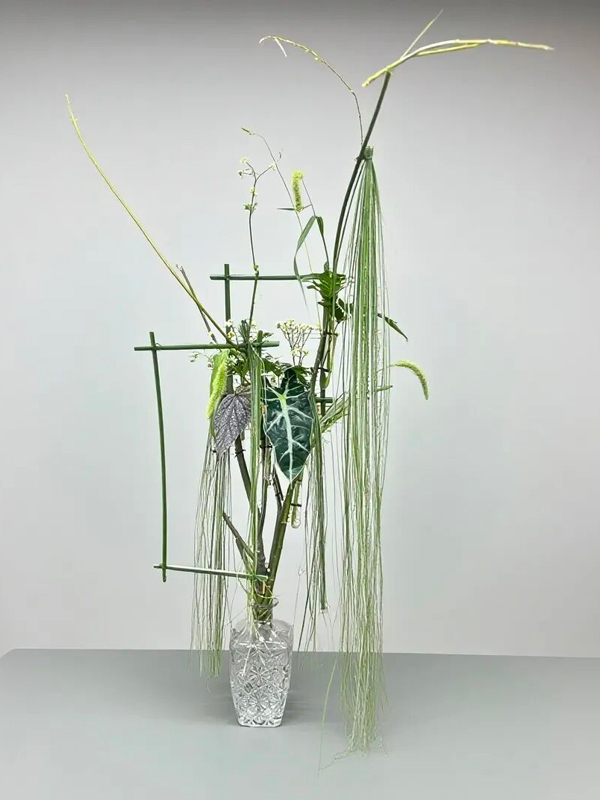
He demonstrates with a simple branch structure, showing how angles and lines can evoke emotions. "Think of a mountain range," Master Ying says, "where peaks and valleys create a sense of journey." The students practice arranging branches into asymmetric triangles, learning to balance visual weight without mirroring sides. This principle, rooted in philosophies like Daoism, teaches that true balance comes from complementary opposites. As they work, the room fills with experimentation, each student discovering how slight adjustments can turn chaos into calm.
Another key aspect is spatial hierarchy, where elements are layered to guide the eye. Master Ying explains that high and low placements aren't just for variety; they represent natural growth and energy flow. For instance, taller branches might symbolize aspiration, while lower ones ground the composition. This approach avoids clutter, allowing each component to breathe. Students note how even a minimalist setup can feel expansive, proving that Eastern design values emptiness as much as form. Through these lessons, they see that mastery isn't about complexity but understanding invisible connections.
Choosing Materials
Material selection is where creativity shines, as Master Ying encourages using everyday items. He points to old window frames, bamboo strips, and even discarded metal as potential foundations. "Nothing is off-limits," he remarks, urging students to see beauty in the mundane. For beginners, he suggests starting with basic shapes like squares or diamonds, which can be rotated for variety. This flexibility allows newcomers to build confidence before exploring intricate forms inspired by ancient architecture, such as moon gates or circular portals.
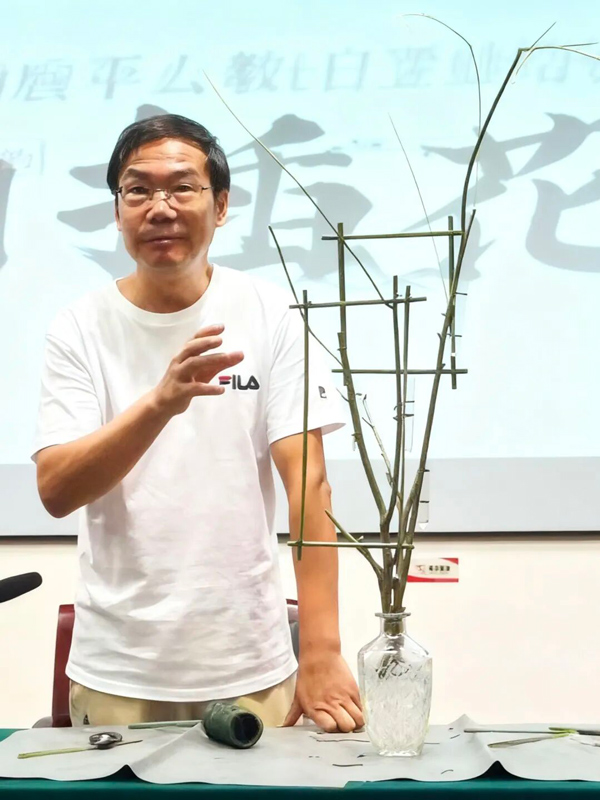
Practical tips follow, like securing test tubes with wire and double-sided tape to prevent slipping. Master Ying shares that adhesion is crucial; a loose hold can ruin the structure's stability. Students recall previous lessons, chiming in with solutions like wrapping wire twice or using adhesives for extra grip. He smiles, praising their retention, and stresses that materials should serve the design's space, not dominate it. Whether using wood, acrylic, or plastic, the goal is to enhance dimensionality without overwhelming the senses.
Experimentation is key, as a student accidentally spills water from a tilted tube, prompting a lesson on uniformity. Master Ying advises keeping tubes upright or at a consistent 45-degree angle to avoid mess and maintain cohesion. He adds that materials like branches can be layered to expand size, showing how a few additions can transform a small piece into a statement. This hands-on segment reinforces that resourcefulness trumps expense, empowering students to craft with whatever they have on hand.
Artistic Pairing
When it comes to adding flowers and leaves, Master Ying starts a fun quiz, rewarding those who remember the pairing rules. Students eagerly shout answers: begin with larger, block-like elements such as Big Fairy Leaf or begonia, then incorporate finer textures like ferns or grass. This method ensures a solid foundation before detailing, preventing a top-heavy look. He cautions against letting materials droop over edges, which can disrupt the composition's cleanliness and focus.
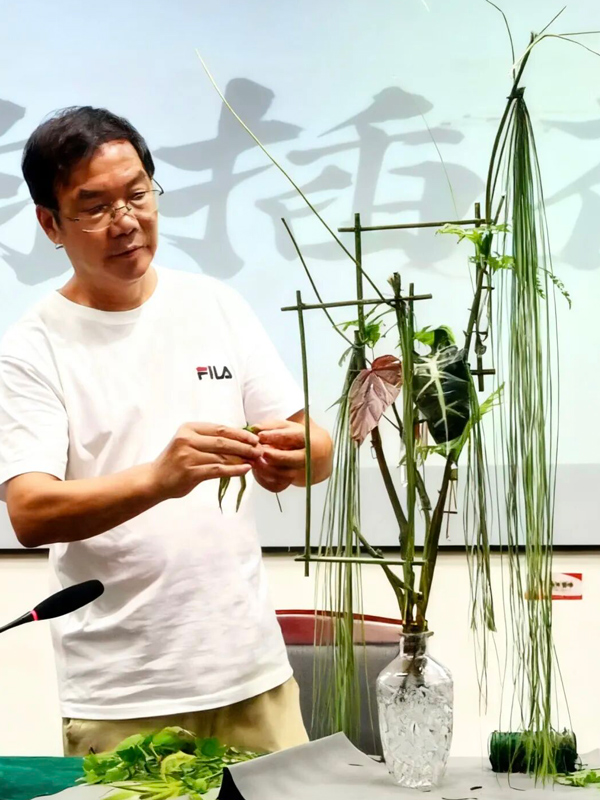
He illustrates with a demo, weaving branches and water bamboo into a cohesive piece that highlights point, line, and plane elements. Small flowers act as "points," straight or vertical branches as "lines," and broad leaves as "planes." This triad creates visual interest through contrast—mixing heights, sizes, and regularity. Master Ying reminds everyone to avoid stacking, which kills depth, and instead layer to suggest movement. The students jot notes, amazed at how theory translates into tangible beauty.
In closing, Master Ying reflects on the journey, noting that Eastern flower art isn't intimidating but inviting. Its strength lies in linear elegance, rivaling any Western technique, while remaining open to innovation. As applause fills the room, students feel inspired to blend tradition with personal touch, seeing that great art starts with humble beginnings. They leave not just with skills, but with a renewed appreciation for their cultural roots and the joy of creation.