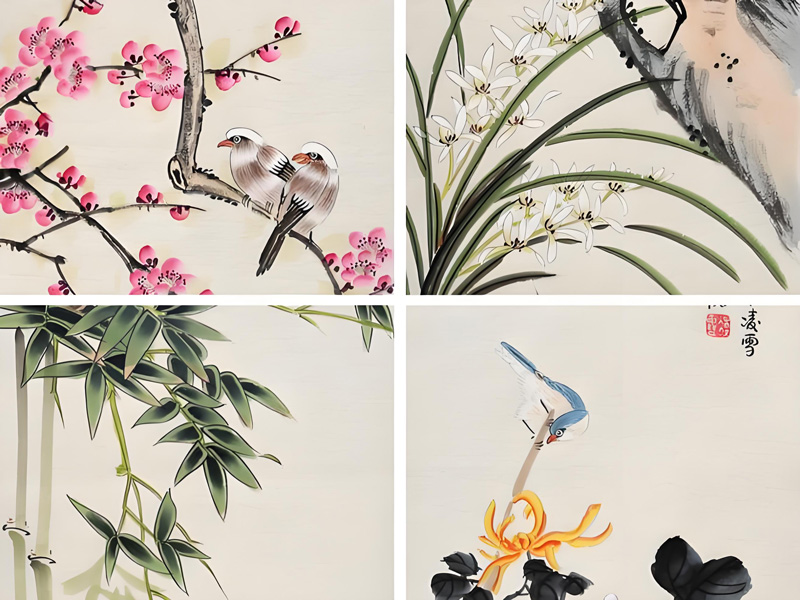
In Chinese culture, the "Four Gentlemen" — plum blossom, orchid, bamboo, and chrysanthemum — are revered as emblems of moral integrity and spiritual ideals, embodying the virtues of resilience, elegance, perseverance, and purity. Known collectively as the "Four Gentlemen," they have long served as foundational subjects in Chinese literati painting and poetry, reflecting the Confucian and Daoist aspirations toward inner nobility and harmonious coexistence with nature. This artistic tradition, deeply rooted in symbolic expression, transcends mere representation to convey philosophical depth and personal character.
Through evolving techniques and stylistic developments across dynasties, the depiction of these plants has become a refined language of the spirit, capturing both the tangible beauty and intangible essence of these enduring natural symbols.

1. The Unbroken Line of Ink Plum Blossoms
1.1 Echoes on Paper
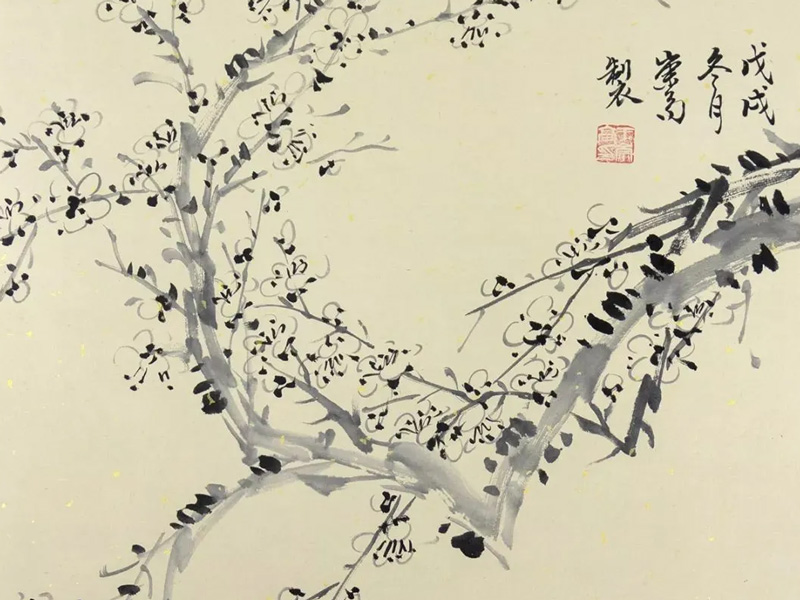
The journey of monochrome plum blossom painting began centuries ago. Records trace its emergence to the Northern and Southern Dynasties, flourishing notably in the Northern Song era. Monk Zhongren pioneered this form, abandoning colour entirely. He found inspiration in moonlight casting a plum's shadow onto paper, capturing its essence solely through ink's subtle shades and washes. His vision sparked a tradition. Yang Buzhi (杨补之) followed, refining Zhongren's (仲仁) technique. He introduced precise outlines, enhancing the flower's inherent purity and untamed grace. This method laid foundations for generations.
By the Yuan Dynasty, Wang Mian (王冕) emerged as a master. Calling himself 'Master of the Plum Blossom Cottage', his style marked a distinct shift. He moved away from the sparse, cool elegance favoured by Song artists. Instead, his branches burst with dense clusters of blooms, radiating vitality and upward energy. His renowned Ink Plum (墨梅图) scroll exemplifies this. Simple ink and restrained yet expressive strokes vividly convey the blossom's stark beauty and resilient spirit. This resonated deeply, embodying the scholar's ideal of noble detachment. Countless artists across the Ming and Qing dynasties carried the torch, oscillating between the Song's sparse chill and the Yuan's vibrant density.
1.2 Spirit Embodied in Ink
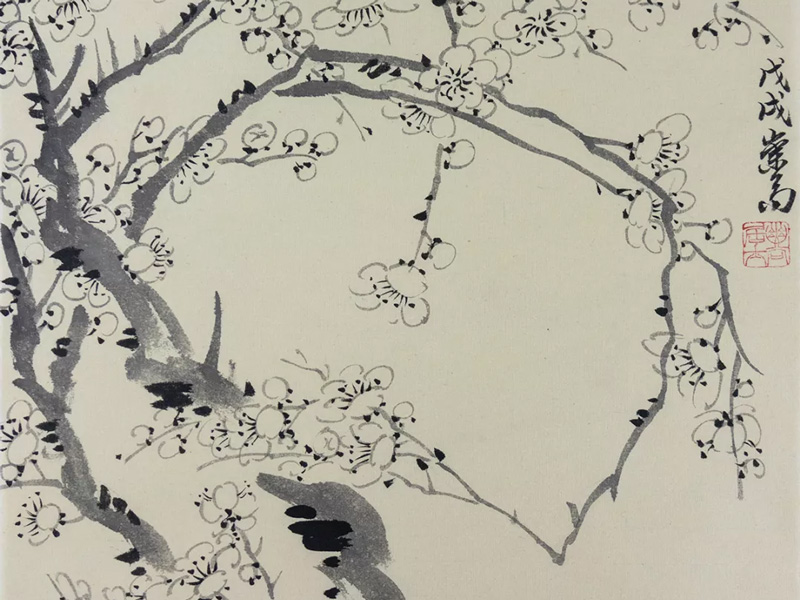
Beyond technical skill, capturing the true nature demands more. Artists speak of possessing "plum spirit" – a core of moral integrity and uncompromising purity. As the saying insists: "To paint plum blossoms requires the spirit of the plum; the person must be as clear as the blossom itself." This pursuit reflects the flower's own character. Thriving in cold, blooming defiantly in early spring while others remain dormant, it stands resilient. Alongside pine and bamboo, it forms the symbolic Three Friends of Winter. The painter's ultimate goal is embodying this very defiance against harshness and frost.
The subject itself, Prunus mume, is a small deciduous tree. Its bark shows grey-brown with textured furrows. Leaves are typically oval. Blossoms emerge from lateral buds along the branches, usually singly or in pairs, releasing a delicate fragrance. Each bloom typically features five petals, ranging from pure white to soft pink, with some double-petaled varieties. Understanding its physical structure – petals, stamens, calyx – is fundamental. Direct observation through sketching provides essential grounding before brush meets paper.
1.3 Crafting a Plum Art
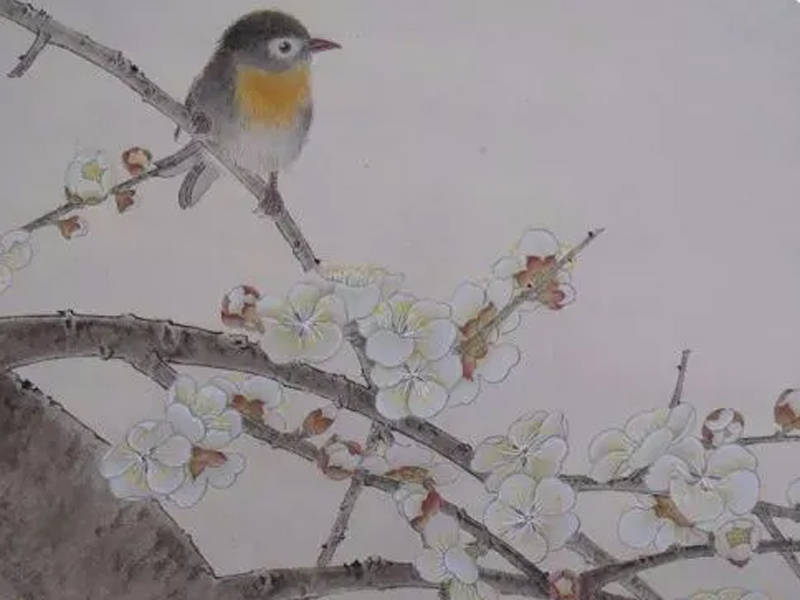
The creation unfolds deliberately. First, outlines define the vision: pale ink for delicate petals, darker ink for the sturdy calyx, and deep, rich ink for the gnarled branches. If a bird graces the scene, its beak, eyes, and claws require strong ink lines, its form suggested with lighter tones.
Preparation sets the stage. A wash of blue-grey ink establishes the background. Once dry, pure white pigment is applied meticulously over the blossom areas, building opacity. The calyx receives an earth-toned wash, subtly blending into the branch with a touch of green.
Depth emerges through shading. A muted yellow wash models the petals' curves. Crimson defines the calyx's form. Diluted ink suggests the bark's texture. For a bird, warm yellows and reds might shape its breast, while its beak and claws gain intensity.
Final touches bring clarity. A pale green wash deepens petal shadows within the white. Stamens glow with pure yellow dots; fine white lines trace delicate filaments. Branches gain richness from a transparent brown wash. Feather details are rendered with precise ink or white strokes. The work achieves harmony, a testament to patience and shared spirit. The plum's enduring defiance finds permanence, the brush becoming an extension of the soul observing winter's beauty.
2. The Silent Eloquence of Ink Orchids
2.1 Brushstrokes of Principle
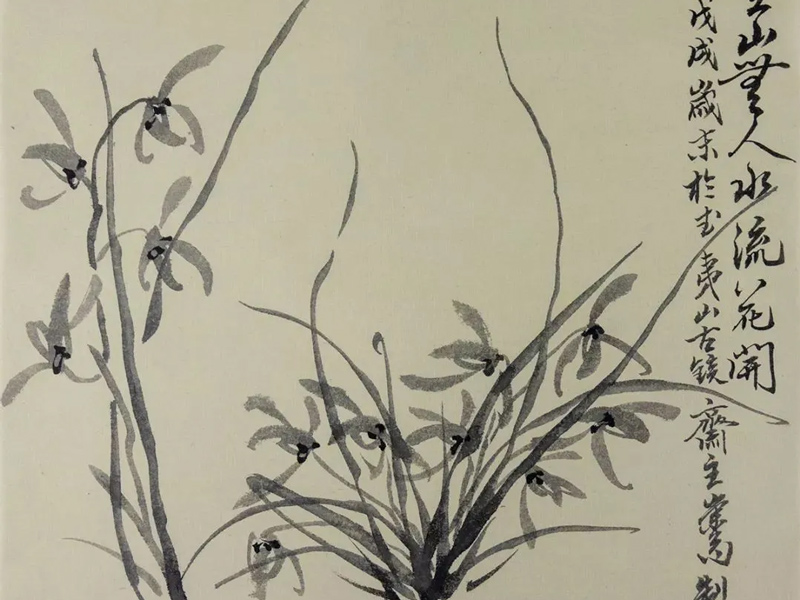
For centuries, Chinese artists have depicted orchids. These works often embody a spirit of quiet virtue and refined purity. Early literary tributes appear in the verses of ancient poets like Qu Yuan (屈原), who celebrated their fragrance and form. While plum blossoms adorned art earlier, orchid painting emerged distinctly during the Tang dynasty. By the Song era, its practice flourished. Figures like Su Shi (苏轼) were known to include thorns amidst their blossoms, suggesting noble tolerance for lesser elements. The turbulent early Southern Song period saw ink orchids become potent emblems of resilience. Artists like Zhao Mengjian (赵孟坚) and Zheng Sixiao (郑思肖) mastered this expression, their monochrome orchids symbolizing an unyielding spirit after dynastic collapse.
2.2 Unrooted Symbols
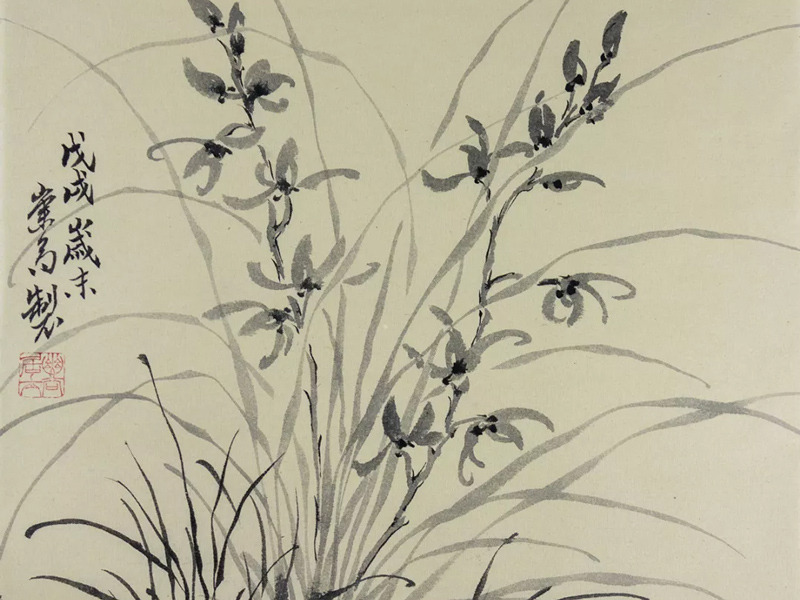
In the Yuan dynasty, Zheng Sixiao's orchid paintings gained profound significance. His personal conduct reflected his art; he famously sat facing south, a gesture mourning the fallen Song court. His refusal to serve the new rulers extended to his brushwork. His orchids floated, deliberately lacking roots. When questioned, his answer was stark: "The soil is lost. How could they take root?" This powerful visual metaphor transforms his paintings into historical statements. Understanding this context is crucial to grasping the depth within seemingly simple ink strokes.
Later, during the Qing period, Zheng Banqiao (郑板桥), a prominent figure among the Yangzhou Eccentrics, became renowned for his orchid depictions. He championed learning directly from nature. While he painted potted specimens, his true passion lay in capturing the wild, untamed beauty of mountain orchids. He cultivated dozens, meticulously transplanting them to rocky crevices after spring to observe their vigorous, upright growth and inhale their potent, unadulterated scent. This immersion allowed him to grasp the essential vitality of the wild orchid – its robust form thriving in harsh conditions.
2.3 Orchid Painting Techniques
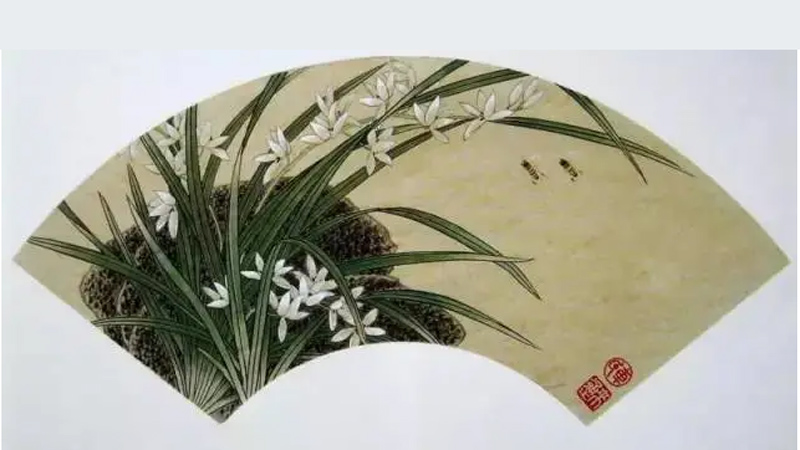
Painting an orchid requires attentiveness to its inherent structure and spirit. The leaves demand careful arrangement: varying lengths and heights create rhythm and dynamism, avoiding monotonous uniformity. While the blossom typically has five petals, its simplicity belies the need for nuance. The artist must render flowers bending upwards or downwards, facing forward or backward, opening boldly or partially concealed. The technique involves distinct stages.
First, light ink defines forms, preserving the underlying sketch lines. Next, a wash of plant green bathes the leaves.
Then, mineral greens are applied: a deeper stone green covers upper leaf surfaces, while a brighter threefold green highlights the undersides. For the petals, white pigment derived from clam shell (clam powder white) is carefully layered from the outer edge inward.
Finally, a single, intense dot of vermillion at the flower's heart brings it to life. Darker ink may deepen shadows where leaves overlap. This meticulous process aims not merely at likeness, but at capturing the orchid's elusive, elegant essence.
3. Bamboo Strokes: Ink's Dance Through Time
3.1 Tang Origin
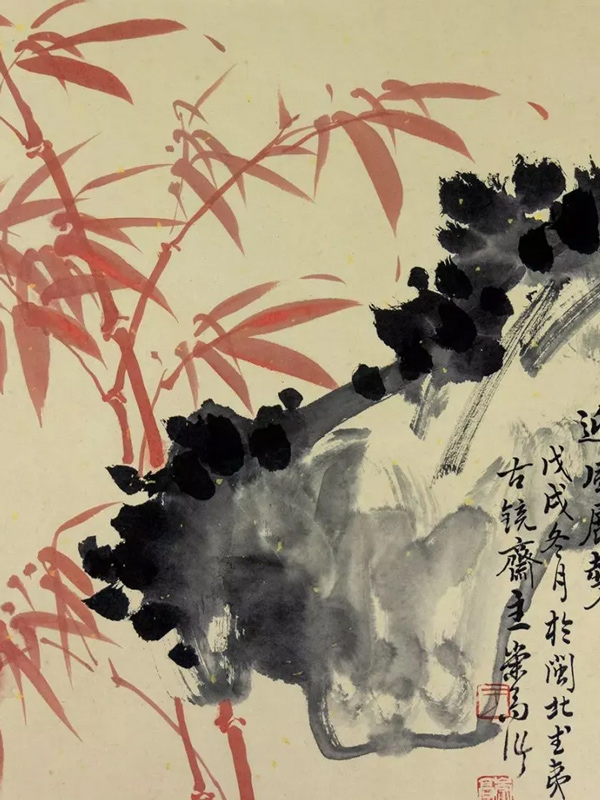
Artists first captured bamboo’s grace on paper during the Tang Dynasty. Emperor Xuanzong (唐玄宗) admired its form, while masters like Wang Wei (王维) and Wu Daozi (吴道子) traced its elegant lines. Legends tell of Lady Li in the Five Dynasties period inventing ink-bamboo technique. She observed moonlight casting intricate shadows through her window lattice, translating these fleeting silhouettes directly onto paper with ink. This moment sparked a new artistic language.
3.2 Song Refinements
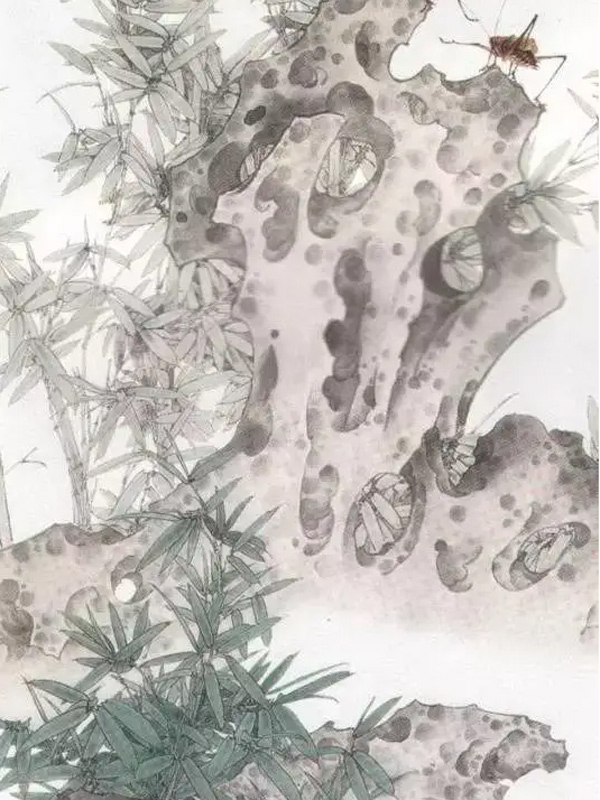
The Song Dynasty witnessed profound shifts. Su Shi revolutionized bamboo painting, abandoning meticulous double-line outlines and color fills of earlier eras. He embraced monochrome washes entirely. Stalks and leaves emerged through layered ink—deep blacks defining leaf surfaces, pale greys suggesting their backs. This approach prioritized spirit over strict botanical accuracy, laying foundations for expressive Xieyi (写意) style. Bamboo became inseparable from scholarly ink painting.
3.3 Ming and Qing Flourishing
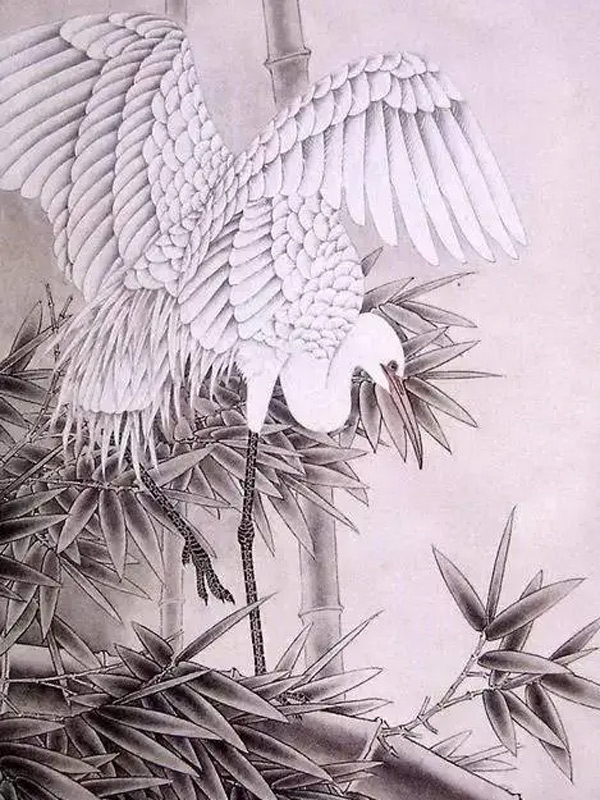
From Yuan to Qing dynasties, bamboo painting flourished. Virtually every landscape or bird-and-flower painter included it in their repertoire. The focus evolved beyond individual stalks; artists sought the plant’s dynamic rhythmic force. Among many renowned practitioners like Zheng Banqiao, achieved unparalleled mastery. His work transcended mere representation, embodying philosophical depth.
3.4 Zheng Banqiao's Revelation: Three Bamboos
Zheng left profound insights into his creative journey. He described autumn mornings by a riverside studio: "Mist, sunlight, dew—all drifting through sparse leaves and dense branches. My heart stirs with urgency to paint." He realized the bamboo perceived by his eyes differed from the image conceived in his mind. As ink met paper, the brush transformed that mental vision again. "Intention precedes the brush—that’s the principle," he noted. "Joy resides beyond technique—that’s the vitality." His process distilled into three transformations: observing nature’s bamboo (eye-bamboo), internalizing its essence (mind-bamboo), and finally, liberating it through the brush (hand-bamboo). This synthesis birthed the artwork itself.
3.5 The Hand-Bamboo Legacy
Zheng’s prolific output found wide admiration. Since the Qing era, collectors treasured his bamboo scrolls. Their power lies not just in visual accuracy but in capturing the plant’s resilient spirit. Bamboo bends in storms but rarely breaks—a quality mirrored in the decisive, resilient strokes masters employed. Its segmented growth, hollow core, and evergreen nature became metaphors for scholarly integrity and endurance.
3.6 Structure Dictates Stroke
Understanding bamboo’s growth is crucial for painters. Shoots emerge from nodes. Young culms, called new huang, appear leafless. Mature culms develop branches typically after seven segments, sprouting pairs laterally—outer segments bearing longer, denser branches. Leaves grow in clusters of five, seven, or more, their parallel veins running straight from base to tip. Stiffness gives way to fluid motion higher up.
3.7 A Painter's Steps
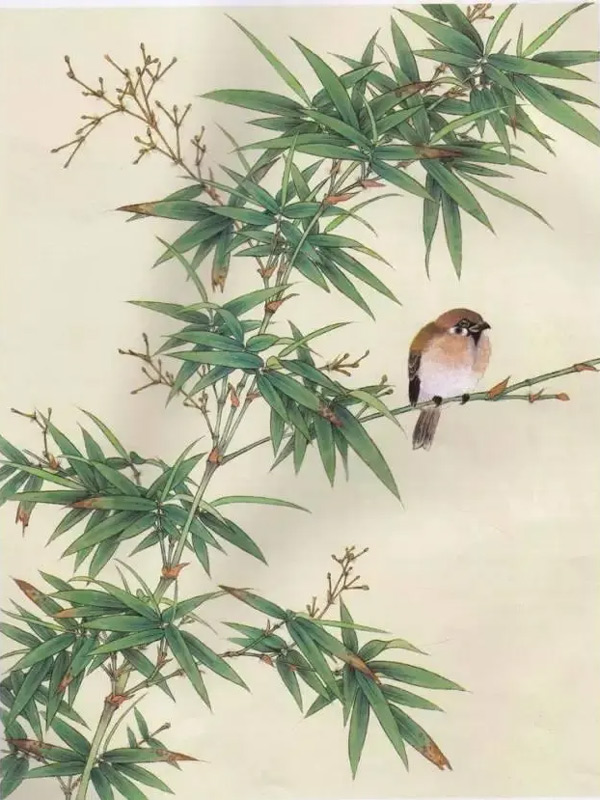
Traditional methods involve deliberate stages:
First, dark ink outlines mature leaves; mid-tone ink defines stalks, branches, and small sheath leaves. Second, indigo wash layers over leaf fronts and stalks; pale ink shades leaf undersides. Third, yellow-green wash covers leaf backs; vegetable green gradates stalks; russet-green tints small branches; reddish-brown coats sheaths. Four, vegetable green glazes leaf fronts, sometimes blending to russet-brown at tips. Bird elements: reddish-brown for heads, ochre-yellow for backs.
Final refinements: Pale green highlights leaf backs; reddish-brown ink traces sheath veins; fine brushstrokes detail bird feathers.
Bamboo endures. Through dynasties and artistic revolutions, its form continues to challenge and inspire. It stands resilient against winter snows, just as the ink-bamboo tradition persists, a testament to nature’s elegance meeting human spirit. The brush dances on, capturing whispers of wind through timeless groves.
4. Chrysanthemums in Art: A Rare Bloom
4.1 Historical Journey
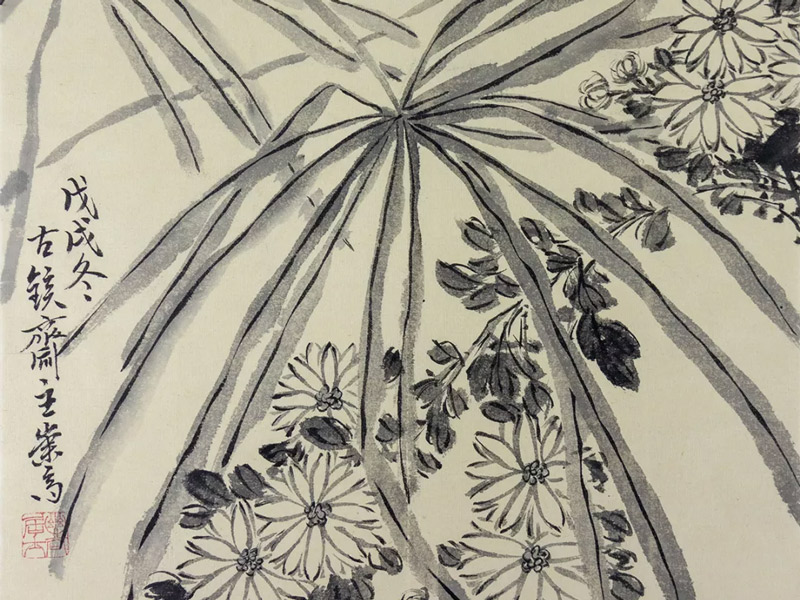
In the vast world of Chinese painting, chrysanthemums hold a unique but understated position. Unlike the popular motifs of plum blossoms, orchids, and bamboo, depictions of this flower emerged later in history. Records trace its artistic debut to the Five Dynasties period, where masters like Xu Xi (徐熙) and Huang Quan (黄筌) pioneered its portrayal. Yet, throughout the Song and Yuan dynasties, artists rarely focused on chrysanthemums. Only a handful, such as Su Mingyuan (苏明远) and Ke Jiusi (柯九思), explored this theme. By the Ming and Qing eras, chrysanthemum paintings remained scarce, making existing works like Chen Chun's (陈淳) Ju Shi Tu (菊石图) exceptionally valuable. This masterpiece, housed in the Capital Museum, exemplifies the flower's elusive charm in art history.
4.2 Painting Techniques
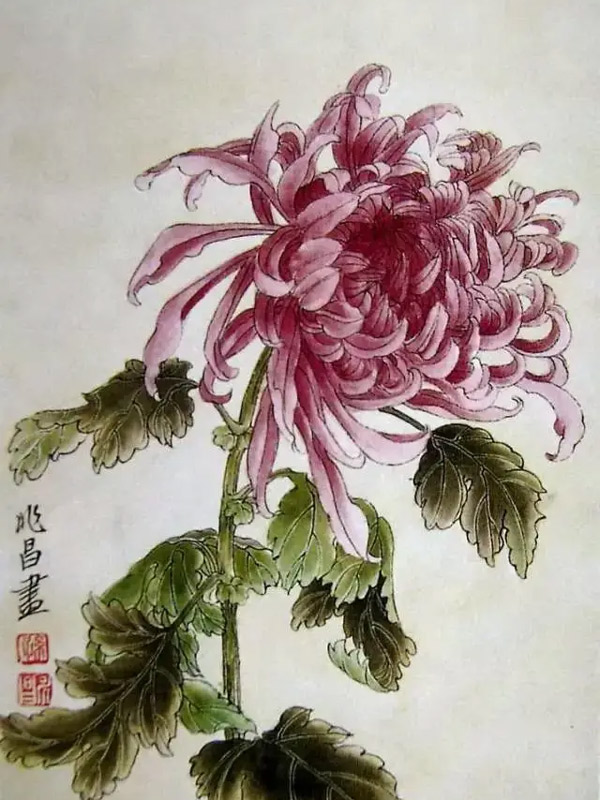
Creating a chrysanthemum painting involves meticulous steps that emphasize structure and nuance. Artists begin with the double outline method, using medium or dark ink to sketch petals from the center outward. This establishes the flower's form. Next, a light pink wash is applied to add depth and variation, ensuring petals appear layered and dynamic. Leaves and stems are treated with diluted ink for texture, while lighter green shades enhance the undersides.
Refinement follows with deeper pink washes to highlight shadows and light on petals, creating a three-dimensional effect. For leaves, artists intensify dark ink on surfaces and use grass green for contrast. A fluid ink outline defines the bloom, while stronger strokes render stems and foliage with natural spacing. The final touches include white pigment to brighten petals, making them vivid, and green overlays to unify the composition. This process balances precision with artistic expression, capturing the chrysanthemum's delicate beauty.
4.3 Specialized Methods
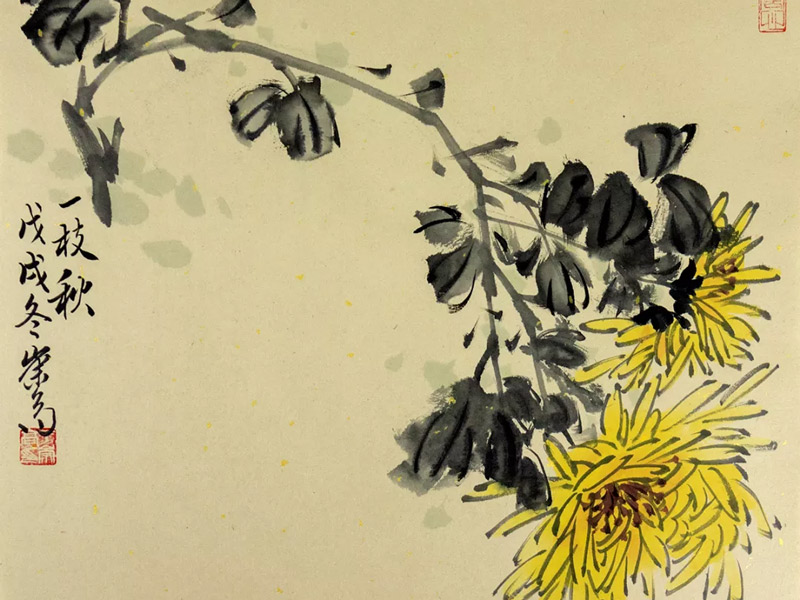
Beyond standard techniques, variations like the exposed pistil approach offer fresh perspectives. Here, artists emphasize the flower's core, using subtle gradations to reveal intricate details without overwhelming the viewer. This method requires careful control of ink density and color transitions, allowing the pistil to stand out as a focal point. By focusing on such elements, painters infuse personality into each piece, celebrating the chrysanthemum's resilience and elegance in nature.
4.4 Artistic Significance
The rarity of chrysanthemum paintings underscores their cultural resonance. Works like Ju Shi Tu not only showcase technical skill but also reflect themes of endurance and refinement. As symbols of autumn and longevity, chrysanthemums in art invite viewers to appreciate subtlety over spectacle. This quiet prominence continues to inspire modern artists, bridging historical traditions with contemporary interpretations. Through these pieces, the flower's timeless appeal endures, offering a serene counterpoint to bolder subjects in Chinese painting.

Final Thoughts
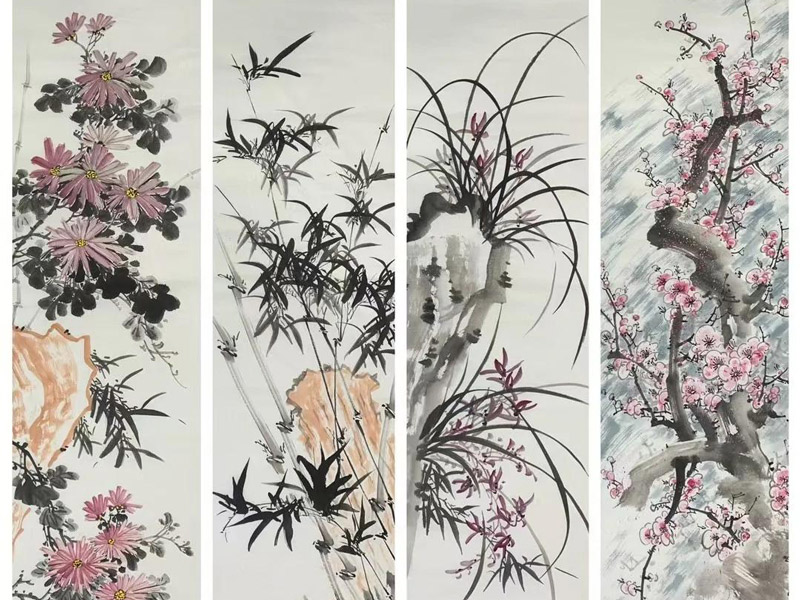
The "Four Gentlemen" — plum blossom, orchid, bamboo, and chrysanthemum — hold profound symbolic meaning in Chinese culture, representing virtues such as resilience, elegance, perseverance, and purity. These plants have been central subjects in Chinese literati painting for centuries, serving not only as objects of aesthetic appreciation but also as vehicles for expressing moral ideals and personal emotions. The artistic tradition began to flourish during the Northern Song Dynasty and evolved significantly across subsequent dynasties. Techniques varied from monochrome ink washes to detailed color applications, with masters like Wang Mian for plum blossoms, Zheng Sixiao for orchids, and Zheng Banqiao for bamboo each developing distinctive styles that captured both the physical form and spiritual essence of their subjects.
Beyond mere representation, this art form embodies a deep philosophical pursuit, blending observation, introspection, and skillful execution to convey inner nobility and harmony with nature. The enduring legacy of the "Four Gentlemen" continues to inspire artists, reflecting an unbroken cultural dialogue between humanity and the natural world.