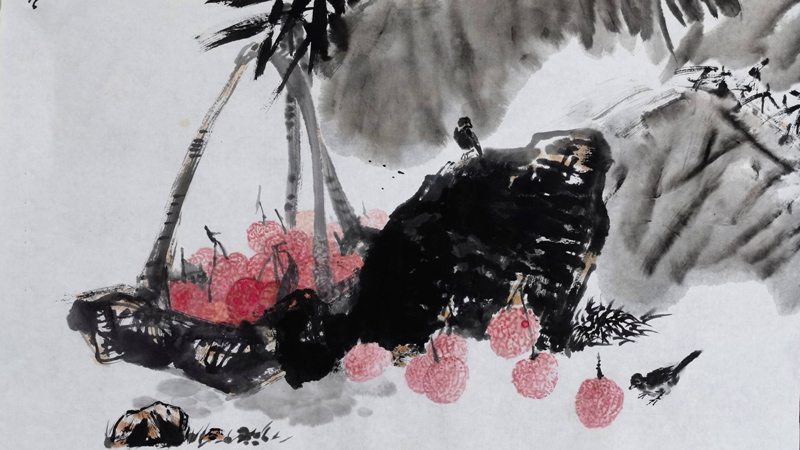
A single branch emerges on rice paper, heavy with lychees glowing like rubies veiled in morning mist. Ink swirls and crimson bleeds, not merely depicting fruit but capturing the humid breath of southern orchards. Artist Huang Jiexin (黄杰信) wields his brush not as a tool, but as an extension of nature itself. His paintings transcend mere representation; they are silent poems where dewdrops cling to imagined skin and bird songs seem to rustle the painted leaves.
Each stroke whispers of seasons turning, of life condensed onto paper through the profound simplicity of ink and water. This is an invitation to witness nature's fleeting moments, immortalized through a master's touch that makes silence audible and stillness vibrate with life.
Lychee
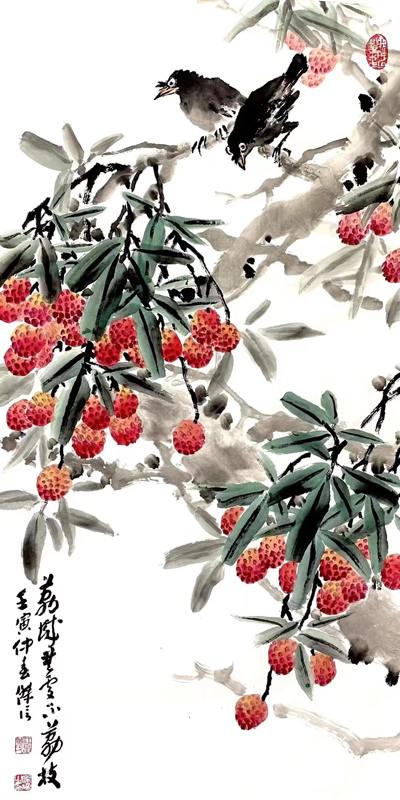
See how the lychees cluster, their forms born from washes of vermilion and carmine. Huang Jiexin avoids rigid outlines. Instead, he lets diluted ink pool and spread, naturally defining the fruit's bumpy texture. A touch of cinnabar at the tip suggests moisture, as if each berry was plucked moments ago, still cool from the dawn. The leaves are broad declarations of green – applied with bold, wet strokes of ink. Veins aren't drawn; they emerge where darker pigment meets lighter, a ghostly structure within the vibrant foliage, feeling more alive than any meticulous line could.
The soul of the scene rests on a slender branch. A songbird, rendered in swift sweeps of pale gray ink, pauses mid-movement. Dark ink dots its alert head; its beak curves slightly, perpetually listening. It doesn't perch amidst the densest fruit, but finds space where branches twist into emptiness. Its delicate form, feathers seemingly trembling, creates a perfect counterpoint to the plump, jewel-like lychees. This balance of stillness and potential motion breathes life into the paper. One can almost hear the rustle of wings against leaf, almost catch the heavy sweetness of ripe fruit hanging in the humid air.
This is the essence captured: the deep, warm red of the lychees, made richer and more refined against the ink's subtle depths, not gaudy but profound. The bird's soft feathers blend seamlessly with the dark green leaves, an ephemeral spirit woven into the solid forms. By showing only a few clusters of fruit and a single bird, Huang invites the breeze in. The vast empty spaces hum with the possibility of a southern summer – the drone of cicadas, the quiet joy of abundance felt rather than seen.
Pomegranate
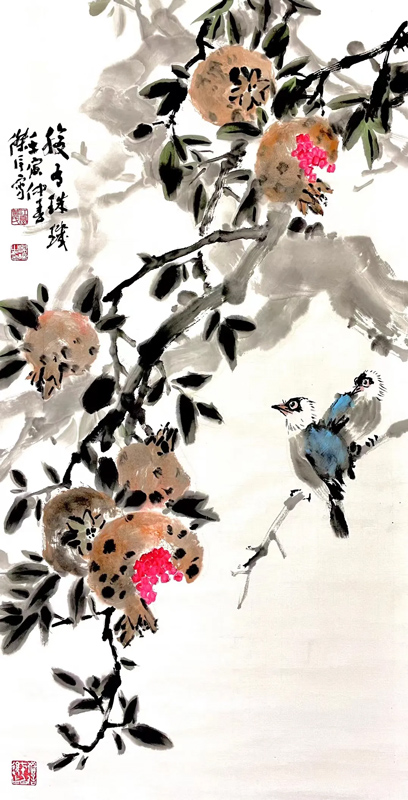
A weathered branch angles across the paper, its aged bark etched in dark, dry strokes. New growth sprouts, tinged with a youthful blush. But the true fire comes from the blossom. Huang mixes vermilion with traces of ink, layering washes to build the petals' substance. Yet, at their edges, he leaves flecks of raw paper – deliberate gaps like the flicker at the edge of a flame. This blossom isn't merely red; it radiates warmth, a small sun igniting the entire composition with its potential.
The fragrance is implied through texture. The leaves are bold statements in dark ink, their central veins sharply defined with near-black strokes. Yet the bodies of the leaves blur softly, infused with watery washes that suggest dampness after rain. Lean closer, and the scent of wet greenery and fertile earth seems to rise from the page. Near the flower's base, dry brushstrokes dabbed in ochre resemble insects alighting, leaving behind the faintest impression of nectar's sweetness. This is scent painted not literally, but evoked through the tactile memory the brushstrokes trigger – the cool damp, the sticky sweetness of spring.
Where the old branch ends, the promise swells. A rounded form, darker than the leaves and edged in warm umber, presses against the paper's skin. It feels taut, ready to burst. This is the nascent fruit, holding summer's bounty within. Sunlight, implied by strategic gaps left untouched by ink, falls between the leaves, warming this hidden treasure. It whispers of autumn days when such a fruit might split open, revealing seeds like glistening garnets, each one a capsule of tart juice waiting to explode – the future held within the present strok.
Tradition Meets Vitality
Huang Jiexin is not confined by the past; he converses with it. His art forges a unique path, blending classical poetry, meticulous seal carving, masterful calligraphy, and innovative painting into a singular voice. While deeply rooted in tradition, his work avoids stale repetition. He understands the foundational techniques – the weight of the brush, the flow of ink, the balance of empty space – but wields them with a contemporary spirit. His compositions feel fresh, avoiding predictable arrangements, finding dynamism in asymmetry.
Look at the energy within the stillness. A branch isn't just a line; it carries the rhythm of a calligrapher's hand. The sweep suggesting a bird's wing has the fluid grace of cursive script. This infusion of calligraphic movement transforms painted forms into living entities. The vitality isn't loud; it's the quiet hum of perfect tension – the poised bird, the heavy yet suspended fruit, the blossom about to unfurl further. His brush captures the moment before the action: the bird might sing, the fruit might drop, the blossom might open wider. It’s perpetually on the cusp.
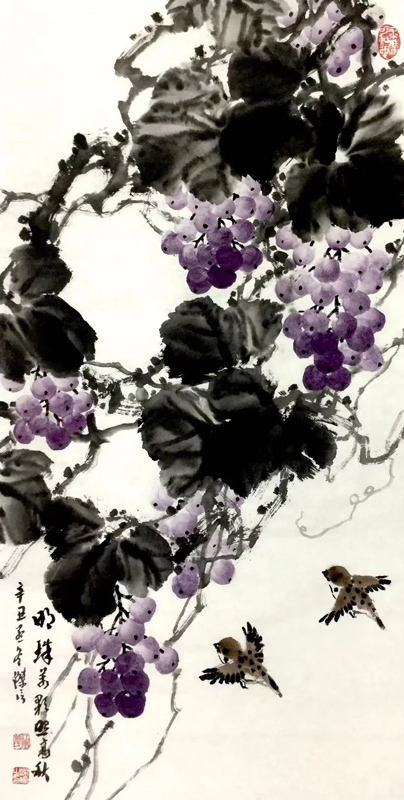
The magic lies in restraint and implication. Huang doesn't paint every leaf on a tree, every grape in a cluster, or every feather on a bird. He paints enough. A few grapes rendered with translucent washes of gray and green, hanging heavily; a single bird suggesting a flock just out of sight; a half-open blossom promising abundance.
The vast emptiness surrounding these elements isn't blank; it is charged with atmosphere – the humidity of the south, the warmth of the sun, the whisper of the wind moving through unseen branches. It allows the viewer to enter the scene, to complete it with their own imagination. His paintings are worlds built with elegant economy, proving that profound beauty and complex emotion can reside within the simplest forms and the quietest moments, making silence resonate and stillness pulse with unseen life.