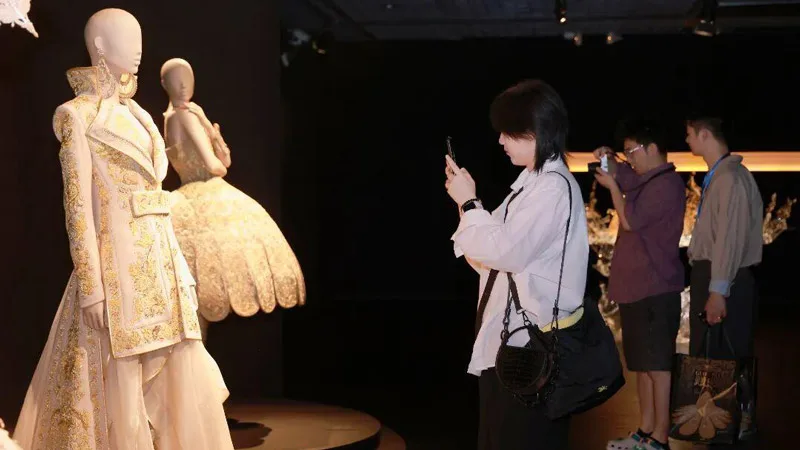
Through the National Day holiday, the fashion hall of the China National Silk Museum in Hangzhou drew a steady line of visitors stopping to photograph themselves beside the displays. The draw was Lingjing Garden (灵境花园), an exhibition of couture by Guo Pei built around more than 200 pieces chosen from four decades of her work. For Guo Pei, among the earliest champions of haute couture in China, the setting carried its own meaning: holding the show here, she said, was less a personal retrospective than a return to the root of Chinese silk, a salute to a craft that has run through a thousand years.
Two Hundred Works Across Forty Years
The show lays out more than 200 couture pieces from Guo Pei’s 40 years of design, gathered to show how far Chinese haute couture has pushed its craft. The materials move through mother-of-pearl inlay, embroidery and traditional knotting, worked onto forms that borrow as much from Western tailoring as from Chinese ornament. Taken as a set, the pieces trace a route from inherited technique to a couture language of her own.
That route is the point of the exhibition. Instead of a parade of showpieces, the rooms read as a working archive, in which a dress becomes a place to test a stitch, a panel or a colour. The scale of the display, 200 pieces and 40 years, gives the visitor a sense of accumulation that a single runway show could not.
A Dress Known as Big Gold
One series, “Dragon’s Story”, shows the house at its densest. A gown in the series sets deep red as its ground and covers the whole surface with gold three-dimensional embroidery, where dragon motifs cross auspicious clouds and a sea-and-mountain wave hem; the cut is a Western three-dimensional construction that gives the woven fabric an almost architectural silhouette. Old silk, in this reading, is not quiet material but something with an edge.
Further in stands a dress shaped like an upturned lotus, its surface wrapped in gold flowers worked in relief. Named “Big Gold”, the piece is among the most watched in the show and appeared in the Metropolitan Museum of Art’s 2015 exhibition “China: Through the Looking Glass”. A docent explained that every gold flower on the skirt is stitched with gold thread in Chinese techniques such as Panjin embroidery, which builds the raised, metallic effect. A visitor surnamed Wang, who had travelled from Beijing to see the exhibition, remarked that she had come to look at the dress up close and found clothing carrying something more than fabric.
Inside the Eastern Palace Chapter
The final chapter, “Eastern Palace Echoes”, is the most Chinese in mood. Its couture pieces draw on the elusive realms of Chang’e on the moon and the dragon king’s palace, and also on palace architecture, ancient ceremonial dress and auspicious beasts; eaves, fret patterns and cloud motifs turn into the shape of a sleeve or a piece of decoration. The palette moves through black, green and gold, building a deep Eastern register in which a single stitch carries a contemporary reading of court aesthetics and old craft.
Silk appears across the whole exhibition in more than one shape. Some pieces push it bright, some weigh it down, some fold it into sculpture. What holds the chapter together is the way the makers treat a historic motif not as a stamp to be repeated but as a structure to be rebuilt.
Why the Silk Museum Made the Venue
Placing couture inside a museum built around silk is a deliberate choice, and Zhejiang has the history to justify it. Silk fragments from the Qianshanyang site, the fine weaving of the Song, and the bolts of Zhejiang damask that travelled the Maritime Silk Road all set the province on a long silk line. Almost every piece in the show, the museum notes, has silk at its core.
Ji Xiaofen, the museum’s director, stated that as culture and tourism draw closer, a museum is no longer only a static space for storing and showing objects but a hub that keeps traditional skills alive and links heritage to contemporary life; the exhibition, she said, is one attempt at a “museum plus heritage plus fashion” route that lets the public see the value of silk, embroidery and weaving today. Seen beside the Qianshanyang sherds in the same city, the gold-stitched gowns read as a recent chapter of a very old story.