For a week straddling the National Day holiday, one of Shanghai’s oldest industries left its display case. On September 30 the Songjiang cultural activity center, which also runs the district’s intangible heritage protection office, opened a pop-up exhibition on Songjiang cloth in the open space by its west gate. The show, titled Yunjian Zhiyu (云间织屿), ran until October 6 and stood a few dozen meters from the Zuibaichi metro station, so that passers-by and visitors heading to other events could stop in without buying a ticket.
Four Threads of One Local Cloth
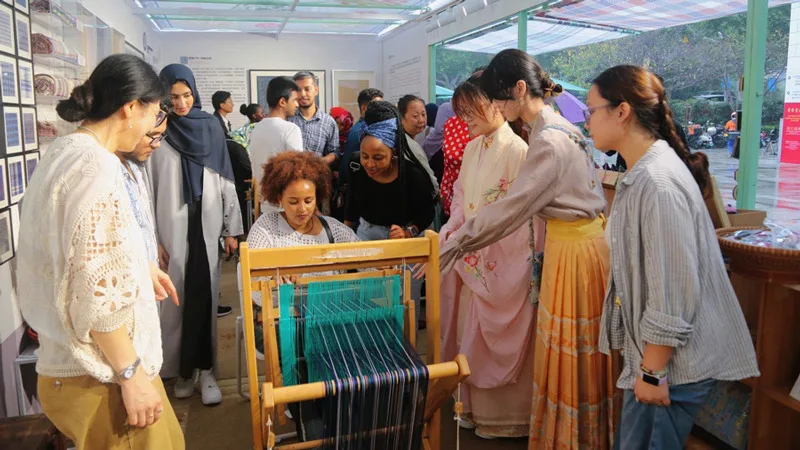
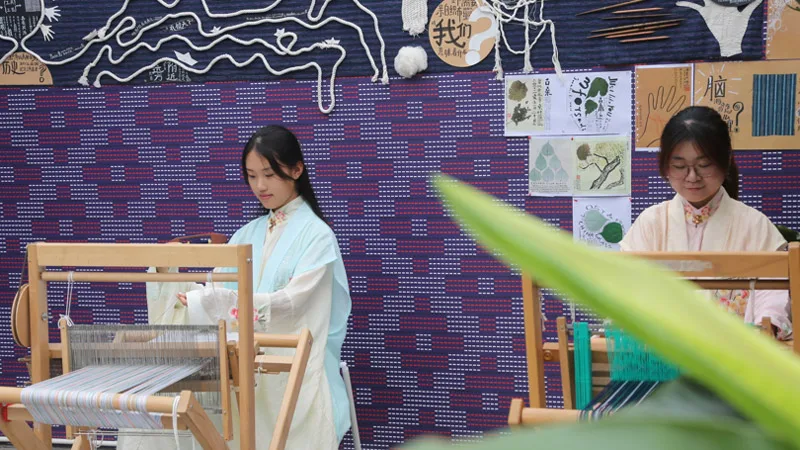
The exhibition told the story in four sections. One traced the hundreds of years of weaving behind Songjiang cloth; a second unpacked the old techniques; a third rebuilt the export trade of the Maritime Silk Road; and a fourth showed how the fabric has been carried into contemporary design. Products on view included Pankou brooches, fabric earrings, badges, fridge magnets, postcards and cushions, all worked from the cloth, and visitors could try the loom, assemble a fabric badge or knot a tassel by hand.
Yang Panhong, who runs the Songjiang cloth project, said that moving the show outside was a deliberate experiment. Heritage exhibitions, she added, had mostly been held in closed halls, while this format mixed display, craft, design and leisure in one open setting, so that people simply walking past could feel what makes the cloth distinct.
A Class That Leaves the Campus
Teaching supplied the show’s strongest thread, through Shanghai International Studies University’s center for the translation and communication of intangible heritage, founded in 2019 and home to a course on the memory and communication of heritage. Zhang Lijun, a teacher there, brought his class into the exhibition and walked students through the weaving technique, the meanings behind its patterns, the history, and the case for carrying it abroad. Heritage, he noted, is not a theory in a book but a living culture with a temperature that can be handled; the course has students take part in every stage, from growing local cotton and sorting the historical record to translating, designing products and putting up the show.
To restore the true texture of the cloth, the students raised a local, older variety of cotton themselves, tending it through a rainy Jiangnan summer and a stretch of heat until a full growing season was done, then harvesting the raw fibre so it could be spun without additions. At the same time, international students from Donghua University’s textile college came for hands-on training, watching the flow of the craft and trying the basic steps of warping, threading and pattern reproduction. Li Siyao, a Songjiang native on the university team, recalled that she had known the cloth only on the surface before and had no idea of the reach that once made it a global export; taking part from cotton research through to the exhibition, she said, reset how she saw it and pushed her to keep working on her home region’s craft.
Huang Daopo Steps Out of the Manual
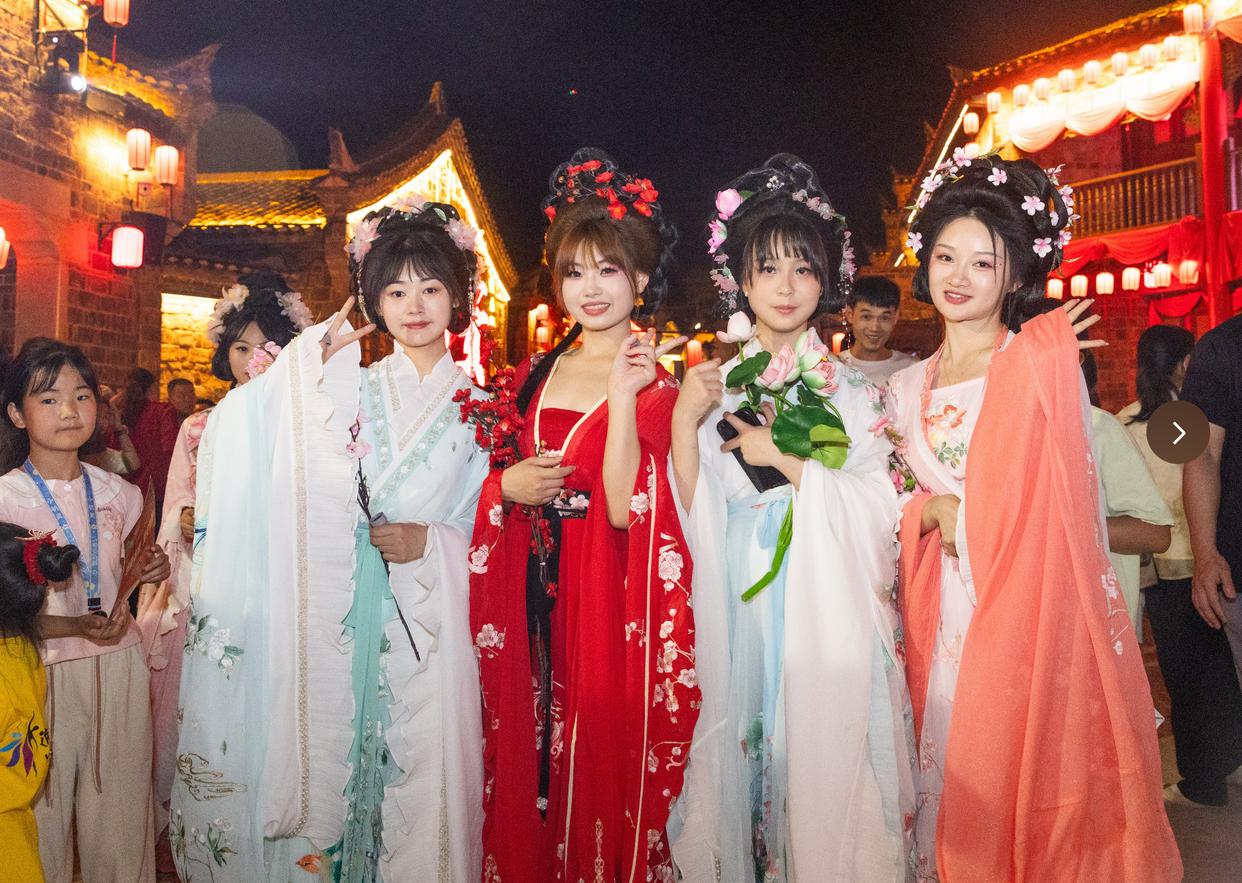
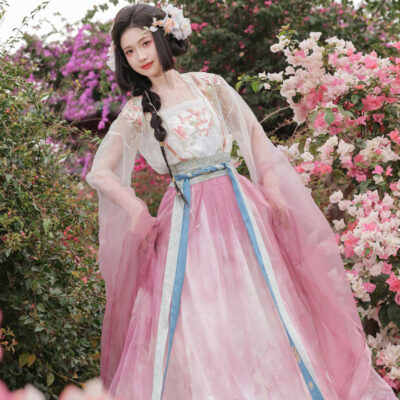
Costumed flash performances gave the show its human thread. Actors took on two names from Songjiang’s textile past: Huang Daopo, the weaver and technologist of the late Song and early Yuan remembered as a founding figure of the craft, and Ding Niangzi (丁娘子), a Ming-era weaver whose fine cloth was known by her own name. Moving through the site, they demonstrated the old skills to onlookers and taught them by hand.
Huang Daopo had appeared in public only days earlier. At the opening of the 48th WorldSkills Competition, a page of the Tiangong Kaiwu (天工开物) was turned on stage and the figure of Huang Daopo rose from it, spinning thread into a shuttle of light, a scene built to carry the idea of dressing the world and passing a craft from household to household.
Cloth That Sailed and Came Home
The programme ran as a joint effort between the district and its universities, and as a test of moving heritage out of its case. It also set the cloth inside a longer arc: a fabric once worn across the country and shipped along the Maritime Silk Road, staged this time beside a metro line in its own district, with students and foreign visitors again handling the looms.
By the time it closed on October 6, the pop-up had done what a museum hall cannot easily do, putting the spinning, the class and the audience in the same open air. What the cloth carries forward, its organisers suggest, is not only a technique but a way of telling a Jiangnan story to people who have never touched a loom.