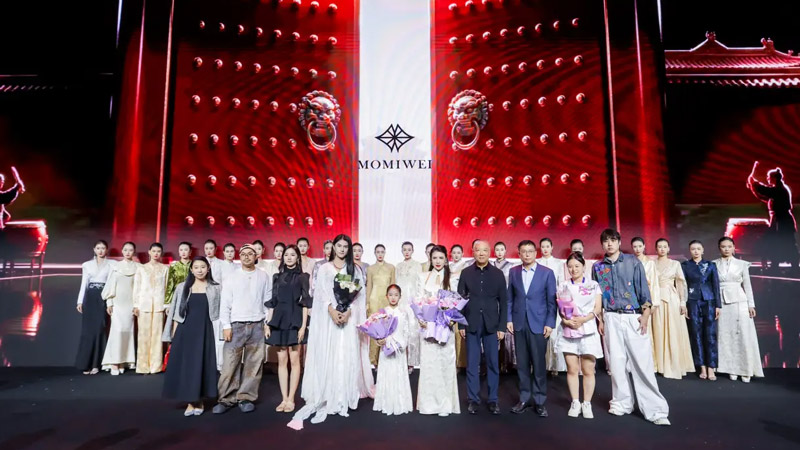
China Fashion Week’s autumn edition opened on September 3 at the 798 Art District in Beijing and runs through September 10, eight days organized by the China Fashion Designers Association under the theme “Jinxu Dongfang, Chaoqi Gongsheng” (金序东方·潮启共生). More than 600 guests attended the opening, among them officials from the Ministry of Commerce, the Ministry of Industry and Information Technology, the Ministry of Culture and Tourism and the Beijing municipal government, representatives of the China National Textile and Apparel Council and several foreign embassies, plus brand executives, industry-cluster delegations, buyers and press. Sun Ruizhe, president of the China National Textile and Apparel Council, used the occasion to place the domestic industry in the world’s first tier and to describe the week as a window for original Chinese fashion.
What runs through the season is a single technical question: how far a heritage weave can be pushed before it stops being heritage. More than 220 brands from over ten countries and regions, among them China, Japan, South Korea, France, Russia, Switzerland, the United States, Colombia, Zambia and Malawi, are showing across more than 100 new-product shows, industry forums, trade-matching sessions and fashion-art exhibitions, with over 500 domestic and international buyers attending. Runways are spread across the 798 Art District, the Beijing Exhibition Center, the CAFA Art Museum, the Longfu Culture Center and Shougang Park, and the season covers business menswear, high-end womenswear, haute couture, Neo-Chinese design, heritage-craft revival, sustainable fashion and technical outdoor wear.
Song Brocade Goes Technical
Most closely watched among the week’s craft stories was Shangjiukai’s Spring/Summer 2027 “Hundred Feathers” collection, shown on September 7 with 52 couture looks and a matching childrenswear line. Design director Bian Huizhong drew on the Ming scholar Lu Ning’s painting-and-poem suite “Hundred Birds, Matching Rhymes,” invoking the classical image of a hundred birds paying homage to the phoenix, and took the Song-dynasty “Auspicious Cranes” and “Dew on Autumn Water” as further anchors. The pheasant motif of Song empress ceremonial dress became the base pattern, broken into geometric language through Song brocade weaving and then interwoven with mulberry silk, gold and silver thread and colored silk in the jacquard.
Its layering technique moved into a new register: multiple yarns stacked and swapped between face and back, formed in one piece to raise a three-dimensional texture that surfaces and recedes as the fabric moves under runway light. The technical headline, though, is a pair of new fabrics. Using laser treatment to replicate the wash patterns of denim, the studio translated denim’s rough hand into a light, breathable silk denim, then fused it with Song brocade weaving to produce a new cloth carrying the pheasant motif. The collection also introduces chou silk, a coarse raw-silk weave, set against the brocade jacquard, and layers in iridescent silk gauze, iridescent satin and Xiangyunsha, the gambiered Canton gauze, so that contrasting sheens and weights widen what Neo-Chinese dress can do. Silhouettes move away from the straight H and A lines that dominate the category and take on an S curve through Western cutting.
Behind those experiments sits more than three decades of mill work. Chairman Wu Jianhua’s team developed an electronic jacquard loom that conforms to traditional Song brocade practice and raised weaving speed 200-fold, led the drafting of the national standard for Song brocade, and built a new smart workshop that has moved from layered jacquard to recycled materials. More than a hundred of the house’s products have been selected as state gifts. This season the brand also separated runway from order book: its hit Badayun (八达晕) medallion brocade was held back from the show and presented the next day at its trade event, an arrangement the house describes as art on the runway, commerce at the order fair.
Color as a Seasonal System
Traditional color got a systematic reading from Wanyue and Li Luyi, whose show “Azure Without End” takes the classical Chinese color qing as its starting point and runs it through spring, summer, autumn and winter, translating spring dew, summer lake, autumn sky and winter ice into four tonal registers. Across the sequence the blue moves from pale and clear to deep and still. The designers set the palette into Xiangyunsha, Song brocade and Shu brocade and paired it with plant dyeing and filigree inlay, letting color, material and silhouette describe the year’s turn together.
Zhongyong Yunsha, a Lingnan label led by designer Jin Yongxuan, works from Xiangyunsha, the national-level heritage craft specific to Guangdong, and pairs its laborious finishing with the sportswear fabrics most likely to be found in a young person’s wardrobe. Her reasoning is blunt: only once young people can actually wear the material does cultural recognition have somewhere to land.
Regional Mills Take the Podium
Shengze, the Jiangnan silk town known as China’s brocade capital, came with its own slate. Heyu Fang and Zhang Daiyu took the “Twelve Flower Deities” as a theme, selecting Song brocade and Yunjin brocade and combining Beijing embroidery, Su embroidery and Panjin embroidery with Western three-dimensional cutting to break the conventions of traditional pattern blocking. Designer Mi Tuoyu instead extracted a color system from traditional opera aesthetics, borrowed the deconstructive logic of paper folding, and used Song brocade as the core fabric, building layered pleats and sculptural structure to push past flat garment construction.
Qijin Workshop, a joint venture between Zibo Hairun Silk and Shandong Vocational College of Light Industry, brought Gold Award designer Liu Yong and a show titled “Silk Resonance,” 48 pared-back black-and-white looks that put the natural slub texture of doupioni silk at the center. The week also set aside days for regional production bases to present design language from yarn to finished garment, drawing on the fabric-research strength of the Keqiao textile hub and the leather and fashion capacity of Haining.
Digitizing Yi Dress in Yunnan
Ethnic dress was another through-line. Liang Yan, a professor at Beijing Institute of Fashion Technology, led a student and faculty team in dress-culture research and design innovation for the Yidi Anuo Spring/Summer 2027 collection “Sparks of an Epic.” Building on earlier fieldwork in Liangshan, the team systematically catalogued representative dress from Chuxiong, Honghe, Wenshan and Dali in Yunnan and digitized it, mapping the regional lineages of Yi costume and how they shifted over time. The collection unfolds in three chapters, Glimmer, Blaze and Return, overlapping historical dress, digital garment and new design, and reworks fire-steel motifs, horse-tooth motifs, scrolling vine and the Soma flower through deconstruction, embroidery, cutwork, laser cutting, appliqué, fringe and pleating.
Sustainability Moves Onto the Runway
A show titled “Green Veins, New Chapter” put workwear on the catwalk. More than a hundred garments covering government offices, financial services, power and energy and other sectors were cut to the service logic and physical demands of each job, and every yarn in them came from recycled plastic bottles, discarded clothing and textile waste. Designer Liu Wei said the closed loop is now complete, from collection and dismantling through re-spinning into new yarn and regenerating into finished fabric whose hand, color and durability match virgin material.
Under the title “Brocade Legacy,” a second show added functional, antibacterial and biodegradable fibers to mulberry silk, cotton and linen and combined them with Yunjin and Song brocade weaving. Designer He Rong said the aim is wider use: commuting, meeting friends, the ordinary occasions where a garment with Eastern sensibility and modern energy can actually be worn. Elsewhere a brand showed leather grown in a laboratory, fermented from coconut water and Acetobacter xylinum into a vegan alternative. Nearly 40 young digital designers brought AI-generated virtual fashion to the week, a format moving from digital collectible toward marketing tool for labels.
The Retail Numbers Behind the Season
Commerce was built into the schedule, with the week linking shopping malls and e-commerce platforms nationwide under a show-and-sell model that lets a collection reach retail shelves the day it walks. China Fashion Week is also about to enter its thirtieth year as what organizers call the East’s fixed coordinate in the global fashion map. The domestic retail picture behind it is steady: National Bureau of Statistics data show that retail sales of apparel by units above the designated size reached 559.89 billion yuan in the first half of 2026, up 6.8 percent year on year and a visibly faster pace than the whole of last year.