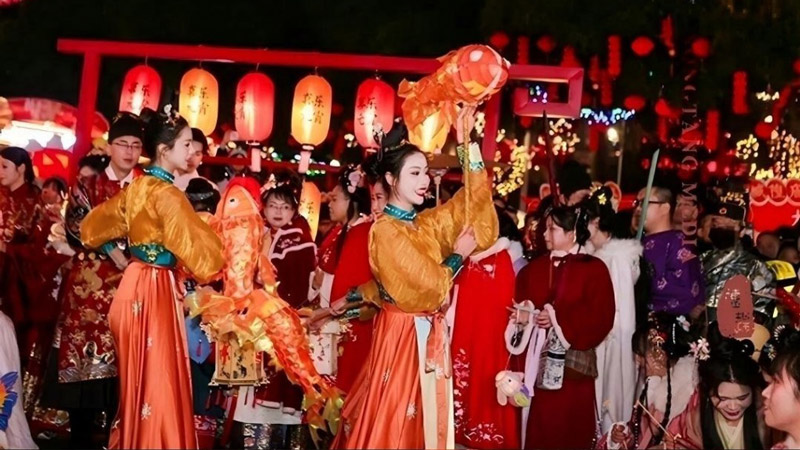
For four days, Nanning’s Sanjie Xiangxiang historic district is being run as a single continuous venue rather than a set of separate shows. The fourth China-ASEAN Intangible Cultural Heritage Week opened there on the evening of September 24 and runs through September 28, carrying across the Mid-Autumn holiday, with the arcade streets lit end to end and the program spread from a main stage out into the lanes, the market stalls and the courtyards between them.
The Block Itself as the Stage
Joint hosting comes from the Guangxi Zhuang Autonomous Region’s culture and tourism department and its ethnic and religious affairs commission together with the Nanning municipal government, and the stated frame is exchange: heritage as the bridge, the festival as the medium, China-ASEAN cultural understanding as the object, and creative reuse of heritage as the method. That shows in the layout. Rather than funnel visitors toward one ticketed performance, organizers turned the whole block into an immersive scene, which makes the route between events part of the programming rather than dead time.
Three Zones Across the Market
Market stalls split into three zones, each with a different job. Craft Learning brings the makers themselves: Vietnam’s Dong Ho woodblock prints and Thai lanterns on the ASEAN side; Nanjing Yunjin brocade, Chongqing Shu embroidery, Dali tie-dye, Luoyang Tang sancai, Qingyang sachets and Huangyuan row lanterns from elsewhere in China; and from Guangxi, Zhuang brocade (壮锦), Nixing pottery and Liubao tea. Shopping for Good Finds leans toward objects a visitor can carry home. Street-Food Aromas handles the queue, with Liuzhou river-snail noodles, Hepu giant mooncakes, Yao oil tea, Henan’s Xiaoyao pepper-hot soup and Qichun moxibustion.
Inheritors of the listed techniques staff the stalls in person, which changes how the market reads. Zhuang weaving, Sichuan’s Shu embroidery, Suzhou’s Su embroidery, Hunan’s Xiang embroidery, Guizhou’s Miao embroidery, Qinghai’s Danggar leather embroidery and Luoyang’s Tang sancai sit within walking distance of one another, so a visitor can compare stitching traditions from five provinces in an afternoon and buy finished pieces on the spot.
Performances From Across the Border
Opening night set the tone with a line-up that crossed borders repeatedly. Zhuang ceremonial drums came first, the Jing single-string zither answered, and Yunnan’s divine bird dance, Gananno, and the Munao Zongge both appeared in Nanning for the first time. Guizhou’s Dong grand song followed, then Myanmar’s arched harp and Malaysia’s Mek Mulung. China Tourism News reported that the show used fish lanterns to lead the audience through the block, that Guangxi Zhuang brocade and ASEAN costumes shared one runway, and that a puppet act performing fire-breathing and face-changing shared the program with a robot doing face-changing of its own.
Interaction was built into the evening rather than added on. A moonlit poetry round, a heritage quiz tied to the festival and a moon-sharing ritual that invited visitors to eat mooncakes together ran alongside a garden party whose games were named for the season: Rising Moon over Bagui, Embroidered Ball Invites the Moon, and Riddles Beneath the Lanterns. On Mid-Autumn night the block is scheduled to work as what organizers call a theater without walls, with Liu Sanjie appearing in the lanes to recreate the Zhuang song fair’s antiphonal singing and the local storytelling form Gongguan Muyu taking over a courtyard. Visitors toss embroidered balls, work through lantern riddles for small prizes, and move between photo installations set up along the route.
What the Week Still Has Ahead
Programmed alongside the market and the performances are a “Guochao Renewal” display of heritage dress, a folk literature light exhibition titled “Birds Carry the Message,” and the launch of “The Hundred-Bird Dress in My Heart,” a Zhuang brocade dress design competition that runs with a designer dialogue salon.
China National Radio described the week’s structure as coordinating stage performance, district parade and market under one schedule, selecting heritage resources from inside and outside China, and building themed check-in scenes along the streets. On the ground, the effect is easiest to see at the smaller booths. At the Zhuxianzhen woodblock New Year print stall, Ms. Zhong and Mr. Lin each picked out a chibi-style badge made from a print design. “Being able to make traditional heritage younger is what really appeals to me,” Ms. Zhong said. “This event lets us see heritage from home and abroad, taste specialty foods and buy heritage goods. It is a rare opportunity, and I am planning to come back with friends over the Mid-Autumn holiday.”