EP YAYING opened its first stand at the China International Import Expo in Shanghai on Nov 6, showing a coat line built on Eastern collars and European cloth. The orders that pushed the line into trade channels were placed earlier, though: at Shanghai Fashion Week’s MODE buyer show in spring, and again in October.
What Foreign Buyers Ordered First
Buyers from Russia, Vietnam and Kazakhstan wrote orders after the spring edition, and the October return brought buyers from the Middle East and the United States to the booth. A brand manager said the styles drawing repeat orders fell into two groups: pieces carrying Miao and Yi motifs, Su embroidery or Song brocade, and plainer coats cut in international fabric with a relaxed, modern silhouette.
That split says more about retail than about taste. Buyer stores and department counters weigh turnover and repurchase, so a coat has to look different enough to leave the rack and ordinary enough to be worn twice a week. Two failures are common for Chinese labels working abroad: piling on dragon and phoenix embroidery until a piece only works on a runway, or borrowing Western tailoring wholesale and adding a collar as an afterthought.
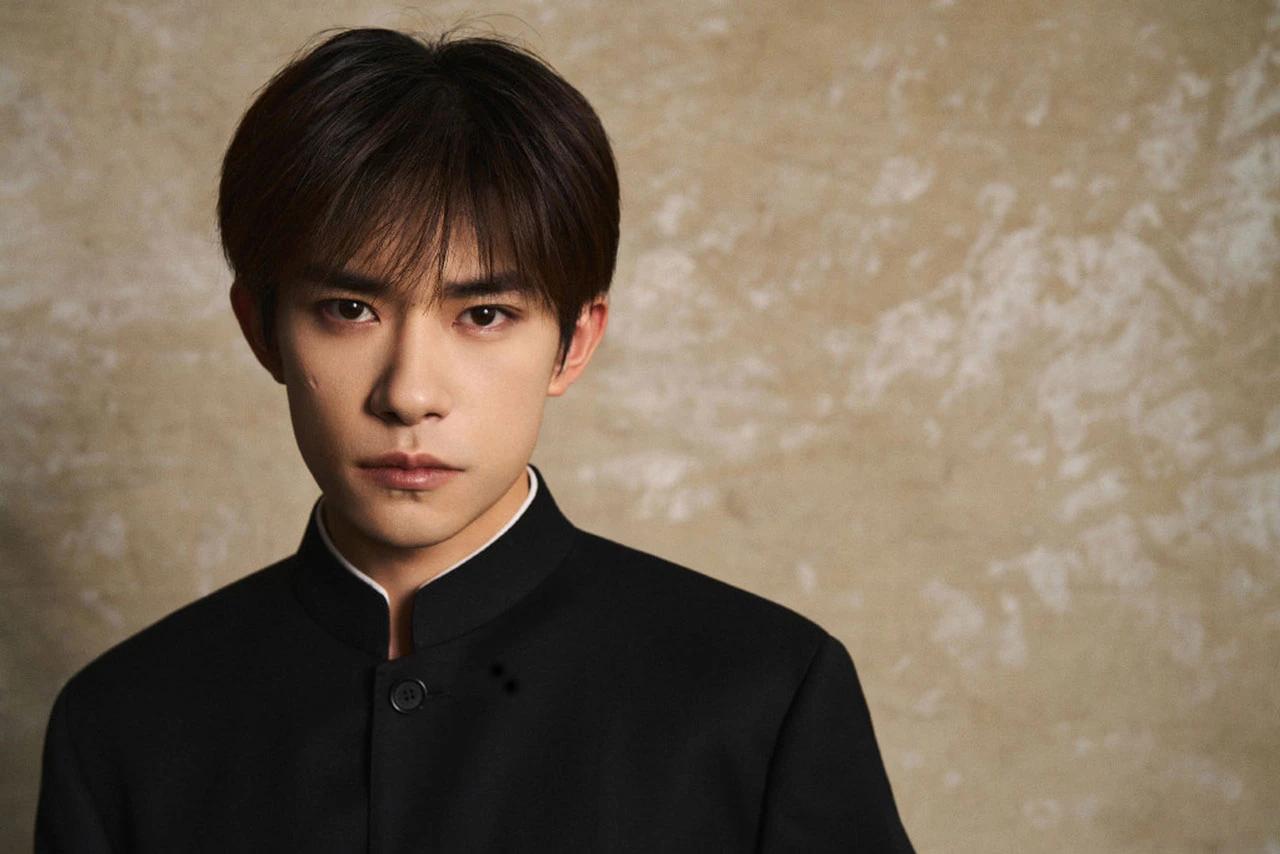
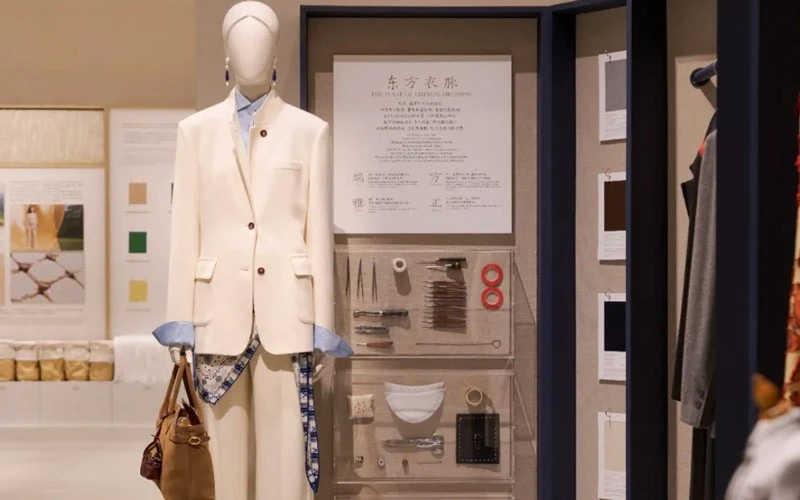
The coat that headlined the booth took the second route seriously. Its outline follows an Eastern stand collar, and the fit work behind it has run for more than a decade through hundreds of iterations, because shoulder width and waist proportion differ enough between markets that a straight translation of a European block shows up on the body. The collar is a mandarin collar, cut close and left unfastened at the throat.
Cutting a Peony Into Jacquard
Sample pieces on the stand show how the two halves are joined. To lift a peony from the Qing painter Jiang Tingxi’s album of peonies onto a gown, the brand worked with the French mill BUCOL on a double-weft jacquard that gives the cloth a raised, engraved surface; printing the flower flat looked cheap, and hand embroidery alone could not be produced at volume; either way the result has to read as cloth for a garment rather than a costume version of traditional chinese clothing. A short panelled suit uses a silk and mohair blend from the Italian mill RICCERI as its base, with counted-thread embroidery from Zhenfeng in Guizhou laid over it, 16,775 sequins stitched by hand across 45 hours.
Older motifs get the same treatment. The Miao wotuo pattern and a star with eight points were pulled apart and rebuilt as jacquard and geometric embroidery for the brand’s contemporary ethnic line, rather than reproduced as costume detail. Fabric sourcing follows the same logic: the collar set made with ambassador Tang Yan uses a silk, wool and cashmere cloth from Loro Piana, which keeps the drape soft without the shine that makes a coat read as formal dress.
Yak Down From the Plateau
Buying cloth from European mills would leave the brand as a well-connected customer, since the same fabric is available to anyone willing to pay. The harder move has been upstream. Since 2018 the group has worked with Aba prefecture on a research herd above 3,500 meters, where herders comb out yak down that the animals shed in summer. The fibre is warm but uneven, short and itchy, so the work has gone into dehairing and into blending ratios with wool that keep a yarn from breaking.
Nine years of that has moved overall use of the fibre within the group’s yak supply from 28 percent to 38 percent, on purchases of 623 tonnes, with ten registered pieces of intellectual property and 36 million yuan paid to 1,380 herding households. Similar bases cover 6A mulberry silk from Ningnan in Sichuan and white cashmere from Alxa in Inner Mongolia.
Chairman Zhang Huaming put the expo in two frames at once, calling it a window through which the world looks at China and a platform where the brand meets the global supply chain. The company first appeared at China Fashion Week in 2005; this was its first import expo, and the buyers carrying Su embroidery and Song brocade styles into overseas stores are the part of that run it can measure.