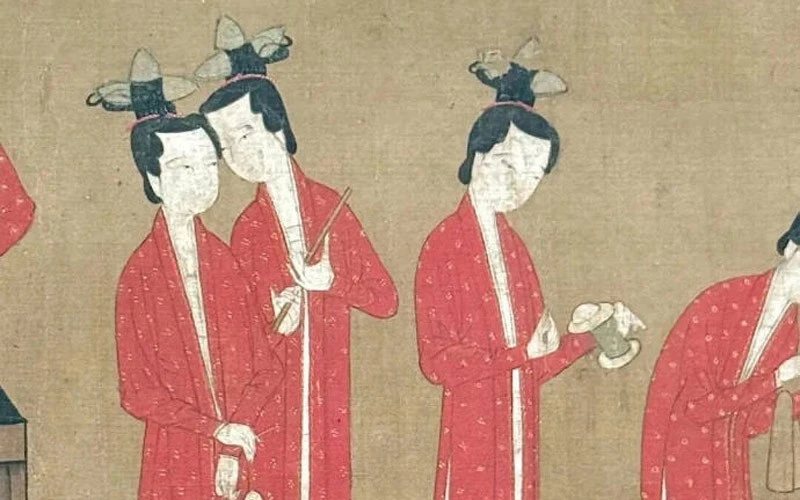
Nine women stand in a garden courtyard, all in red. Their coats share one cut, one length and one collar, and the gold pattern on each is different. Eight centuries on, that combination is the most useful thing in the picture.
What the Beizi Is in This Scroll
A straight-collared, open-front outer coat, slit at the sides from the armpit and fastened nowhere down the front: that is the Song Dynasty Beizi. Of the many types of Hanfu outer layer, it is the one worn open over something else. Women in the Song put it over a chest wrap and a floor-length skirt. In the Gele Tu, a handscroll held by the Shanghai Museum, nine court musicians wear it in red, falling to the ankle, sleeves fitted to the wrist, and it is the only garment in the painting repeated without variation.
Two features of the cut matter for reading the painting. A Beizi can be bordered or plain, and its sleeves can be wide or narrow, so nine identical red coats are a choice rather than a rule. Song examples are usually narrow-sleeved and long, slit from the armpit, trimmed along collar, cuff and hem. Nothing closes the front: the two edges carry paired cords that hang loose instead of tying, a reference to the crossing ties of an older inner robe, kept as a nod to antiquity. An older name for the garment is explained as coming from the maids and concubines who stood behind their mistress, an etymology that says more about who wore it than about how it was cut.
Museum records are precise about this one. Anonymous, Southern Song, silk, ink and colour, 25.5 cm high and 158.7 cm wide, catalogued as academy painting with the subjects listed as courtyard, bamboo, rock, flowers, musicians and instruments. There are no collector seals and no colophons. One inscription sits at the base of a Taihu rock near the end of the scroll, and the record notes that the transmission history before acquisition is unknown. Some essays give 25.6 by 157.7 cm; this article uses the museum figures. The catalogue files it as a display object rather than a document, lists the technique as fine-line drawing in colour, and assigns the style to the academy. Those labels do useful work: a court workshop picture records regulation as much as it records a scene.
Composition explains an odd opening. A palm tree stands alone at the front of the scroll with little to do with anything else in it, and its job is to balance the page. The middle section holds the figures. The end is scenery: a Taihu rock among bamboos, a railing whose posts run to the edge of the silk, a tree in small white blossom. The rest of the silk is left blank.
Twelve Figures Under Three Dress Codes
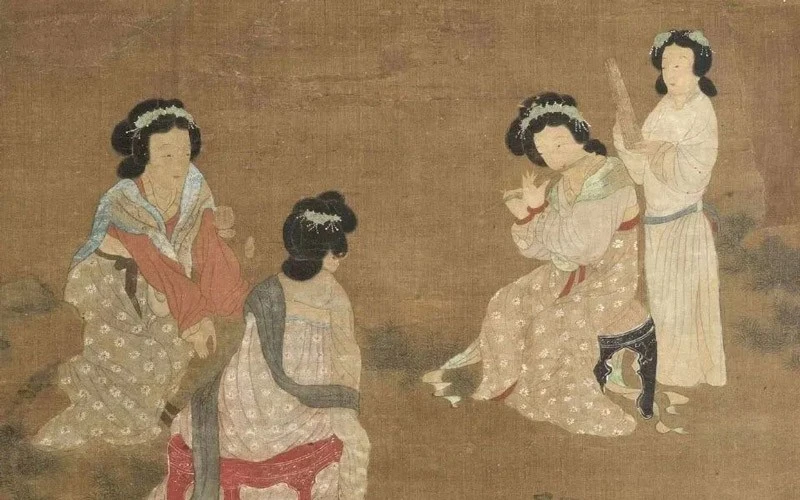
Count the people and the painting divides cleanly: nine adult female musicians, two girls, one older male music official. Each group is dressed by a different rule, and treating them as one costume is where most short descriptions of this scroll go wrong.
Nine musicians wear their hair in high coiled styles, possibly wigs, capped with a three-lobed flower-shaped wrap tied in red cord and set with white pearls. Strings of blue-green beads hang at the temples. Over a plain chest wrap and a floor-length skirt they wear the red Beizi, narrow-sleeved, long enough to reach the floor. Faces, brows, makeup and even the shade of face powder are identical across all nine. One set of formal clothing, copied nine times.
Two girls wear straight-winged Futou caps, flowered at the crown, and both bunch their sleeves up as if clearing their hands. The one on the right has a blue-green round-collar robe, narrow sleeves, a red painted-flower cloth wound at the waist, a silk sash, and the front hem tucked into the belt so a two-layer inner robe shows in red and white. The one on the left wears a right-over-left cross-collar robe with side slits, belted with a red-ground cloth woven in gold.
Only the male official is painted as an individual. He stands at the far left in a narrow-sleeved round-collar robe over an inner layer, trousers, cloth shoes and a Diexie belt hung with small fittings. A four-string curved-neck Pipa is in his hands, and he is passing it to one of the musicians. Sources disagree on his cap: the museum calls it a court-audience Futou, while technical essays read it as a curled-foot or curled-wing form. That disagreement returns in the dating argument.
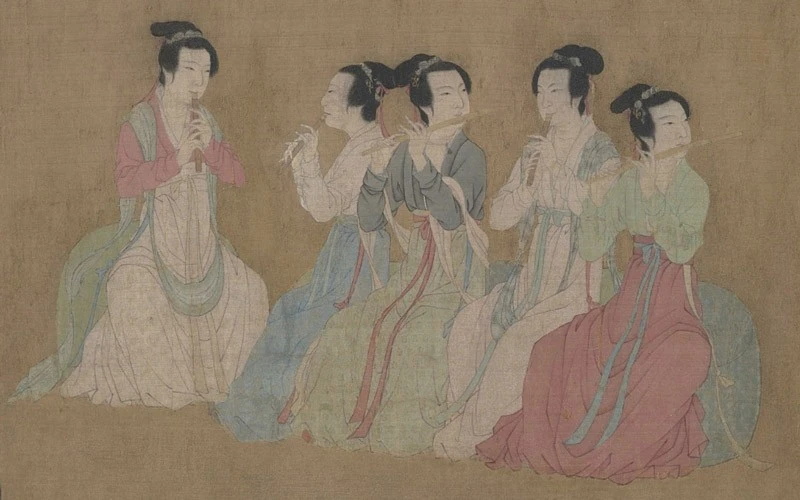
Faces are the painting’s quiet argument. Nine musicians share one face, the two girls share another, and the official alone is drawn with wrinkles, brows and expression. Academic painting sorted figures by status, so blank uniformity states something about a bureau rather than betraying a shortage of skill.
The flowers in the musicians’ hair are harder to name. Palmate leaves and clustered heads suggest hollyhock, though the blooms may be silk: Song flower-making was an industry, and artificial flowers carried no season, which made them useful for a crown worn all year. Real or silk, the habit was general, and abundance was the point: a crown packed with blooms was called a cluster arrangement, and the recorded maximum was seven. Lu You, past seventy, still took the first flower at a banquet table. Emperor Zhenzong once handed blossoms to Kou Zhun and observed that a young man was at the right age for wearing flowers and drinking.
Gold Leaf as a Marker of Rank
Nine identical cuts carrying nine different patterns is not a workshop accident. The Song History’s treatise on carriages and dress records that inside the palace everyone below the empress was barred from gold-decorated clothing: no gold-leaf application, no gold-thread weaving, no twisted gold cord, nothing that used the metal as ornament. Dress carrying gold therefore said something the cut could not.
Look at the nine coats one at a time and the pattern does individual work. Each red ground carries a different gold design, laid on as gold paint rather than woven or stitched in metal thread, which is what separates these garments from the gold-brocade pieces the same law names. Comparison across the group, not a single figure, is what makes the argument: a shared cut establishes an institution, and nine separate patterns establish nine separate positions inside it.
Nothing in that cut was restricted, and the sources let the garment travel the full social range. In the Qiandao period the court fixed the everyday dress of empress and consorts as a wide-sleeved robe with coloured collar, a long skirt, a Xiapei, a jade pendant and a Beizi, all in crimson gauze, and the record itself concedes it was no different from what officials’ wives wore.
Elsewhere the same coat shows up much further down. The Wulin Jiushi lists a pearl-embroidered great coat and a Beizi among a princess’s dowry. The Dongjing Menghua Lu dresses the top rank of matchmakers in a purple Beizi. The Fansheng Lu has Hangzhou wine houses hiring singers who arrive in red Beizi and tall coiled hair. By the Xuanhe years women in the capital were wearing a short, tight, unfastened coat called the unbuttoned collar, and the fashion moved out from the palace until the whole country had it.
What the law regulated was the gold layer, never the silhouette. That is how Song Dynasty Clothing sorted people, and it is the reading this painting supports: nine women in one institutional garment, each carrying a different gold pattern, in a picture where nobody else wears gold at all. The pattern is the rank. The uniform is the job.
Six Plectrum Pieces and a Jiaofang Rehearsal
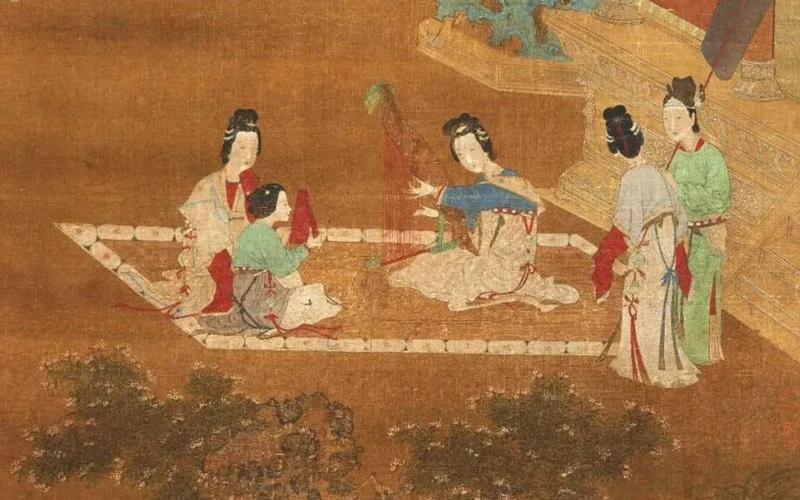
Name the instruments and the ensemble turns out to be a formal one: curved-neck Pipa, panpipes, a Fangxiang stone-chime rack, a flat drum, a transverse flute, a Paiban clapper, and one piece still unclassified, a ring struck with a short rod that works like a triangle. The Fangxiang rack is the showpiece, its two ends finished with phoenix heads holding pearls and hanging tassels. Sixteen iron plates of equal size and unequal thickness hang in two rows, an instrument that began under the Liang of the Southern Dynasties and stayed standard in court music before fading out.
A clapper count settles it. Song Paiban came in two sizes: a nine-slip form for popular settings and a six-slip form for the Jiaofang (教坊), the imperial music bureau. The Gele Tu shows six. That single count ties the figures to the bureau rather than to a private household troupe, and it is exactly the sort of detail a copyist working from style alone would be unlikely to get right.
Rehearsal, not performance, is what the picture records. The Dongjing Menghua Lu says the bureau gathered its students a month before an inner-palace banquet to drill group dance and musical drama in sequence, and that on rest days it rehearsed where spectators could watch. The same memoir describes audiences standing at the stages in any weather. The Fansheng Lu claims thirteen entertainment houses in Hangzhou never stood idle. Against that appetite for spectacle, surviving pictures of a working court ensemble are few, which is why this scroll keeps being cited.
Dating the Scroll: Southern Song, Jin, or Later Copy
The museum’s date rests on the standard reference corpus: the Complete Collection of Chinese Painting assigns the Gele Tu to the Southern Song. A Jin-dynasty reading has been argued on two grounds. The performers’ dress mixes Song and Jin features, with the women and girls in Song fashion while the man’s robe and cap carry Liao traits; and the instrumental set matches the ensemble of northern drama and Jin variety plays, which would put the scene inside a Jin performance.
A closer study takes the figures group by group. The two dancers’ headwear follows Song regulation, with comparable forms excavated from Liao and Song-Jin tombs and Song texts describing the same type, and stage costume is allowed to depart from everyday dress. The nine musicians’ heads and clothing follow Song practice and lean Northern Song. The older official’s dress follows Song practice but sits closer to Liao. The instruments resolve to curved-neck Pipa, Fangxiang, Paiban and a Tang-style drum, a Song combination. The railing at the end carries posts, handrail, basin lip and hook plates of a plain Song type, comparable with Liu Zonggu’s painting of moonlit terraces.
Sharpest of all is the inscription. Five characters at the foot of the Taihu rock read as a dedication from Gu Hongzhong, the Southern Tang painter who worked at the Nanjing academy between 910 and 980. He died two centuries before the Southern Song. A later hand can copy an earlier picture; an earlier hand cannot paint a later regulation. The signature went on afterwards.
Brushwork produced a third position: Song subject, later hand. Song painting is exact enough that buildings can be rebuilt from it, and this scroll falls short, with visible slips such as a Fangxiang base set off its axis and the crescent sound-hole of the Pipa left out. Recent work crossing dance history with dress history dates the execution to the Southern Song or no earlier than the late Northern Song, and reads the content as a large song-and-dance suite staged for a literati audience. One physical clue pushes the other way: the mounting uses Jinsushan sutra paper, a stock heavily used in the Southern Song for high-grade backing.
What would close the argument is technical rather than stylistic. Pigment analysis on the gold could date the leaf; weave analysis on the silk could place the ground; a full transcription of the mounting could test the Jinsushan paper against recorded Southern Song practice. None of that has been published for this scroll, which leaves the case resting on dress regulation and brushwork, two lines of evidence that keep pulling in opposite directions.
| Reading | Core evidence | What it cannot explain |
|---|---|---|
| Southern Song (museum record) | Reference corpus dating; women’s dress, railing hook plates and instrument set all Song; Jinsushan sutra paper mounting | The official’s cap and robe read as Liao; brushwork below Song standards |
| Jin dynasty | Dress mixes Song and Jin features; instruments match northern and Jin variety drama | Women and girls are firmly Song; the railing plates are Song |
| Later copy, before late Ming | Brushwork short of Song exactness; misplaced Fangxiang base; missing crescent sound-hole; forged signature | Dress, instruments and architecture are consistent enough to demand deep familiarity with Song regulation |
Rarity keeps the dispute running. Painted records of a court music ensemble are scarce, and tomb murals showing musicians, variety players and dancers are mostly fragmentary. Whatever the hand that made it, the scroll preserves a complete bureau roster with its formal clothing, which makes it a specimen for music history, dress history and the ordinary working day.
Read that way, the date stops being the point. The nine red coats are uniforms first and fashion second; the gold is rank; the six slips are a payroll; the three faces are academy convention. Separate those layers and an eight-hundred-year-old rehearsal stays legible even while its attribution remains open.