Shaoxing opens a three-day city walk through its old town from 14 to 16 November, with a stamp book, a spendable brass-style token and a schedule built around Lu You, the Southern Song poet whose family home sits in the Yuecheng District. Thousands of Hanfu wearers are expected to walk the route across the weekend.
| Dates | 14-16 November 2026, launch at 9 a.m. on 14 November |
|---|---|
| Venue | Lu You Former Residence Square, Yuecheng District, Shaoxing, Zhejiang; checkpoints across the old town |
| What it is | Autumn city-walk programme paired with a Song-style living season at the poet’s former residence |
| Scale | 11 required checkpoints and 45 optional ones, ten themed routes |
| Tickets | 29.9 yuan individual, 49.9 yuan family (two adults, one child); free for university students |
| Included | Free entry to nine paid scenic areas run by the organiser, half-price seats at four shows, a token purse |
| Collect stamps | Lu You residence visitor centre 09:00-20:30; Nanzhen Kuaiji Mountain centre 08:00-17:00 |
How the Ingot Works
The organising idea is compressed into three objects: one route, one map, one ingot. Behind it sits a four-step sequence the Shaoxing Culture and Tourism Group states openly, which is to bring people in, keep them overnight, get them spending and give them something to do while they are here. The stated aim is to turn event traffic into winter consumption and to shift the city’s trade away from passing coach tours toward walking visitors.
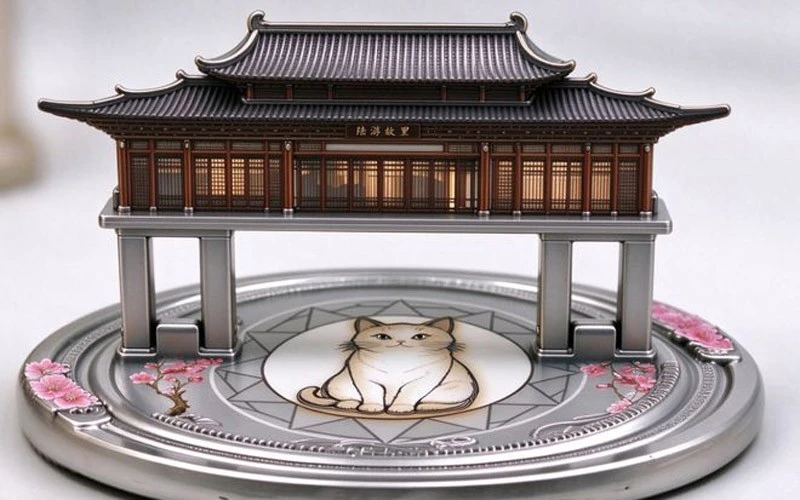
An ingot is the interesting part. Each registration pack carries a token modelled on a silver ingot, issued in denominations of ten, five, two and one liang, antique in style and either kept as a souvenir or spent at the group’s scenic areas, hotels and partner shops. It also converts into parking vouchers, bus tickets, add-on experiences inside attractions and selected design products. An individual ticket carries ten liang, a family ticket eighteen.
Stamps That Decide Where You Walk
Eleven checkpoints are compulsory: the Lu Xun Memorial, the Lu You residence, East Lake, Lanting, Nanzhen Kuaiji Mountain, the Yangming residence, Zhou Enlai’s ancestral home, the Jiemin Library, the Sage of Calligraphy quarter, the old city’s north gate area and the Youyi Village dock on the ring canal. The optional list runs to 45 more, scattered wider, from the Baicao Garden exit and the viewing terrace at the poet’s home to the old Shan Fang house, the Shaoxing Hotel, the boat dock on City Square and the canal theatre.
Finishing conditions are arithmetic rather than vague. Collect all eleven required stamps plus fifteen of the optional ones and the book holds 26 marks, which earns a commemorative medal and one lottery entry with an annual city pass among the prizes. Medals can be claimed across all three days at three counters, the two visitor centres and the Yangming residence, which stays open until 17:00.
The Ticket Bundle Behind the Walk
A 29.9 yuan ticket is not where this event earns its keep. The bundle attached to it is. Registration clears entry to nine paid sites the group operates: the Lu Xun hometown and Shen Garden, East Lake, Lanting, Nanzhen Kuaiji Mountain, the Yangming residence, the 30th Parallel Geography Museum, the Lu You residence, the Xu Wei Art Museum and the Wang Xizhi exhibition hall.
Four stage productions sell adult seats at half price, among them the Shen Garden piece built on the poem inscribed there, a Lu You themed show and the canal theatre. Ten walking routes are published as well, split between theme and experience: red history, notable residents, calligraphy, locations used for the filming of Journey to the West, and a route strung between famous names, bridges and old lanes, alongside a performance-led walk, an autumn leisure walk, a food walk, a yellow rice wine route and a climb through the Kuaiji hills.
Lu You’s Old Town, Walked Slowly
The format suits the place for physical reasons. Shaoxing’s old town is dense with ruins, former residences and lanes, and the footpaths between them already connect. Chaining scattered sites onto one line works better than selling a ticket per gate, and it belongs to a broader move in Chinese old-town tourism away from single attractions toward roaming a district.
Attaching the launch to Lu You gives the abstraction somewhere to stand. He was a Southern Song official, historian and poet, born in Shanyin, the county that became Shaoxing, and his family home is in Yuecheng. Putting the opening ceremony in his courtyard, and running a market alongside readings of his verse, breaks the Song aesthetic into four usable carriers: a stamped route, a theatre seat, a market stall and a boat. A visitor does not need to know Song history to enter any of them.
Costume is where the event differs from a themed market. Thousands of people walking the same streets in the traditional Chinese clothing of the Han people are not a decorative crowd; they are the content. For an ordinary visitor, joining in is the least expensive way to enter the scene. For the wearer, the appeal is a walk with a route, a target and something to spend at the end. City walking and Hanfu outings have been converging for several seasons, and this is that convergence written into an official programme.