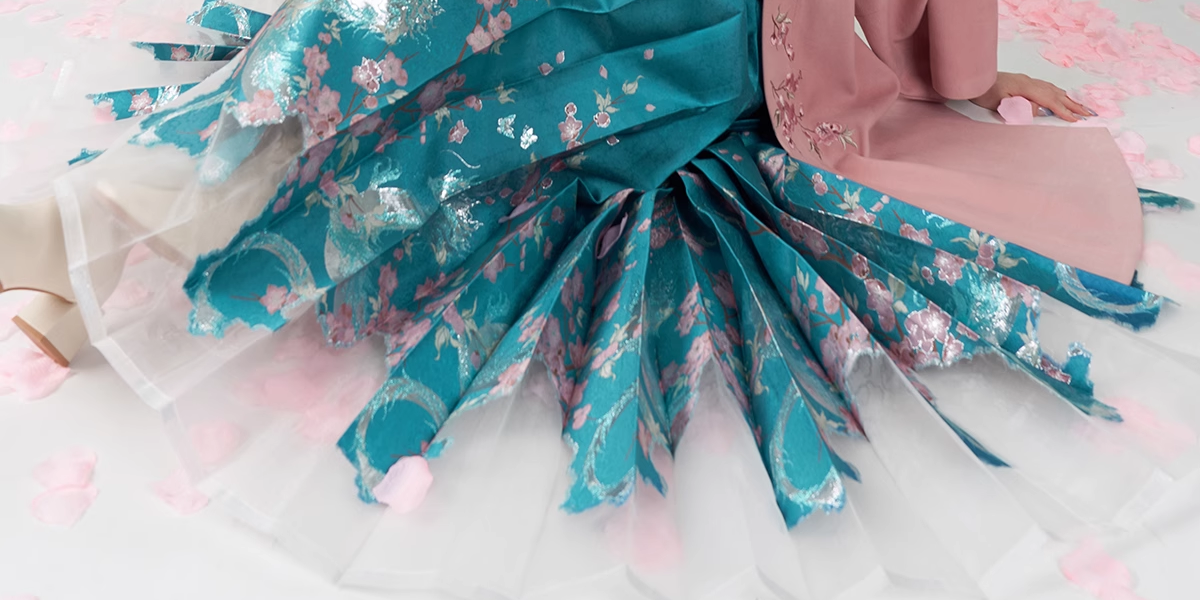

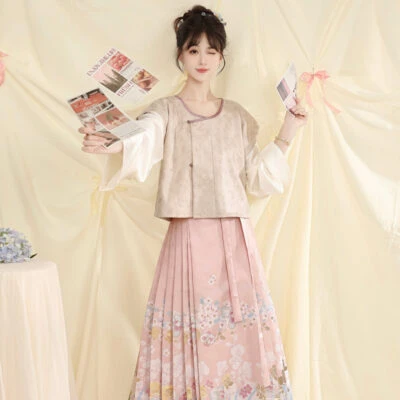
A mamianqun (马面裙), also called a horse face skirt or horse-face skirt, is a traditional Chinese wrap skirt built from two overlapping panels of fabric joined at a single waistband. It has a flat, unpleated front and back, deep pleats on both sides, and it fastens at the natural waist without a zip or elastic. Every mamianqun for sale in this collection is a wearable garment rather than a costume piece — made for daily wear, hanfu meetups, weddings and photoshoots.
Mamianqun Basics
The skirt consists of two overlapping panels with a shared waistband. The flat front and back “Mamian” panels contrast with the pleated sides, which flow like waves when moving. Traditional styles reach ankle length, while modern variations include midi and mini versions. Common fabrics are silk, brocade, cotton or blends, adorned with motifs like dragons, phoenixes, clouds or florals.
Structurally, each half of the skirt carries a flat, unpleated panel at either end, so the finished garment has four panels — or doors — in total. The two halves are joined by overlapping one door over another and sewing the whole assembly along the waist. The overlapping doors are not sewn to each other; they are attached at the waist only, which is precisely why the skirt opens and moves freely as you walk. Laid flat, three doors are visible. Worn, the two end doors also overlap at the back, so you see one pair of overlapping doors at the front and another at the back.
The pleats deserve their own note, because they are not ordinary knife pleats. A mamianqun uses a double-folded pleat known as gongzi zhe (工字褶, “I-shaped pleat”): both sides are folded toward the centre and then back out again, each fold spreading away from the middle until the two sides pleat in opposite directions. When worn, this produces the trapezoidal line the garment is recognised by, with the pleats falling forward and backward at once. Usually there are four to seven pairs of folds on each side.
Historically worn by women for formal events, the Mamianqun horse face skirt symbolised social status and Confucian propriety. Its structure also carried a cosmological reading: the flat panels represent earthly stability, while the pleats embody celestial harmony — the garment as an argument for balance, worn on the body. Whether or not a wearer today reads it that way, the opposition between stillness at the front and motion at the sides is the source of the skirt’s visual character.
What Makes a Mamianqun Different from a Pleated Skirt
A pleated skirt is pleated all the way around its circumference at even intervals. A mamianqun is not. Its pleats are confined to the sides, and the front and back are left as broad flat panels. That single difference changes everything downstream: the flat panels give the wearer a clean, architectural front, while the pleated sides supply volume and movement. The pleat type differs as well — a double-folded gongzi pleat against a single knife pleat — and so does the fastening, since a mamianqun closes by overlap and waist tension rather than a zip, button or elastic band.
In practice, this is why a mamianqun does not read as a generic pleated skirt even from a distance. The contrast between flat and pleated is the whole design.
A Short History: Song, Ming and Qing
The mamianqun emerged in the Song dynasty and became widespread in the Ming, remaining in use throughout the Qing. Its name comes from the mamian — the flat, tower-like platforms projecting from Chinese city walls — which the unpleated front panel resembles. The resemblance is functional as well as visual: those platforms were the surfaces through which horses passed, and the skirt’s open doors were what allowed a wearer to ride.
Each dynasty interpreted the garment differently. Song aesthetics favoured sleekness, so Song-era skirts were often simple, monochromatic and made of softer fabric, sometimes embroidered. The Ming brought volume and luxury: bold reds, blacks and blues, thick silk or wool, and gold-thread patterns worked in stacked horizontal bands. Because the ao top of the period grew longer and covered more of the skirt, decoration migrated downward — which is why most mamianqun today concentrate embroidery and pattern near the hem while the upper panel stays relatively plain. In the Qing, the defining feature became contrast taping around the edges of the skirt doors, usually white and decorated with floral embroidery.
The garment has never fully left use. Princess Diana was photographed wearing one, and the Dior controversy in 2022 returned it to global headlines. Historically it was worn by both men and women and only later became associated primarily with women’s dress. For the full chronology and a detailed walk through the skirt doors and pleat construction, read the history and construction of the mamianqun.
Fabrics Used in Mamianqun
Structure matters more than fibre in hanfu generally, but fabric decides how the pleats behave. Stiff fabrics hold the architectural line; soft fabrics drape and move.
- Woven brocade (zhijin) — the classic choice: heavy, sharply creased, patterned with metallic thread. Best for formal occasions and cold weather.
- Polyester jacquard — the practical everyday option. Holds pleats reliably, resists wrinkles, washes at home, and is the usual choice for a first purchase.
- Chiffon and organza — light and airy, closer to the Song dynasty aesthetic. Needs steaming to stay crisp, and struggles to hold a sharp pleat without maintenance.
- Silk and silk blends — the traditional luxury option, with the best drape and the highest care requirement.
- Wool blend — warm and matte, suited to winter wear with a padded top.
For weave, weight and authenticity checks before checkout, see our buyer’s guide to mamianqun fabric.
Sizing: Waist, Width and Length
Measure your natural waist, not your hips. The skirt sits above the navel, and the hips are unconstrained because the panels overlap rather than enclose them — hip measurement is irrelevant here, which is why mamianqun sizing confuses people who are used to Western skirts.
The number that actually matters is flat width. Because the skirt wraps and overlaps, the total flat width of the fabric should be at least 1.5 times your waist measurement, and closer to twice is safer. A skirt cut too narrow develops a visible gap at the front the moment you move, and no amount of styling hides it. Sizes in this collection run S, M, L and XL; several styles also offer a colourway or trim option.
Length is the second decision. A 90–95 cm skirt falls mid-calf and suits commuting and casual outfits. At 100–105 cm it reaches just above the ankle and is the most versatile length. Anything over 110 cm is ceremonial — dramatic in photographs, awkward on stairs and public transport.
What to Check Before You Buy Mamianqun
Three details separate a mamianqun that hangs well for years from one that collapses within a month.
Fabric width. Covered above, but worth repeating: if the seller does not publish flat width, ask. A cheap skirt usually saves money precisely by cutting narrow.
Pleat depth and setting. Shallow or heat-sealed pleats lose the trapezoid line after a few washes. Deep, pressed pleats hold. If a listing shows a skirt whose side pleats lie flat in the product photos, that is the skirt you will receive.
Skirt door alignment. The two front panels should be sewn at the waist only. If they are stitched shut down the seam, the piece is a decorative replica: it will look correct standing still and fight you the moment you walk or sit.
Where to Buy a Mamianqun Online
Every mamianqun for sale in this collection is a finished garment rather than a made-to-order listing, so the fit you see is the fit you get. Choose a fabric and length above, then check the flat width before you order — it is the single figure that decides whether the skirt closes cleanly at the waist.
To buy a mamianqun for a first hanfu outfit, start with ankle length in a mid-weight jacquard. It holds its pleats through travel and needs no specialist cleaning. For a wedding, a photo shoot or a formal banquet, the brocade and gold-woven styles carry the same construction with a heavier hand.
Sizing runs S to XL on the size chart above. If you sit between two sizes, size up: the skirt is held by waist tension and overlap, and a slightly larger waistband is easier to take in than a tight one is to let out.
Styles in This Collection
Our mamianqun skirt range spans the historical and the contemporary. Ming dynasty styles pair a deep colour ground with gold-woven panels concentrated near the hem, a direct inheritance of the long-ao silhouette described above. Song-influenced pieces are quieter: pale, soft, embroidered rather than brocaded. Qing-style designs favour contrast taping along the door edges.
Modern cuts include short and midi lengths, and some designs hide a pocket inside the pleats, where the folding naturally conceals the opening. Everyday versions favour machine-washable polyester jacquard in neutral colours, while ceremony pieces use brocade with metallic thread and are meant to be dry cleaned.
If you are new to the garment, start with a mid-weight polyester jacquard at ankle length in a colour you will actually wear. It photographs well, survives travel, holds its pleats, and does not need a specialist cleaner — which matters, because the main reason first-time buyers stop wearing a mamianqun is fear of ruining it.
A note on wording: a mamianqun is a skirt, not a dress. When shoppers search for a mamianqun dress they usually mean the full outfit — this skirt worn with a matching ao or stand-collar top. We list the skirt on its own because the fit of the top matters more than the skirt does, and pairing them yourself gives a better result than a fixed set.
How to Wear a Mamianqun Horse Face Skirt
Centre the doors front and back, wrap the waistband around, and tie the attached ties at the side or back. The skirt holds itself by overlap and waist tension, so the ties set position rather than carry the weight of the garment. Align the front and back panels symmetrically before you finish the knot; an off-centre door is the most common styling mistake and the easiest to avoid.
Traditional Styling
Pair with a cross-collar or stand-collar short jacket, fastened with a waist tie, and keep the silhouette clean so the flat front panel reads clearly. Historically the skirt was worn with an ao top, and the proportion still works: a top that ends at the hip leaves the pleats visible, while a longer top shifts attention to the hem, which is exactly what Ming dynasty wearers did.
Modern Twists
Tops: blouses, knitwear or cropped blazers that highlight the waist. A plain white button-down with a Ming-style skirt is the most reliable combination for first-time wear; keep the shirt simple so the skirt carries the colour and pattern.
Accessories: delicate belts, jade pendants or tassel earrings for a cultural touch. Avoid heavy statement belts — they sit on the waistband and distort the door alignment.
Footwear: loafers or Mary Janes for elegance; sneakers for a casual vibe. Flat soles are kinder to the hem than heels.
Occasions: the garment moves between contexts more easily than most hanfu. A midi-length polyester piece reads as an ordinary skirt at the office; a brocade ankle-length piece reads as formal wear at a wedding or a photoshoot. Short and mini versions work for summer streetwear.
Care Tips
Never wring a mamianqun out. Roll it in a towel to absorb water, then hang it by the waistband so the damp weight of the fabric pulls the pleats straight as it dries. Steam rather than iron, and press along the pleat line rather than across it.
On movement: the doors are designed to open, so walking, sitting and climbing stairs will not damage the skirt — the pleats are pressed and set, not stitched. What does shorten their life is repeated crushing, so avoid packing it at the bottom of a bag or leaving it folded under heavy items.
For washing: hand-wash, or use a delicate cycle with the skirt inside a mesh bag. Air-dry inside out. Avoid high heat at every stage — heat is what kills pleat memory. Brocade, silk and any metallic-thread piece should be dry cleaned rather than washed.
For storage: hang by the waistband with clip hangers, or lay flat. Folding along the existing pleat lines is acceptable for travel if you roll rather than crease; folding across the flat Mamian panels creates permanent marks that no amount of steaming removes.
Mamianqun Horse Face Skirt FAQs
What body types suit mamianqun horse face skirts?
High waists elongate the legs; wide pleats flatter the hips. Belted styles enhance curves for H-shapes; dark colours slim pear shapes. Because the panels do not enclose the hips, the garment is more forgiving across body types than a fitted skirt — the variable to manage is length, not hip width.
How to tell apart mamianqun horse face skirts and pleated skirts?
Mamianqun horse face skirts have flat front and back panels with pleats confined to the sides, and they use a double-folded pleat. Regular pleated skirts lack panels and carry uniform folds all the way around. From the front the difference is immediately visible: one is a single flat surface, the other is a continuous fan.
Can I machine-wash it without ruining the pleats?
Hand-wash, or use a delicate cycle in a mesh bag. Air-dry inside out. Some modern styles are wrinkle-resistant, but avoid high heat. Never tumble dry brocade or silk, and never wring.
Can men wear mamianqun horse face skirts?
Yes. The garment was originally unisex and was worn by both men and women before becoming associated mainly with women’s dress. Modern brands offer neutral designs; style with a tunic, a plain shirt or a T-shirt.
What does “mamian” actually mean?
It means “horse face.” The name refers to the flat, tower-like platforms on ancient Chinese city walls, which the unpleated front panel of the skirt resembles. It describes the shape, not the animal.
How much fabric width do I need?
At minimum 1.5 times your natural waist measurement, and closer to 2 times is more comfortable and safer against the front gap. This is the single most useful number when comparing listings.
Can I wear a mamianqun casually, not just for hanfu events?
Yes, and this is how most people now wear it. A midi-length polyester jacquard with a plain shirt or knitwear reads as an ordinary skirt. The styling rule is to keep everything above the waist quiet so the pleats and pattern stay the focus.
Are the side pleats stitched closed?
They should not be. The pleats are pressed and set, not sewn shut. If a listing explicitly says the pleats are stitched, the skirt will not move correctly.
What length should I choose for a first purchase?
Ankle length, around 100–105 cm, is the most versatile and the most historically faithful. Midi is easier to wear daily but changes the proportion; full length is best reserved for ceremony and photography.
How should I store it?
Hang by the waistband with clip hangers or lay it flat. For travel, roll rather than fold. Avoid compressing the flat front panels under other garments, since creases there are permanent.
Where can I buy a mamianqun online?
From this collection — every piece is listed with its flat width so you can check the fit before you buy. In person, the garment is common at hanfu rental studios and costume shops in Chinese cities, but their ready-made sizing is usually narrower than what you see here.
Is a mamianqun a dress or a skirt?
A skirt. The term mamianqun dress appears in search because the garment is almost always photographed as a full outfit, with an ao top above it. Buy the skirt and the top separately and the proportions stay adjustable.
Still deciding between styles? Our complete mamianqun guide covers body type selection, step-by-step wearing and styling in more depth.




