
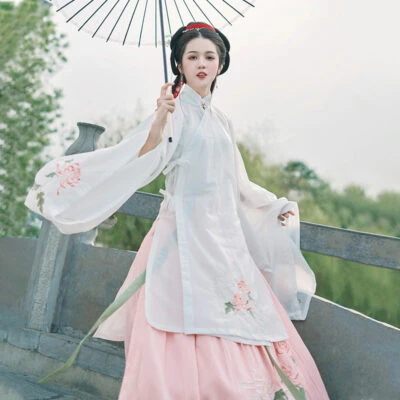
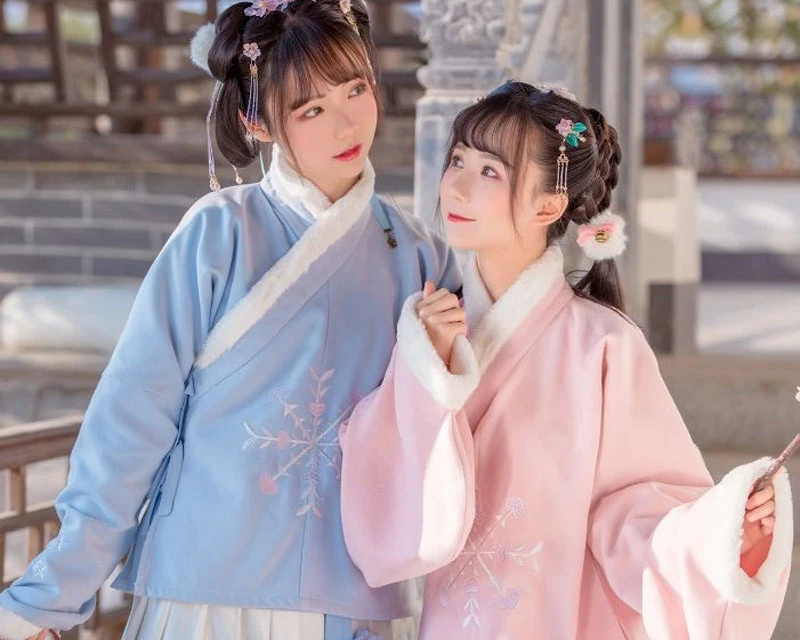
What Is an Aoqun?
An aoqun is a two-piece outfit made of an ao and a qun: a lined jacket worn over a skirt, not tucked into it. The name is literal — ao is the jacket, qun is the skirt. In modern usage the term almost always points to the Ming dynasty form, where the jacket falls outside the skirt waistband and the skirt is usually a mamian or a pleated style.
Two details separate it from other hanfu looks. First, the ao is lined, meaning it has two layers of fabric, while the skirt is typically a single layer. That construction makes an aoqun a cold-weather garment by default, which is why most listings you will see are sold as autumn and winter wear. Second, the pieces are designed to be worn together: the jacket length, the skirt waistband and the placement of the skirt’s decorative bands are set up to read as one silhouette.
You will also see the romanisation written as ao qun, and listings stack the same garment under several names: a Ming dynasty jacket and skirt set, a ming dynasty aoqun, or a ming dynasty hanfu aoqun. All of them point at the same combination.
Aoqun vs Ruqun: The Waistband Rule
The aoqun vs ruqun question has one reliable answer, and it is not about dynasty. It is about where the jacket ends. In an aoqun, the jacket covers the skirt waistband. In a ruqun, the top is tucked into the skirt or stops at or above the waistband, so the waistband stays visible.
That rule matters because both are top-and-skirt combinations and both have been worn for centuries. Ruqun is the broader category and includes the chest-high qixiong ruqun, where the skirt line sits above the bust, and the waist-high qiyao ruqun. An aoqun sits at the natural waist and reads as a jacket over a skirt rather than a blouse tucked into one. If you put a qixiong ruqun next to an aoqun, the difference is obvious at a glance; if you put an aoqun next to a waist-high ruqun, the waistband is the tell.
One caution on terminology: Chinese sources treat aoqun as a general description of a jacket-and-skirt combination rather than a fixed sub-type of ruqun, and they note that a jacket worn outside the skirt was already depicted in Song and earlier murals. The Ming association is real but it is a matter of which version survived and got reproduced, not of invention.
The Jacket: Collar and Sleeve
Ming jackets are recorded in seven collar types, but for buying purposes three do most of the work: cross-collar with a side closure, standing collar, and square collar with a centre opening.
The cross-collar version closes diagonally across the chest and fastens at the side. It is the older of the three and stayed common in the south. The standing collar, called liling, appeared in the mid-Ming, evolved from the straight collar, and became the dominant style in the north by the late Ming — which is why two garments sold as Ming style can look quite different at the neck. The square-collar jacket opens straight down the centre front; a square-collar example was excavated from the Dingling tomb, so it is a documented form rather than a modern invention.
Sleeves follow the same logic. The Ming women’s jacket is usually cut with a pipa sleeve: wide through the arm, gathered in at the cuff, often finished with a contrasting band. Straighter sleeves and archer’s sleeves also exist. Many jackets add a detachable protective collar band at the neck, a practical detail that lets the part touching your skin be washed separately.
Metal buttons, known as zimukou, spread alongside the standing collar and are one reason the late-Ming silhouette closes so high at the throat.
When you look at an aoqun top online, check two things in the photos: whether the opening runs diagonally or straight down the middle, and how high the collar sits. Those two readings tell you more about the cut than the product title usually does. Sellers do not always label the collar type, so ask before ordering if the listing only says Ming style.
The Skirt: Mamian or Pleated
The mamian skirt is the default partner for an aoqun, and its construction is worth understanding because it explains how the garment moves and how it is sized.
A mamian skirt has four flat panels, called skirt doors, arranged front, back and inside. Laid flat you can see three; worn, the panels overlap so only the front and back doors show. Each side between the doors carries the pleats, and the whole thing closes at a waistband with ties. The doors are where the decoration sits, which is why the aoqun pattern you notice first in a photo is usually on the front door and along the hem rather than across the pleats. Sellers who photograph an aoqun hanfu pattern in detail almost always frame the door and the hem band for the same reason.
Door width varies: excavated Ming examples include narrow doors in the 13 to 18 cm range and wide doors around 31 cm. Neither is more correct; they belong to different periods and different garments.
The pleated alternative is a lighter, single-layer skirt gathered into fine pleats. It is the easier piece to wear in warm weather and the cheaper one to replace. Mamian skirts generally use a heavier, more structured fabric because the flat doors need to hold their shape.
The decorative bands, called lan, sit at the knee and at the hem. On earlier Ming outfits with short jackets the knee band was wide and the hem band narrow; as longer jackets came in, the balance flipped and the decoration dropped to the hem. That is a useful dating cue and an even more useful styling cue: a long jacket wants a skirt whose decoration sits low, or the two compete.
One naming note: mamian is a modern term. The structure existed in the Song, but the word only entered costume studies in the late twentieth century, when it was defined as a skirt with flat front and back doors, pleated sides and a waistband. Ming texts simply call it a skirt, or name it by its bands.
Set or Separate, and How the Proportions Work
An aoqun dress is normally sold as a matched set: jacket, skirt and sash together. Buying the pieces separately is possible but demands more attention, because the jacket length and the skirt band placement are designed as a pair.
The proportion rule is simple. A short jacket, ending above the knee, puts the visual weight high and lets a wide knee band carry the decoration. A long jacket covers the knee and pushes interest to the hem, which lengthens the body. If you are buying a skirt on its own to wear with a jacket you already own, match the band position to the jacket length rather than to the skirt’s own photos.
For height, measure from your waist to the floor in the shoes you plan to wear, then subtract two to three centimetres so the hem clears the ground. A mamian skirt that puddles is a photograph skirt, not a walking skirt. Street length, ending at the ankle, is the practical choice for anything involving stairs or public transport.
If you only want the jacket, look for an aoqun top sold separately and check that the length works with a skirt you already own — a long jacket over trousers reads as a coat, which is a legitimate modern look but not the historical one.
Sizing: Two Measurements
An aoqun is sized on two separate measurements, and treating it as one letter size is the most common reason an order arrives wrong.
For the jacket, the two numbers that matter are bust circumference at the fullest point and jacket length from shoulder to hem. Because the cut is loose and often has a dropped shoulder, shoulder width matters less than it does on a fitted top. For the skirt, the numbers are waist circumference at the waistband and skirt length from waistband to hem. A mamian waistband ties and adjusts, so a few centimetres of tolerance is normal; a pleated skirt with elastic gives less control over where it sits.
Do not translate your usual letter size directly. Letter sizing in hanfu varies by seller, and the same S can differ by several centimetres between two listings. Ask for flat measurements of the actual garment — jacket length, bust, sleeve span, skirt length, waist — and compare those against your body plus the ease you want. For a jacket worn over a layer, add room; for a skirt, the waistband measurement is the one to hold firm.
The armspan question comes up with wide sleeves: ask whether the listed sleeve number is a full span across both arms or a single sleeve length, because the two differ by roughly a factor of two.
Fabric, Lining and Season
The lining is the reason an aoqun behaves differently from a summer hanfu set. A lined jacket traps warmth and holds its shape; a single-layer skirt keeps the outfit from becoming heavy at the bottom. That combination is comfortable from autumn through early spring and unpleasant in humid heat.
Cotton is the most common jacket fabric in ready-to-wear versions: breathable, easy to wash, and prone to creasing. Structured brocade and jacquard appear on the skirt, especially on the doors and bands, because those fabrics hold a pattern and a flat plane. Synthetic blends are cheaper and resist wrinkles but trap heat. Historically the jacket could be silk or hemp; hemp creases badly, which is why it survives mostly in the historical record rather than in modern ready-to-wear. Silk versions exist but are a smaller part of the market than the fabric’s reputation suggests.
A practical seasonal read: single-layer jacket with a pleated skirt for spring and early autumn; lined jacket with a brocade mamian for winter, worn with a base layer underneath. If you are buying for a summer event, choose the pleated skirt and skip the lining.
Care follows the fabric, not the label. Brocade should not be wrung or tumble dried, and a mamian skirt needs its pleats pressed back into shape after washing, otherwise the doors stop lying flat.
Wearing It Outside a Photoshoot
An aoqun is one of the easier hanfu shapes to wear in ordinary life, because the jacket reads as a jacket. The full set suits festivals, weddings, tea gatherings and museum visits; the jacket alone over a long skirt or wide trousers works as everyday outerwear without looking like a costume.
The traditional layering options are still the practical ones. A sleeveless vest, bijia, adds warmth without disturbing the jacket’s line; a cloak, pifeng, goes over everything for cold weather. Both are Ming-appropriate and both solve the same problem a modern coat would.
Footwear does more for the look than most people expect. Flat cloth shoes or simple leather flats keep the proportion; heels lengthen the skirt but make the hem drag. Hair does not need reconstruction — a low bun or a single braid is enough, and it keeps attention on the collar, which is the part of the outfit people actually notice.
For colour, the safest modern choice is a single strong tone on the skirt with a quieter jacket. A green aoqun, for example, reads as deliberate rather than costume-like when the jacket is cream or undyed, and it photographs well outdoors without competing with the surroundings. A Chinese aoqun in one strong colour also travels better than a heavily patterned one: fewer pieces to match, and less to explain when someone asks what you are wearing.
Aoqun FAQ
What is an aoqun?
An aoqun is a two-piece Chinese outfit consisting of a lined jacket, the ao, worn over a skirt, the qun. The jacket sits outside the skirt waistband rather than tucked in, and the most commonly reproduced version is the Ming dynasty form, usually paired with a mamian or pleated skirt.
What is the difference between aoqun and ruqun?
The difference is the waistband. In an aoqun the jacket covers the skirt waistband; in a ruqun the top is tucked in or ends at the waistband, leaving it visible. Ruqun is the broader category and includes chest-high and waist-high versions, while an aoqun always sits at the natural waist.
Is aoqun only from the Ming dynasty?
The Ming version is what survives and what most sellers reproduce, but the jacket-over-skirt combination appears in Song and earlier depictions too. The Ming contribution is the specific cut — standing collar, metal buttons, structured mamian skirt — rather than the idea of wearing a jacket outside a skirt.
What is the difference between a mamianqun and a pleated skirt?
A mamianqun has four flat panels with pleats only at the sides and a decorated front and back door, which gives it a structured, panelled look. A pleated skirt gathers the whole width of the fabric into fine pleats, so it is lighter, softer and easier to wear in warm weather.
Does an aoqun come as a set or as separate pieces?
Most aoqun dress listings sell the jacket, skirt and sash as a matched set, and that is the easier way to buy because the proportions are designed together. Separate pieces exist, but then you have to match the jacket length to the skirt’s decorative band yourself.
Should I choose a short ao or a long ao?
Choose short if you want the decoration to sit at the knee and the outfit to feel lighter; choose long if you want a longer line and a hem-level band. If you already own the skirt, follow its band position rather than picking the jacket length first.
What measurements do I need before ordering?
For the jacket, bust circumference and jacket length from shoulder to hem. For the skirt, waist circumference and skirt length from waistband to hem. Ask for flat garment measurements rather than converting your usual letter size, and confirm whether the sleeve number is a full armspan or a single sleeve.
Can I wear an aoqun in summer?
Not the lined version. The jacket has two layers by definition, which makes it a cold-weather garment. For summer, wear the skirt with a single-layer top instead, or choose a lightweight pleated skirt and leave the lined jacket for cooler months.
What goes with an aoqun besides the skirt?
A sleeveless vest, bijia, and a cloak, pifeng, are the period-appropriate outer layers and the most practical ones for cold weather. Flat cloth shoes or simple leather flats keep the proportion, and a low bun or braid is enough to finish the look without reconstruction.
How do I wash and store an aoqun?
Wash the jacket by hand in cool water and dry it flat, since a lined garment loses shape on a hanger. Brush or spot-clean brocade rather than washing it, press the skirt’s pleats back into place while slightly damp, and store the skirt rolled or folded along the pleats so the doors stay flat.




