Was That 1,600-Year-Old Northern Wei Fur Coat the Original ‘Old Money’ Aesthetic? See how Empress Feng (冯) in Jiangshan Datong (江山大同) wore a leopard-trimmed robe that looks just like today’s luxury winter wear—and why it’s not just a fashion cycle, but a 1,600-year-old status code.
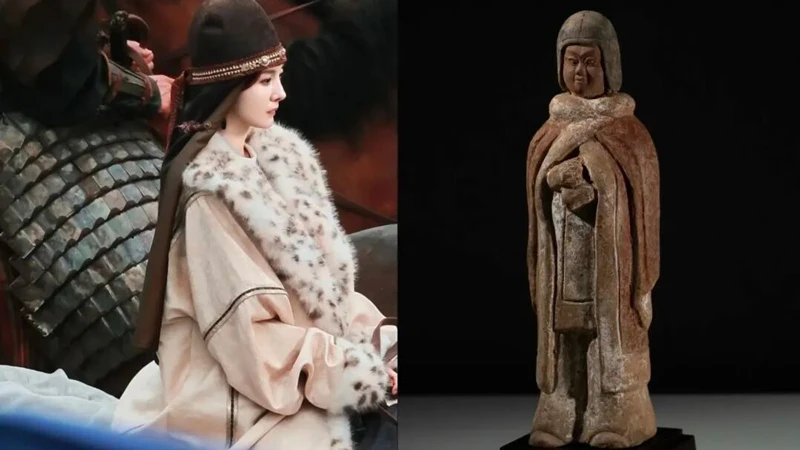
When a recent set of behind-the-scenes images from the historical drama Jiangshan Datong surfaced online, it didn’t take long for fashion watchers to freeze the frame. There stood actress Yang Mi (杨幂) as the young noblewoman Feng, before she became the legendary Empress Dowager of the Northern Wei dynasty. What caught everyone’s eye? A creamy-white fur robe trimmed with leopard-print collar and cuffs. The comment section exploded: “This looks like something a modern billionaire’s wife would wear to a ski resort.” And they weren’t wrong. The robe in the stills isn’t a costume designer’s fantasy. It’s a near-exact visual echo of what Xian Bei (鲜卑) aristocrats wore 1,600 years ago to survive—and dominate—the frozen steppes.
The Xian Bei DNA
To understand that robe, forget “fashion cycle.” Instead, look at survival. The Northern Wei was founded by the Tuoba (拓跋) clan of the Xian Bei, a nomadic people who came from the Greater Khingan Mountains. Winter on the Mongolian plateau could hit minus thirty degrees Celsius. For them, fur wasn’t a luxury; it was a life-support system. Fox, sable, leopard—each hide meant the difference between thriving and freezing. But it also became a rank marker. Not everyone could hunt a snow leopard or trap a sable. A full-length fur coat with a thick, glossy collar was the equivalent of a luxury watch today: you wore your status on your body, literally.
Archaeological finds back this up. At a Northern Wei tomb in Datong, a painted pottery figurine of a robed noble shows exactly the same detailing: fur trim on the collar, sleeves, and hem. That’s the classic Xian Bei silhouette. Another leather coat unearthed in Inner Mongolia, round-collared and made of hide, shows Central Asian influences along the Silk Road. It looks strikingly modern—almost like a 1970s aviator jacket. Yang Mi’s costume in Jiangshan Datong blends both: the Xian Bei love for bold, functional fur plus the flowing, wide-sleeved cut of Han Chinese robes. That mix wasn’t random. It was political.
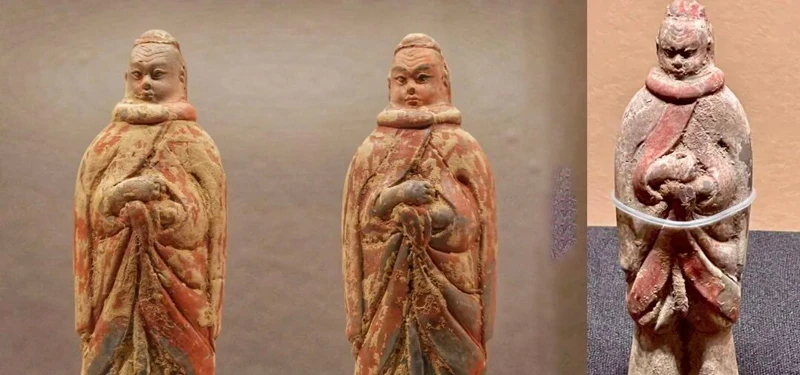
Her character, Empress Feng, lived through that fusion. She started as a low-ranking noble girl, became a concubine at 14, and later ruled as regent for decades. The robe in the images captures a transitional moment: the heavy, practical fur collar of a nomadic warrior tribe, hanging over a soft, draped Han-style gown. It’s not just clothing. It’s a visual handshake between two cultures that were learning to live together.
Frugal Empress, Regal Fur
Here’s where it gets interesting. Historical records describe Empress Feng as famously thrifty. One account says: “She was simple and economical, disliked lavish ornaments. Her robes had no double embroidery; her belt had no gold or jade.” That sounds like a minimalist, not a fur-loving aristocrat. But there’s no contradiction. For a Xian Bei empress, wearing fur wasn’t showing off—it was ritual duty. The court had strict rules on who could wear what kind of pelt, how wide the fur trim could be, and on which garments. Skipping the required fur collar would have been like a modern president refusing to wear a tie to a state dinner: a breach of protocol, not a statement of humility.
So the robe in the stills isn’t about vanity. It’s about identity. At a time when the Northern Wei court was actively promoting Han-Chinese customs—changing Xian Bei surnames, adopting Confucian rites—the fur collar remained a stubborn, proud piece of steppe heritage. It said: we may wear Han robes now, but we still remember where we came from. That tension makes the garment far more than a pretty costume. It’s a political document sewn in cloth and leather.
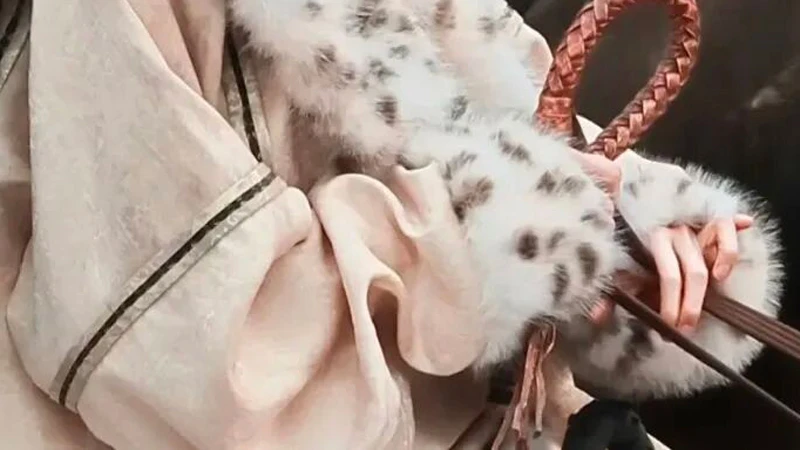
And that leopard trim? It wasn’t just decoration. In Xian Bei culture, specific animals carried specific messages. Leopard fur signaled courage and hunting prowess. It also implied that the wearer had access to the best hunters and the most dangerous territories. Even today, when you see a high-end fur coat with a dramatic leopard-print collar, the subliminal message hasn’t changed: rarity, skill, and a touch of the wild.
Why It Still Works
Now look at any luxury fashion magazine from the last five years. You’ll see the exact same design formula: a clean, solid-colored coat body (often cream, beige, or black) with a big, fluffy, contrasting fur collar. That’s not a coincidence. The Northern Wei aristocrats figured out 1,600 years ago what modern designers know: the human eye loves contrast, and the face framed by a rich, textured collar instantly reads as “wealthy” and “powerful.” No logos needed. The material itself does the talking.
Ancient Chinese texts already documented this. The Book of Songs (诗经) has a line: “Take the foxes and wildcats, make a robe for the noble son.” Even then, fox fur was coded as elite. The Northern Wei codified it further: different grades of officials wore different furs—sable for the highest ranks, lynx or wolf for lower ones. Today, the same hierarchy exists in the fur trade. Russian sable remains the holy grail. The selection criteria haven’t changed either: even hair length, uniform color, and dense underfur. A modern furrier would recognize a Northern Wei noble’s coat as top-tier work.
What about the leopard pattern? A mural from the Northern Qi (齐) dynasty’s Xu Xianxiu (徐显秀) tomb shows a fur coat made from hundreds of silver marten pelts, sewn together to create a spotted pattern. That’s the same “patchwork” aesthetic you see in contemporary designer pieces—think of those multicolor shearling jackets or patchwork fur coats on runways. The ancients were already doing it, not as a gimmick, but because small animals were easier to hunt, and piecing their pelts together created warmth and a distinctive look. Fashion calls it “artisanal craftsmanship” now. Back then, it was just Tuesday.
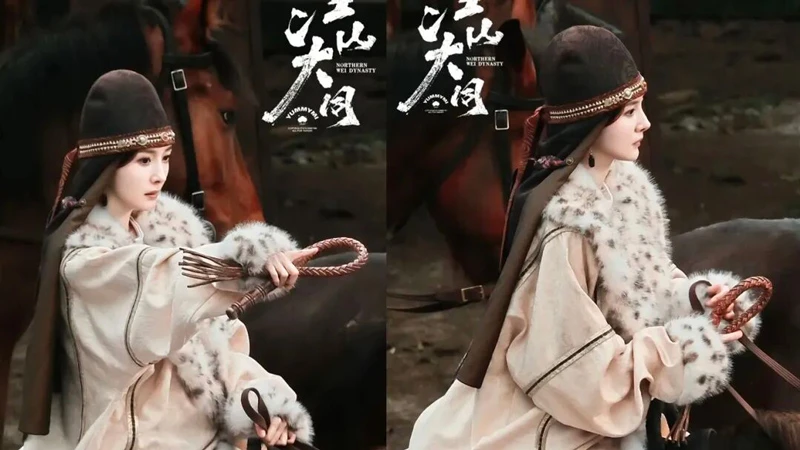
So when Yang Mi’s Empress Feng rides a horse in that fur-trimmed robe, wearing a silver-ornamented Xian Bei hood, she isn’t playing dress-up. She’s stepping into a 1,600-year-old conversation about power, survival, and taste. And the reason modern viewers find it “expensive-looking” and “chic” isn’t because they’ve seen it before in a magazine. It’s because their eyes are wired to recognize the same signals a Xian Bei noble would have seen: rarity, craftsmanship, and a collar that says, “I can afford the best hunter on the steppe.” That’s not a fashion cycle. That’s a hardwired human code. And it never went out of style.