What if the most profound lesson from a classical text wasn't about scholarship, but about the quiet, devastating truth of a teacher’s poverty? In the animated series Sword of Coming 2 (剑来), a moment of humor unravels into a scene of raw emotion, redefining the bond between master and student. The story revolves around a single, seemingly trivial question: why does the classic essay Encouraging Learning (劝学) state that a crab has “six legs and two claws” when everyone knows it has eight?
The answer, delivered not by a scholar but by a tiny incense figure, cuts through centuries of academic debate to reveal something far more personal—a secret of sacrifice that brings a proud man to tears and resonates deeply with viewers.
A Teacher’s Silence
The journey begins years before the main events of Sword of Coming 2. A young man named Cui Chen (崔瀺), who would later take the name Cui Dongshan (崔东山), was once a penniless student traveling with his teacher, the man known simply as the Old Scholar. Their travels were the very definition of a “frugal” education.
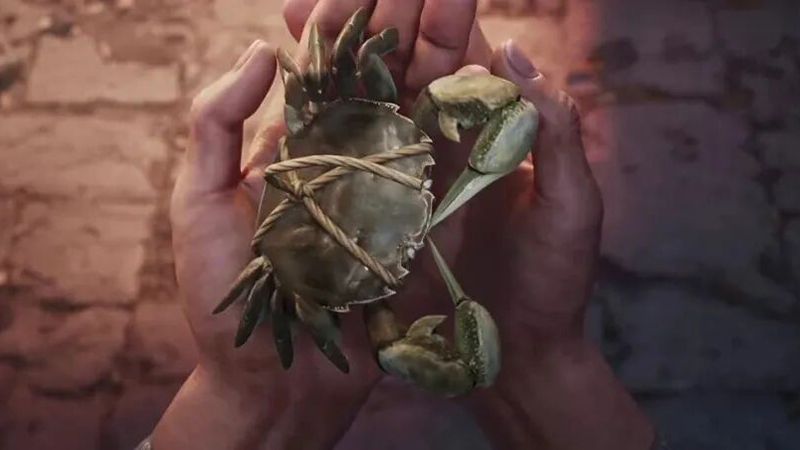
They were often hungry, and the Old Scholar, a man of immense wisdom, was perpetually broke. This period cemented his reputation as the “penniless scholar.” Despite his own empty stomach, the Old Scholar’s devotion to his young disciple was absolute. When he managed to beg for a single crab, he gave it entirely to Cui Chen, not taking a single bite for himself. This act was a silent testament to a love that would later be tested by betrayal.

The dynamic between the Old Scholar and Cui Chen is central to the emotional weight of the story. Years after their time together, Cui Chen would commit an act considered the ultimate transgression in their world: betraying his master. Yet, even in the face of this deep wound, the Old Scholar’s protective instincts never wavered. He embodies the ideal of Wuxia loyalty—the principle of “protecting one’s own.”
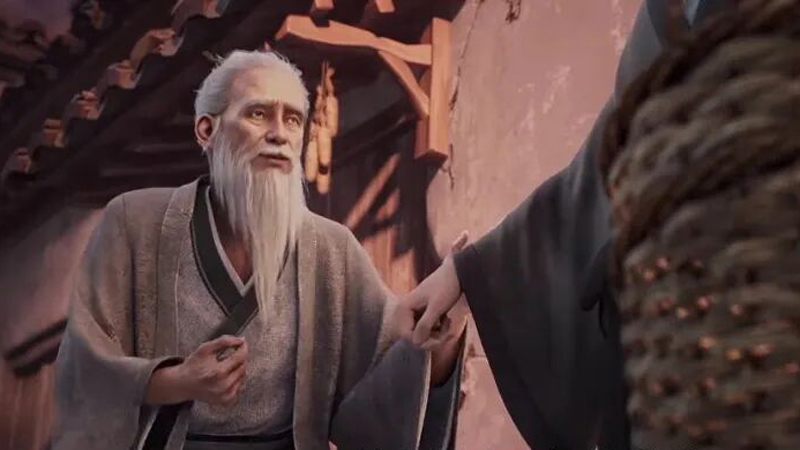
When Cui Chen, now in a new form as Cui Dongshan, faces mortal danger from his new teacher, the swordsman Chen Ping’an (陈平安), the Old Scholar rushes to his side. His concern isn’t for the past betrayal, but for the life of his former student, showing that for a true master, the bond forged in those hungry, wandering days can never be entirely broken.
The Answer That Broke a Man
Before departing, the Old Scholar leaves a final message for Cui Dongshan. It is delivered not in person, but through a small, ethereal being: an Incense Figure sustained by prayers and offerings. The message is a reply to a question Cui Chen had asked in his youth, a question that had likely lingered in his mind for decades. He had wondered about a line from Encouraging Learning by the ancient philosopher Xunzi (荀子): “The crab has six legs and two claws.” The line is famous, but biologically inaccurate. Cui Chen, sharp and meticulous, had wondered if it was a mistake. The Incense Figure, channeling the Old Scholar’s voice, delivers the answer with heartbreaking simplicity: “The Old Scholar was too poor to know any better.”
In that moment, the weight of the past crashes down on Cui Dongshan. The “truth” of the classical text is not a scribal error or a philosophical metaphor. It was a simple fact of his master’s impoverished reality. The Old Scholar, a man of letters, had never seen a crab until that day he begged for one for his student. He had only known the text, and so for years, he had taught the “six legs” as fact.
The answer shatters Cui Dongshan. He first erupts in laughter, a sharp, incredulous sound at the absurdity of it all. But the laughter quickly gives way to uncontrollable tears. This moment of realization is the story’s emotional core. The sacrifice wasn’t just giving away the crab; it was the quiet, lifelong consequence of that poverty—a small, unknowing lie in a revered text, carried by a master for the sake of his disciple.
More Than a Mistake
The revelation resonates powerfully with audiences, mirroring Cui Dongshan’s own tears. In the real world, the phrase “six legs” has been a point of scholarly debate for centuries. Some argue it’s a transcription error, as the characters for “six”and “eight” can look similar in ancient scripts. Others propose the “paddling” theory, suggesting the crab’s two back legs are used only for swimming and don’t count as “legs” for the purpose of the text.
A third view posits that numbers like three, six, and nine were often used in classical Chinese as “empty numbers” to imply abundance rather than a precise count. All these theories offer intellectual closure, but none carry the emotional weight of the story’s answer.
The genius of this scene in Sword of Coming 2 lies in how it uses a tiny, personal history to illuminate a grand, classical text. It takes a line from a 2,000-year-old essay on scholarship and infuses it with a father-son dynamic of poverty, sacrifice, and enduring love. The “error” becomes a testament to the Old Scholar’s character. It’s a reminder that knowledge is often passed down not as pure, objective fact, but through the flawed, beautiful, and deeply human filter of our relationships.
For the audience, the tears are not just for a sad story, but for the profound understanding that some of the most important lessons we learn are not from books, but from the people who gave us their last meal without us ever knowing it. The scene redefines what it means to be a master—not as a flawless font of knowledge, but as someone whose imperfections are born from a complete, selfless devotion.
