What if a single actress could show you, in two photographs, the entire emotional shift of a civilization? This morning, the internet was captivated by Lan Yingying (蓝盈莹) in two sets of Hanfu. One image placed her in the unrestrained, wine-drunk alleys of Tang Dynasty Chang’an; the next, she was a formidable lady of a Ming Dynasty manor, her posture radiating quiet power. It wasn’t just about the clothing. It was a masterclass in how fabric, color, and silhouette can define the very soul of an era. Looking at her, you understand why the aesthetic wisdom of our ancestors remains an untouchable, living legacy—one that has never, and will never, lose its relevance.
The Tang in a Sleeve
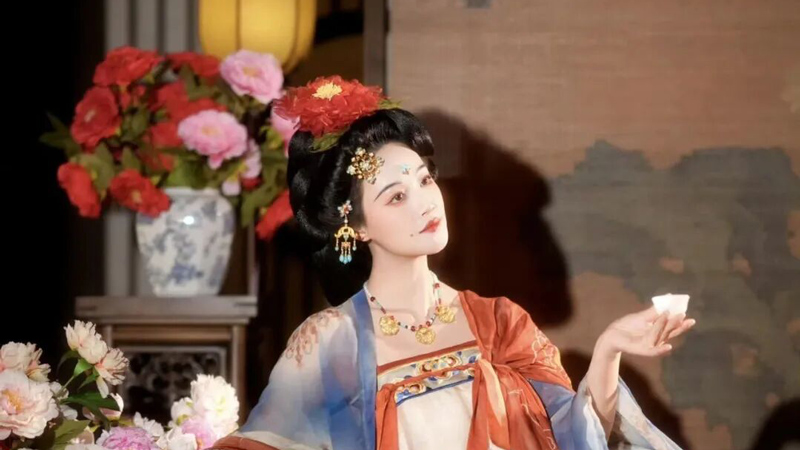
In the first image, Lan Yingying becomes a figure plucked directly from a painting—specifically, Court Ladies Adorning Their Hair with Flowers (簪花仕女图). She wears a gradient robe of blue and red, the wide sleeves of the Da Xiu Shan (大袖衫) paired with a chest-high Qixiong Ruqun (齐胸襦裙). A large peony is pinned in her hair, a delicate Hua Dian (花钿) adorns her forehead, and she holds a small wine cup. It is an image of pure, unbothered opulence. You can almost hear the laughter and the spontaneous poetry recitals of Chang’an’s taverns, a testament to the dynasty’s open, cosmopolitan spirit.
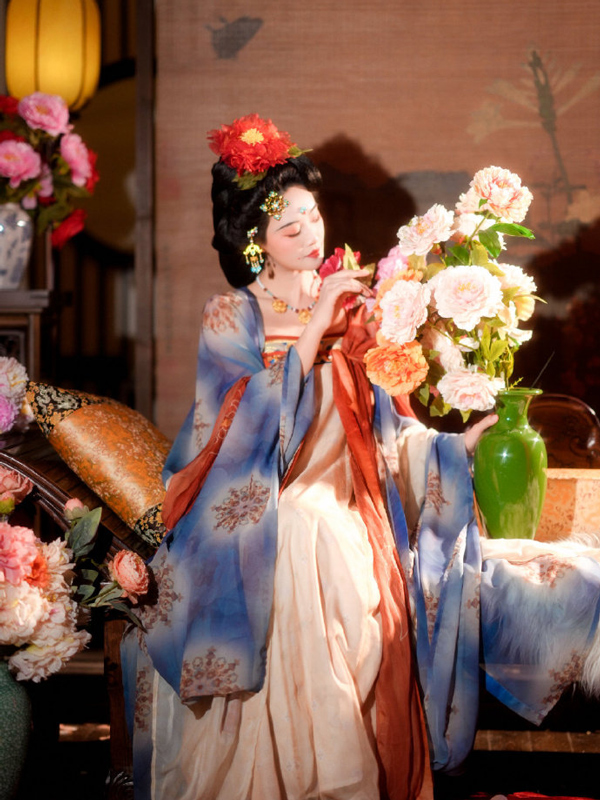
What makes this interpretation so compelling is the movement. The sleeves aren’t just wide; they are sculptural, designed to catch the wind and create a sense of flight. The silhouette is unapologetically expansive, reflecting a society that celebrated boldness and excess. This wasn’t merely fashion; it was a declaration of freedom. Lan Yingying doesn’t just wear the clothes; she embodies the physicality of a Tang aristocrat—a languid tilt of the head, a casual grip on the cup—making the aesthetic feel less like a costume and more like a state of being.
The Ming in the Stitch
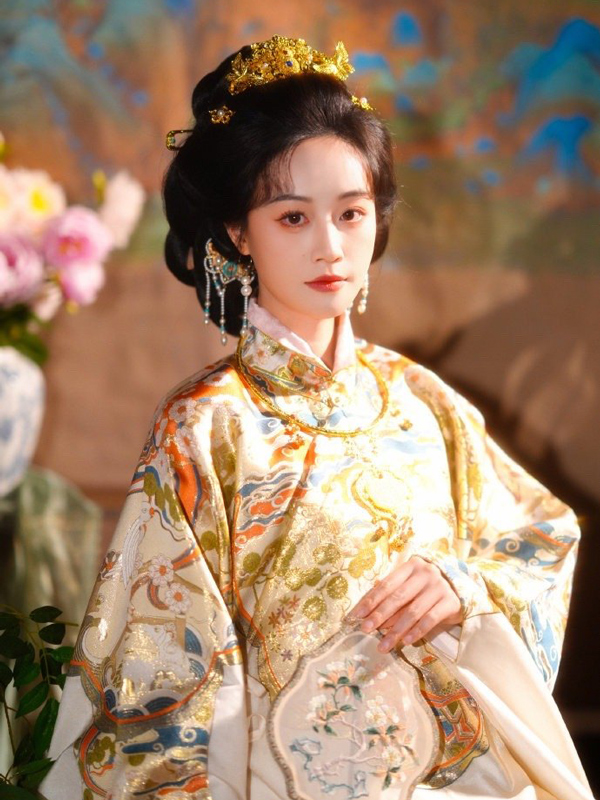
The transition is stark. In a moment, she shifts from the bustling streets of the Tang to the structured courtyards of the Ming Dynasty. Here, she is encased in a vertical, intricate Liling Chang’ao (立领长袄) with gold-woven Zhuang Hua (妆花) brocade, paired with a stunning Ma Mian Qun (马面裙). A golden crown and elaborate earrings frame her face. This is a lady of a grand Jiangnan household—her beauty is a fortress, her closed fan a symbol of unapproachable sophistication. Every line is crisp, every detail deliberate.
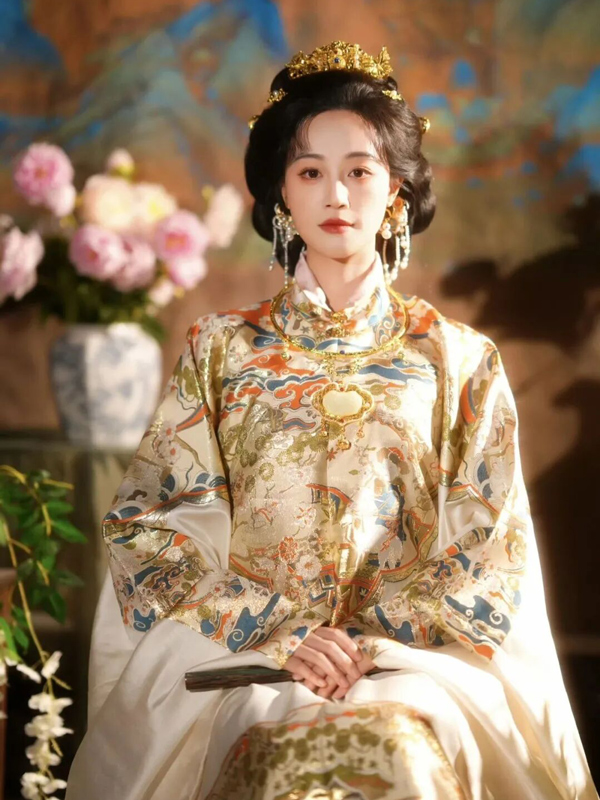
If the Tang aesthetic was about outward expression, the Ming was about inward control. The high collar and structured shoulders demand a certain posture: a straightened spine, a measured gait. The richness is in the texture and the hidden details, a wealth that speaks without shouting. It’s the confidence of a long-established lineage. Lan Yingying captures this dichotomy perfectly. In her hands, the Hanfu isn’t just “ancient clothing”; it becomes a biography of a woman, revealing whether she lived in an era of outward revelry or one of refined restraint.
Why It’s Never Just a Costume
For many, the perception of Hanfu stops at “pretty photography.” But seeing these two distinct interpretations side-by-side shatters that shallow view. The Tang robe is a celebration of life, its wide sleeves mirroring the silk roads that brought the world to its doorstep. The Ming attire is a statement of resilience, its intricate patterns a testament to a culture that had matured into an unparalleled sophistication. Lan Yingying’s performance—for it is a performance—reminds us that these clothes carry the DNA of their time.
It forces a realization: this is not a revival of “old” things, but a reclamation of a continuous aesthetic lineage. When she dons the Tang robes, she embodies the dynasty’s spirit of inclusivity; in the Ming attire, she reflects an era of intricate craftsmanship and social structure. The beauty is not superficial; it is intellectual. It’s a reminder that Chinese aesthetics have always been at the forefront, evolving with the emotional needs of its people. Looking at her, the statement becomes undeniable: this beauty was never a fleeting trend. It is a legacy, worn with pride, and it remains undefeated.
