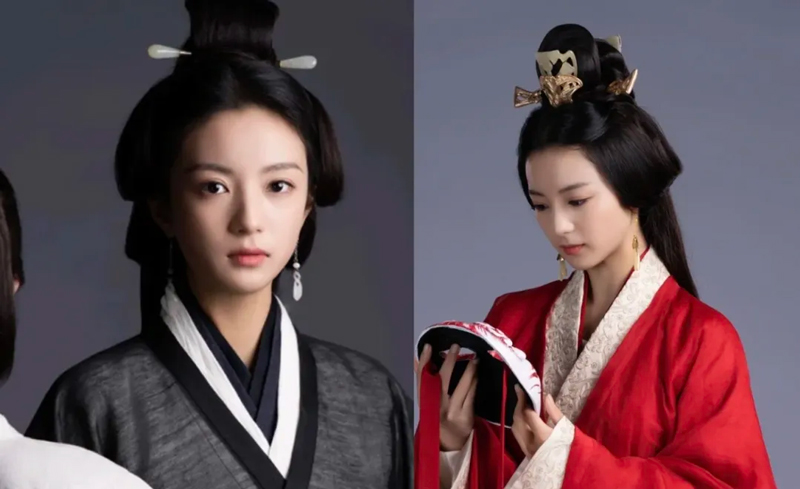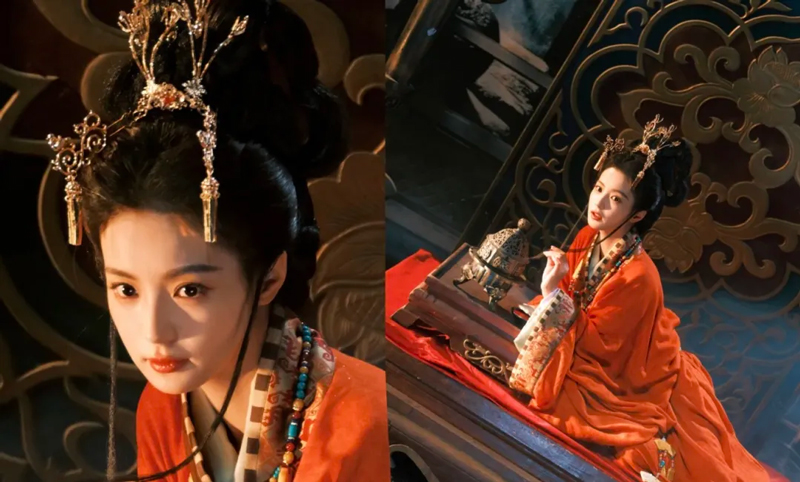
When actress Zhang Yaqin (张雅钦) recently appeared in a Hanfu ensemble, the internet divided. For some, it was an immediate callback to her role as Lu Yuan (陆鸢) in the time-travel drama An Ancient Love Song (古相思曲). For many others, the look missed the mark, feeling disjointed and overly busy. Why did this particular outfit, rich in historical references, fail to resonate? The answer lies not in a lack of beauty, but in a collision of eras. Her styling became a textbook case of how mixing distinct historical aesthetics without a unifying vision can create visual confusion, pulling the observer out of the immersive fantasy such clothing aims to build.
Historical Harmony Lost
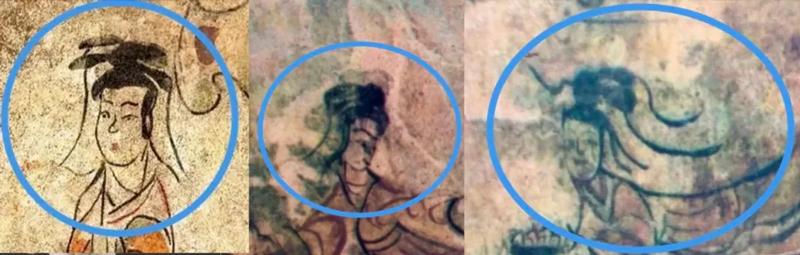
The most striking issue is the temporal dissonance. Her hairstyle is a Shuang Huan Wang Xian Ji (双鬟望仙髻), a high, twin-loop style popular during the Wei, Jin, and Northern and Southern Dynasties, often seen in deity and court lady paintings. This ethereal look was complemented by dangling side locks, or Chui Shao (垂髾), enhancing the otherworldly vibe. However, the hairpins tell a different story. She wore two styles of Buyao (步摇), or step-shakers. One was a Western Han design, its dangling beads meant to sway gently with movement, embodying a reserved elegance. The other was a Wei-Jin style, shaped like a flowering tree with leaf pendants, often incorporating foreign-inspired animal motifs.
The garment itself pulled from an even earlier period. It was a Zhiju Pao (直裾袍), a straight-robe style from the pre-Qin era, characterized by a cross-collar, enormous fabric volume, a trailing hem, a wide belt, and distinctive Chuihu sleeves (垂胡袖). Modern versions often replicate robes from the Mawangdui Tomb (马王堆墓). The excessive fabric creates natural, flowing lines and, due to layering, necessitates a wide neckline. Each element, from hair to robe, is historically grounded but from vastly different centuries.
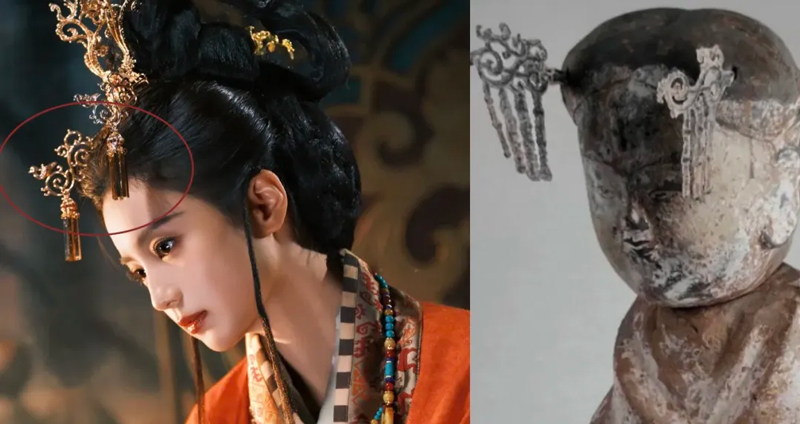
The final layer was the makeup—delicate willow eyebrows and a modern base. While Zhang Yaqin possesses classically elegant bone structure, the makeup did not bridge the gaps between the clashing elements. It felt generic, failing to tailor a distinct persona for this specific amalgamation of styles. In contrast, her styling in An Ancient Love Song, while not flawless, succeeded through consistency, maintaining a unified Han aesthetic that served the character and the story’s atmosphere.
Two Paths Forward
This incident highlights a central tension in the contemporary Hanfu movement. Today, two primary approaches coexist: historical accuracy and fashionable adaptation. The first path is one of scholarly revival and meticulous reconstruction, treating historical garments as cultural artifacts to be understood and replicated. Adherents study textiles, patterns, and documented styles from specific dynasties, aiming for educational and cultural preservation. The second path embraces Hanfu as living fashion, adapting cuts, colors, and elements for daily wear and modern sensibilities, prioritizing aesthetics and personal expression.
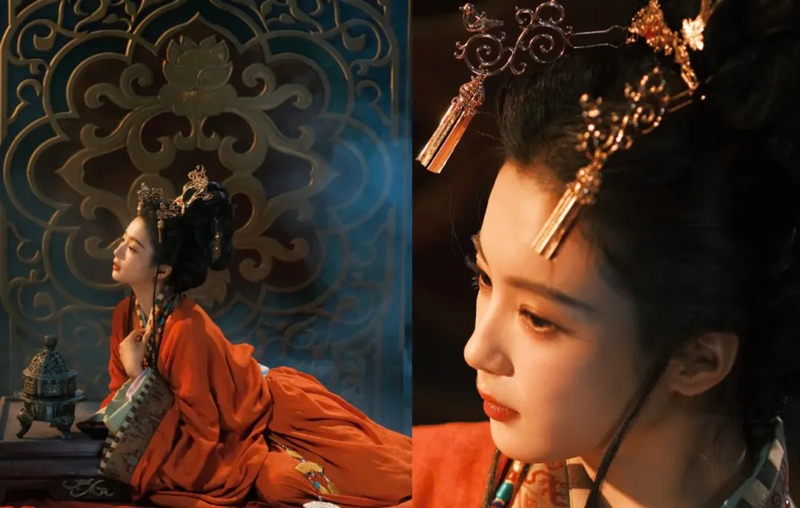
Both approaches play valid roles in cultural propagation. Accurate reconstructions offer a tangible link to the past, while modern adaptations ensure the tradition remains vibrant and relevant. The controversy around Zhang Yaqin’s outfit stems from occupying a murky middle ground. It wasn’t a faithful reconstruction of any single period, nor was it a conscious, cohesive modern design statement. It was an aesthetic collage, where elements were combined primarily for visual impact, arguably diluting the cultural narrative each piece carries.
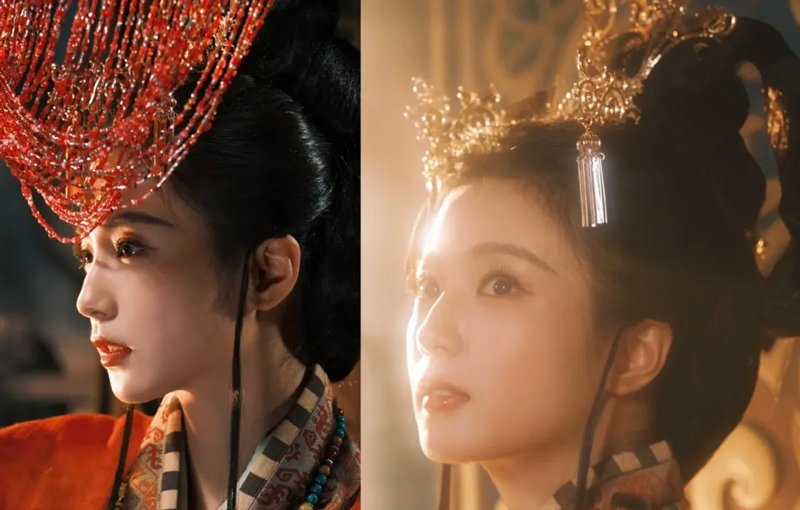
This raises a question for observers and wearers alike: What is the intent behind the outfit? Is it an homage to history, a personal fashion experiment, or a blend of both? There is no absolute right or wrong, but the goal shapes the outcome. As one netizen commented, personal styling is a free choice, provided it doesn’t mislead culturally and the hybrid nature is acknowledged. The key is intentionality—understanding the origins of what one wears and making conscious choices, whether for depth of history or sheer delight in design.