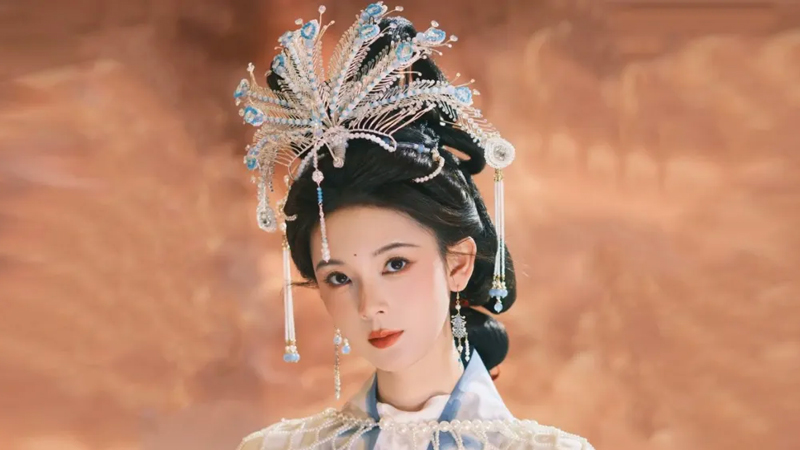
Many viewers who grew up watching Chinese costume dramas recall the grand Phoenix Hairpins. These are ornate hairpieces made of gold, silver, or velvet flowers, and they often adorned characters like queens or noblewomen. These pieces were so luxurious that people often wondered: Why have such grand hairpins become rare in today’s costume dramas?
The answer lies in evolving aesthetics and character design. Each generation has its own taste, but hairpieces must serve character portrayal and match actors’ features. Older Phoenix Hairpins suited the rounder face shapes common among actors in the past, while today’s preference for "white, young, and slim" aesthetics makes such large hairpieces less flattering on modern actors.
The Most Memorable Phoenix Hairpin: Wang Xifeng

The most iconic Phoenix Hairpin comes from A Dream in Red Mansions (红楼梦). When Wang Xifeng, a feisty noblewoman, first appears in Chapter 3, she wears a "gold-thread eight-treasure pearl bun" and a "sunrise five-phoenix pearl hairpin". Imagine five phoenixes each holding a string of pearls, with a large bead or mirror in front to mimic sunlight — the craftsmanship is breathtaking.

The "gold-thread eight-treasure pearl bun" is actually a Diji (䯼髻), a metal hair frame shaped like a steamed bun, often inlaid with precious stones. According to Imperial Revised Qing Dictionary (御制增订清文鉴), it was a traditional Han women’s hairpiece.
Grand Phoenix Hairpins in Classic Dramas

Even simplified versions of Ming-style Phoenix Hairpins still showcase luxury. Some classic pieces drew inspiration from cultural relics — like the gold-thread phoenix hairpin unearthed from the tomb of Prince Liangzhuang of the Ming Dynasty, whose craftsmanship remains unmatched today.

Creative adaptations also existed. For example, the Queen of the Women’s Kingdom in Journey to the West wore a velvet flower Phoenix Hairpin made using the intangible cultural heritage technique from Jiangsu. Though less glittering than gold ones, it exuded a soft, elegant charm.
How Phoenix Hairpins Were Worn
Phoenix Hairpins had specific wearing rules. The "upright style" was for formal occasions: placed in the center of the bun, it symbolized dignity. In the late Ming Dynasty, it even replaced phoenix crowns as formal headwear. The "side style" was for daily use — smaller, more casual, and easier to match with everyday outfits.
Once a status symbol that elevated any look, grand Phoenix Hairpins are now replaced by headbands in most dramas. Many viewers miss the old designs: "I used to envy those tasseled Phoenix Hairpins as a kid, but they’re harder to find now. Even if we can’t have the exact ones, why not make similar alternatives?"