
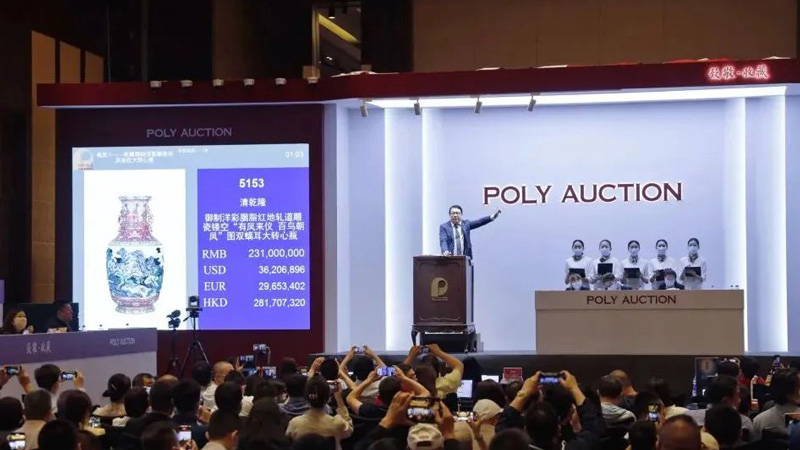
In the hushed, high-stakes auction rooms of Hong Kong and Beijing, a specific type of artifact consistently commands breathless attention and record-shattering bids. The names are poetic—a "Gourd Vase with 'Longevity' Design," a "Revolving Vase with Dragons," and a "Phoenix and Hundred Birds Vase." The prices are astronomical, soaring past hundreds of millions. The common thread weaving through these sales isn't just the Qianlong era; it's a specific, dazzling technical achievement: Yangcai (洋彩), or "foreign colors."
This isn't just porcelain. It's a story of imperial ambition, a virtuoso craftsman, and a unique moment of East-West fusion, frozen in glaze and fired to perfection. So, what is the secret code that makes Qianlong (乾隆) Yangcai the undisputed emperor of the auction world?
The Master & The Monarch: A Partnership For The Ages
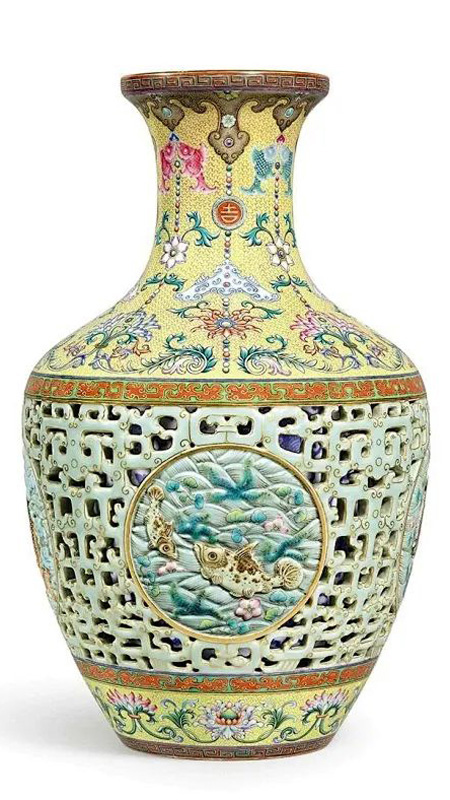
The story of Yangcai is inextricably linked to two men: the Qianlong Emperor, one of China's most powerful and artistically ambitious rulers, and Tang Ying (唐英), his genius Superintendent of Pottery.
Tang Ying wasn't just a bureaucrat; he was a visionary artist and technologist. Stationed at the imperial kilns in Jingdezhen (景德镇), he personally oversaw the creation of the emperor's wares. Under constant pressure to innovate and impress, Tang pushed ceramic technology to its absolute limits. He pioneered mind-bogglingly complex techniques—vases with revolving inner layers, intricate openwork carving, and vessels with multiple, independently moving parts. The Qianlong Emperor himself was so astonished by the difficulty of these creations that he advised Tang to produce them only in small batches, noting their extreme complexity.
This royal patronage was crucial. The emperor didn't just want vases; he wanted technical marvels that reflected the glory and sophistication of his reign. Tang Ying delivered, and in doing so, he gave his name a permanent place in art history. The quality of porcelain produced under his direct supervision was so high that it was never replicated after his tenure, making early Qianlong pieces the undisputed peak of the craft.
The Technique
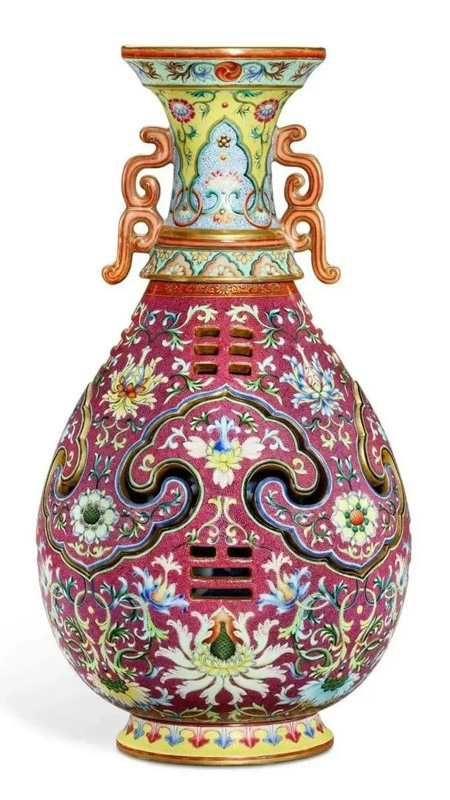
If there's one technical innovation that defines Yangcai, it is the Jin Shang Tian Hua (锦上添花), or "adding flowers on a brocade ground" technique. This wasn't just painting; it was an act of microscopic sculpture.
Artisans would first create an incredibly dense, intricate background pattern—a "brocade" of interlacing lines, tiny spirals, or honeycombs. This was often achieved through yadao (轧道), a technique of incising the pattern into the unfired glaze with a sharp tool, a painstaking process requiring immense skill to avoid errors.
Onto this complex, three-dimensional ground, they would then paint the main motifs—blooming peonies, swirling dragons, or playful birds. This created an overwhelming visual feast of texture and depth, a testament to an almost superhuman level of craftsmanship. The effect is one of opulent, luxurious density, with not a single millimeter of the surface left undecorated.
A Unique East-West Fusion
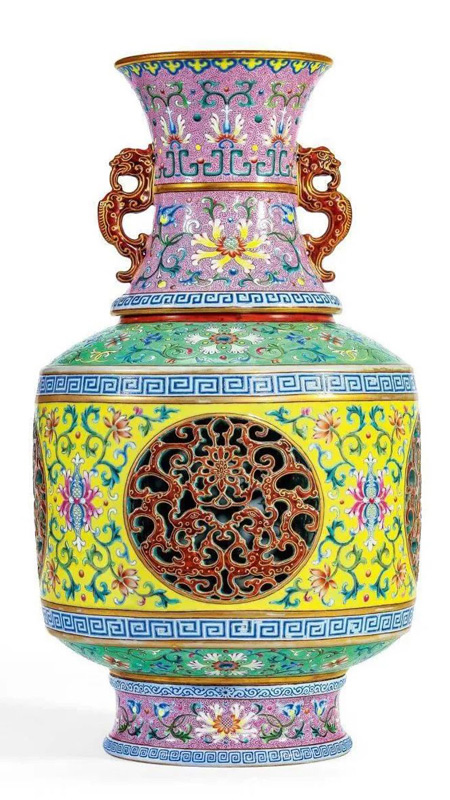
The "foreign" in Yangcai is deliberate. The term was first used by Tang Ying himself to describe a "new method of imitating Western painted enamels." But this was not mere imitation. It was a sophisticated adaptation.
Western missionaries in the Qing court brought with them the visual language of the European Renaissance: chiaroscuro (the play of light and shadow), perspective, and a more naturalistic approach to rendering flora and fauna. Chinese artists adopted these concepts but filtered them through their own sensibilities.
On a Yangcai vase, you can see white enamel used to highlight petals and leaves, creating a sense of volume. Flowers recede into the background, suggesting depth. This fusion is what sets Yangcai apart. It’s a Chinese artistic spirit expressed with a borrowed Western visual vocabulary, creating something entirely novel and breathtaking. It represents a brief, brilliant moment of cultural exchange before a turn toward isolation.
The Ultimate Driver: Extreme Rarity
Perhaps the most straightforward reason for their astronomical value is their breathtaking scarcity. These were not commercial products; they were the pinnacle of imperial production, made exclusively for the emperor.
Every single piece was personally approved and often meticulously catalogued by Qianlong himself. The finest examples were stored in special boxes in the innermost sanctums of the Forbidden City. The majority that survived wars and upheavals now reside in major museum collections like the National Palace Museum in Taipei.
The pieces that appear on the market are extreme rarities—often from old European collections or other well-documented provenance. When one emerges, it represents a once-in-a-generation opportunity for a collector to own not just a vase, but a definitive masterpiece from the absolute zenith of Chinese ceramic art. In the world of collecting, where the ultimate trophies are defined by quality, provenance, and historical importance, Qianlong Yangcai checks every box. It is, quite simply, the best of the best.
