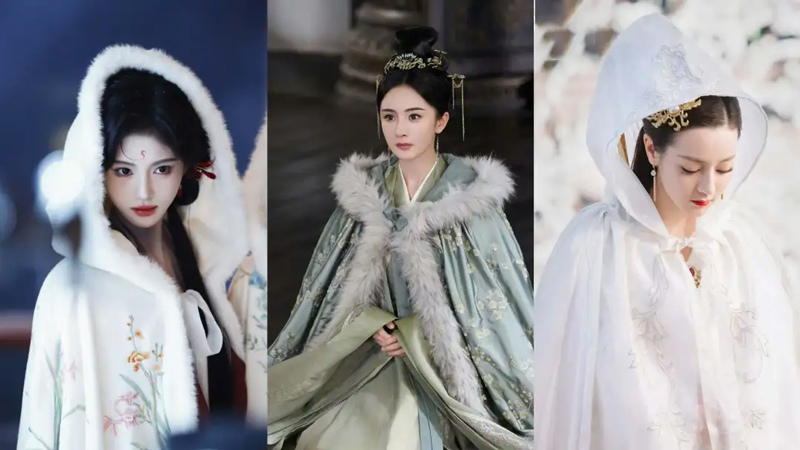
From celestial beings in fantasy epics to noblewomen in palace intrigues, one costume piece silently reigns supreme: the hooded cloak. This garment, seemingly simple in design, has become an indispensable visual shorthand across Chinese historical film and television. Its sweeping presence raises questions – is this a nod to historical authenticity, a practical filmmaking choice, or pure aesthetic enchantment? The answer weaves together threads of function, symbolism, and modern creative license, transforming the hooded cloak into far more than just a covering.
Power, Mystery, and Practicality on Screen
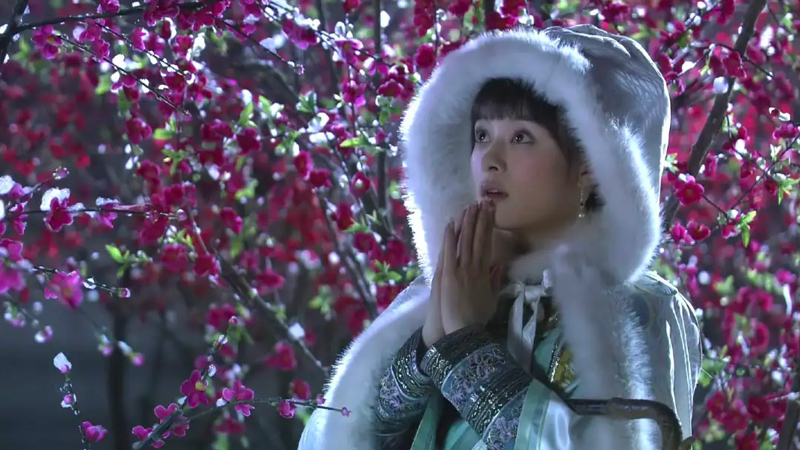
In Zhong Kui: Snow Girl and the Dark Crystal (钟馗伏魔:雪妖魔灵), the snow spirit Xue Qing (雪晴), portrayed by Li Bingbing (李冰冰), glides through icy landscapes enveloped in a pale blue hooded cloak adorned with intricate snowflake embroidery and fur lining. This exemplifies one core function: elemental protection. The cloak shields her from the biting wind and snow, a practical barrier against harsh weather. Similarly, in the acclaimed series Empresses in the Palace (甄嬛传), the protagonist Zhen Huan (甄嬛) dons a light-colored hooded cloak for discreet warmth during a nighttime visit to the Plum Garden. It allows her to move outside undetected while staying comfortable.
Beyond warmth, the hooded cloak serves as the ultimate tool for anonymity. Its deep cowl casts shadows over the wearer's face, while the voluminous fabric obscures the body's outline. This transformative power is used strategically in Creation of the Gods I: Kingdom of Storms (封神第一部:朝歌风云). When the hero, Ji Fa (姬发), visits his imprisoned father in the dungeon, he wears a dark hooded cloak. Only upon revealing himself to his father does he lower the hood, using the garment to conceal his identity until the crucial moment.
Variations exist within this screen staple. While many are single-piece designs with attached hoods, some dramas feature detachable styles. The classic 1987 adaptation of The Dream of Red Mansions (红楼梦) showcases characters like Lin Daiyu (林黛玉) and Xue Baochai (薛宝钗) wearing matching capes and separate hoods.
Unveiling Historical Reality
Contrary to their screen ubiquity, historical evidence reveals that traditional Chinese Dou Peng (斗篷) were predominantly hoodless. Scholars trace their origins back to garments like the Jin Dynasty's ”He Chang” (鹤氅), a heavy, sleeveless outer coat often decorated with crane feathers for winter warmth.
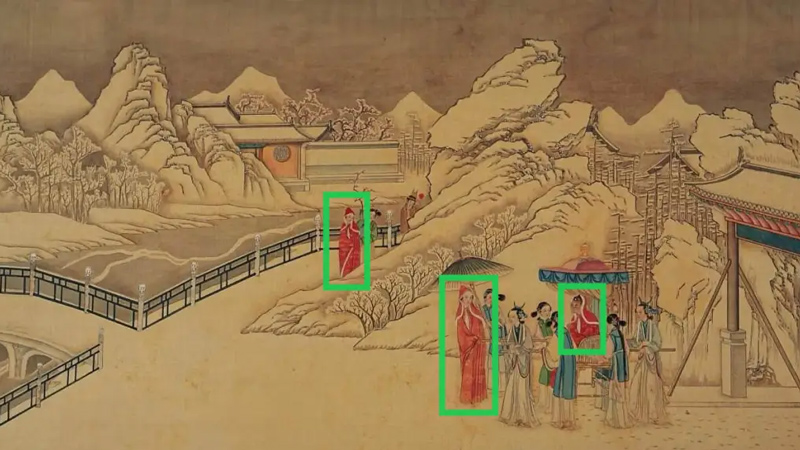
By the Ming and Qing dynasties, the term "Dou Peng" became commonplace in literature, most notably Cao Xueqin's (曹雪芹) The Dream of Red Mansions. This novel vividly describes cloaks worn by the elite residents of the Grand View Garden. Illustrated editions like the Qing Dynasty Qing Caihui Quanben Honglou Meng (清彩绘全本红楼梦) detail their form: sleeveless, ankle-length, featuring either no collar or a standing collar, opening down the front, and worn draped over the shoulders. Their bell-like silhouette earned them nicknames like "Yi Kou Zhong" (One Mouth Bell) or "Yi Guo Yuan" (One Wrap Round).
Crucially, hoods were separate accessories with specific names: "Guanyin Hood", "Warm Hood", or "Soft Scarf Hood". The novel explicitly describes characters wearing cloaks and hoods together, like Grandmother Jia shielded by a large cloak and a squirrel-fur Nuan Dou during snowy outings.
A Global Garment Reimagined
While modern Chinese dramas often imply hooded cloaks are Western imports, historical Western capes were also largely hoodless. Ancient Greece utilized the Himation, a large rectangular woolen wrap draped over the body and sometimes pulled over the head for protection or mourning – a makeshift hood rather than an integrated design. During the Gothic period (13th-15th centuries), cloaks became highly stylized, influenced by architecture, appearing in varied lengths and silhouettes (A-line, H-line, slender). Yet, illustrations and records show hoods remained distinct, detachable items.
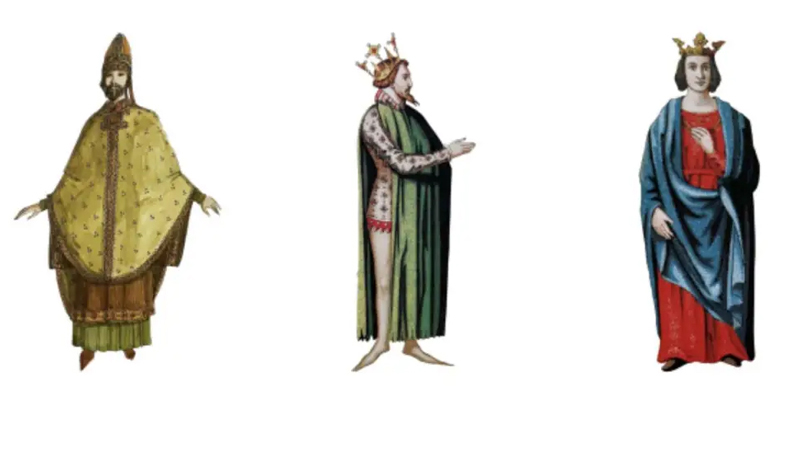
One exception was the short shoulder cape called the Mozzetta, worn by certain clergy, which sometimes featured a small attached hood. However, this was a specialized garment, not widespread secular wear. The consistent portrayal of hooded cloaks seems rooted more powerfully in Western literature than historical fact.
The hooded cloak dominating today's Chinese historical dramas is ultimately a modern cinematic invention. Costume designers have synthesized elements: the flowing elegance of the Chinese Dou Peng, the dramatic concealment offered by literary hoods, and the practical advantages of a unified garment for quick character transformation on set. It satisfies visual storytelling needs – conveying status, mystery, or environmental challenge – while offering logistical ease for actors and crew. This fusion creates an instantly recognizable icon, a piece that feels simultaneously ancient and freshly dramatic, proving its enduring power to captivate audiences on screen.