
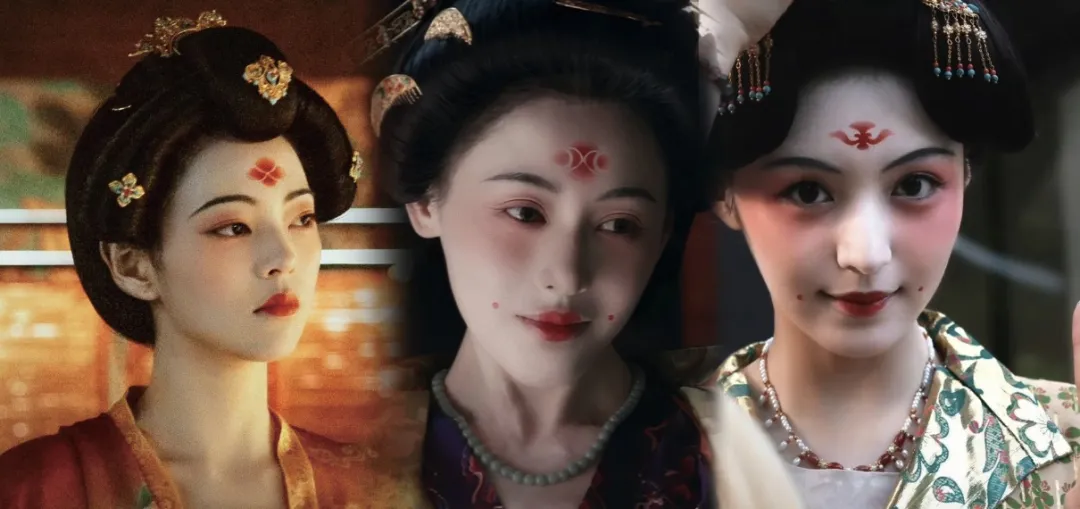
The Tang-style makeup and hairstyles nowadays indeed seem different from before. You may wonder why there are such obvious red patches on their faces, even to an exaggerated degree. Actually, this is a kind of classical makeup called 'Jiuyunzhuang' (酒晕妆). As the name implies, it resembles the blush after getting drunk. The bold 'red makeup' became the mainstream of facial makeup as women became more confident and independent. It was extremely popular, with many noble ladies applying rouge to their entire cheeks, including the upper eyelids, half of their ears, and the lower jaw.
This boldness and preference for red was a popular makeup style during the reign of Empress Wu Zetian and the prosperous Tang Dynasty (even until the Five Dynasties), which was rare in other dynasties. 'Zhuangtaiji' (妆台记) clearly states, 'For a beauty's makeup, after applying powder on the face, mix rouge in the palm and apply it to both cheeks. The thick one is called Jiuyunzhuang; the light one is 'Taohuazhuang' (桃花妆); applying a thin layer of red and covering it with powder is 'Feixiazhuang' (飞霞妆).' It's evident that 'Jiuyunzhuang' is the most extreme one, also known as 'Yunhongzhuang' (晕红妆) and 'Zuizhuang' (醉妆).
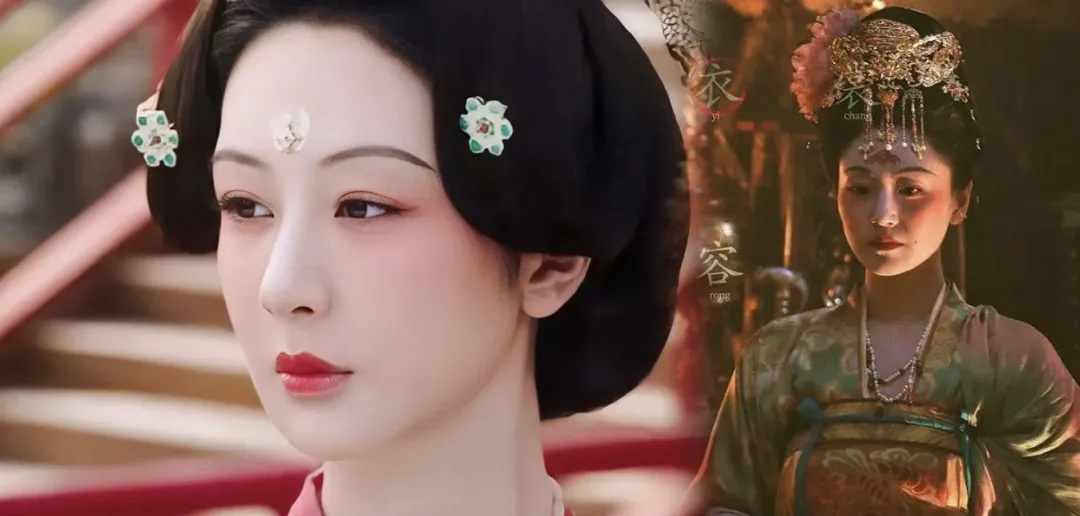
In Tang Dynasty paintings of ladies, the 'Jiuyunzhuang' on the ladies' faces mostly extends to the eyebrows and lower jaw. This color is called 'Wozhe color' (渥赭色) in traditional Chinese colors, an old red. In Chinese painting, ochre can be made by mixing Zhubiao with ink. The idiom 'Heruwozhe' means a person's face is rosy, like being dyed with a thick layer of cinnabar.
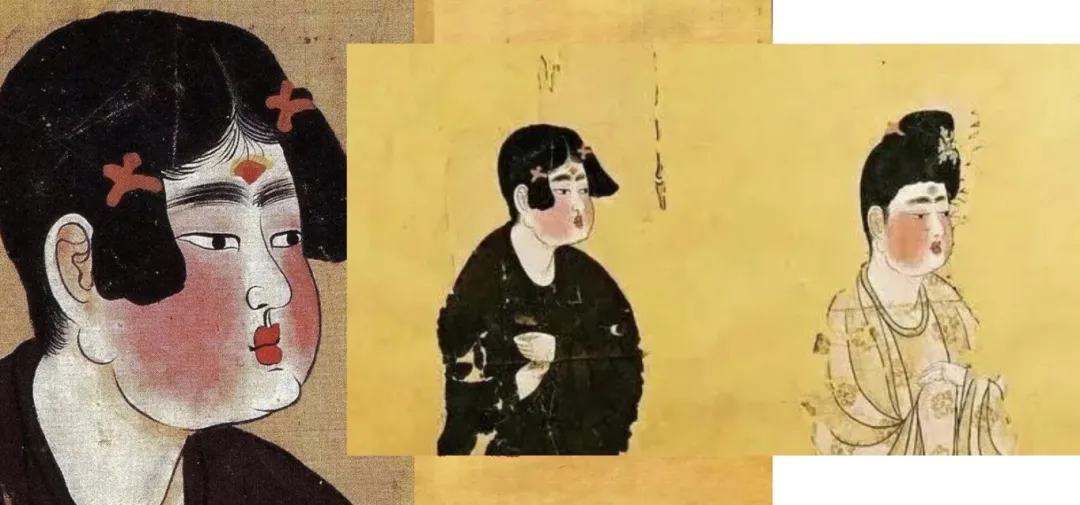
Some people interpret the most prominent feature of classical makeup as'red makeup'. Using'red' to describe the characteristic of classical makeup makes sense. Although it seems like heavy makeup today, it was a contouring method back then. Red makeup has two functions. One is to make the skin tone look healthier and rosier, and the other is to fill the blank areas of the face, making the whole makeup more atmospheric and fuller.
In the middle of the prosperous Tang Dynasty, thick eyebrows paired with 'Jiuyunzhuang' once emerged. It may be hard for modern people to accept, but the main function of this makeup is to make the woman look very healthy, plump, and unique.
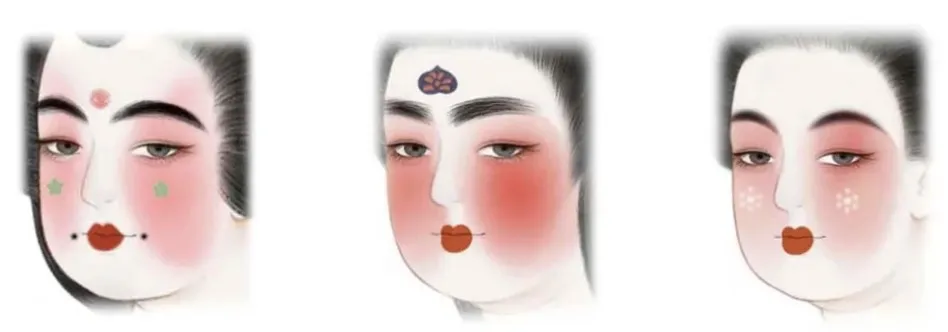
In the Tang Dynasty's makeup steps: applying foundation ➡️ applying rouge ➡️ shaping eyebrows ➡️ applying lipstick ➡️ pasting Huadian (花钿) and dotting Mianye (面靥) ➡️ drawing Xiehong (斜红) (the order of the makeup part can be adjusted, with different versions), applying rouge is the most important part of the red makeup, similar to our modern step of applying blush. Many people skip the blush step in modern makeup, thinking it's too bright and not suitable for daily use. It's just that we don't understand it well and can't handle it properly.
The importance of red makeup can be seen from its later annotations. Red makeup is called a woman's grand makeup and also generally refers to 'beautiful women'. Some literati also use it to describe fully - bloomed flowers, which shows its extended meanings. Actually, from 'a woman beautifies herself for the one who appreciates her' to 'living for herself' is a process of a woman blooming like a flower.
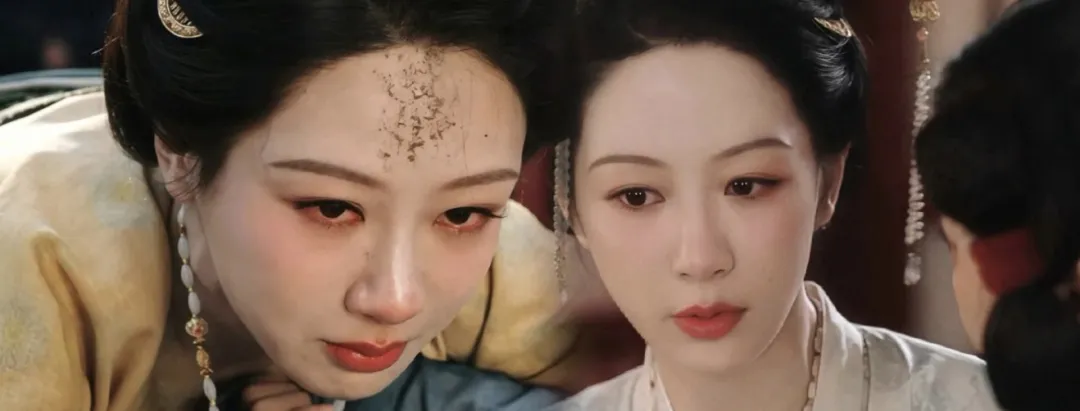
However, the suitability of this red makeup for different people should be considered. Nowadays, actors are generally too thin, and such large - area red makeup makes their faces look swollen, having the opposite effect. For example, Yang Zi's red makeup in the drama 'Guose Fanghua' was obviously not as suitable as Zhang Yaqin with a round face.
A slightly lighter blush would be more appropriate. For modern makeup reference, we don't need to make it so red. But appropriately spreading the blush can add a classical charm to the overall makeup and also fill and modify the face shape. It's also a makeup technique. The makeup transformation of Lu Yuxiao and others mainly used this 'atmospheric' makeup method. Of course, this technique is suitable for women with more blank areas on their faces. If you already have a small face, don't over - makeup. It's better to do subtraction rather than addition.
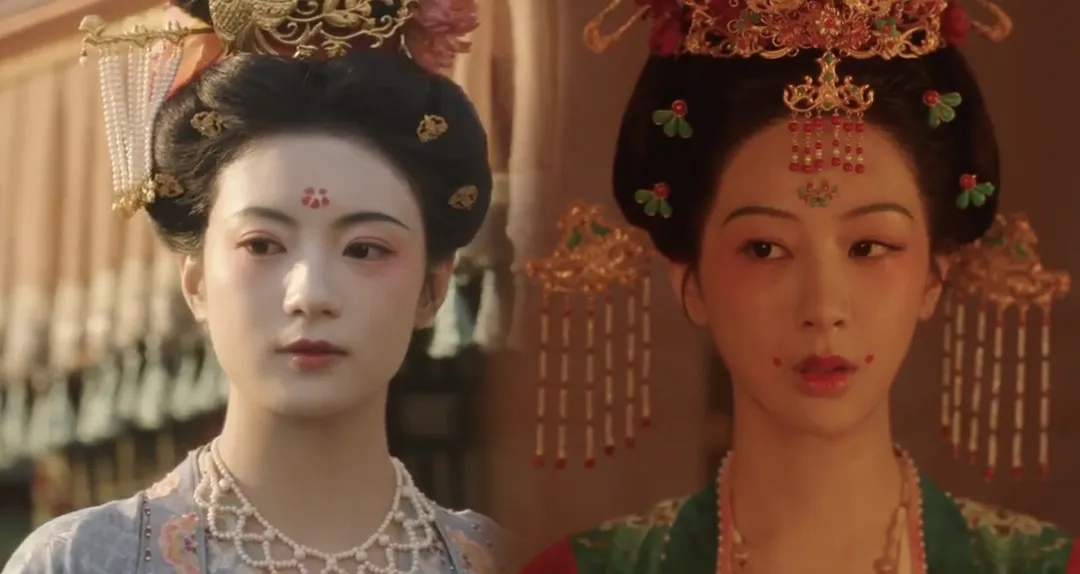
I hope you can also have the'red makeup' that suits you. Nowadays, the Tang - style makeup in costume dramas is getting more and more delicate. Our traditional culture should be presented on the big screen in this way! It allows more people to understand and appreciate the charm of ancient makeup and feel the unique connotations of traditional culture.
