
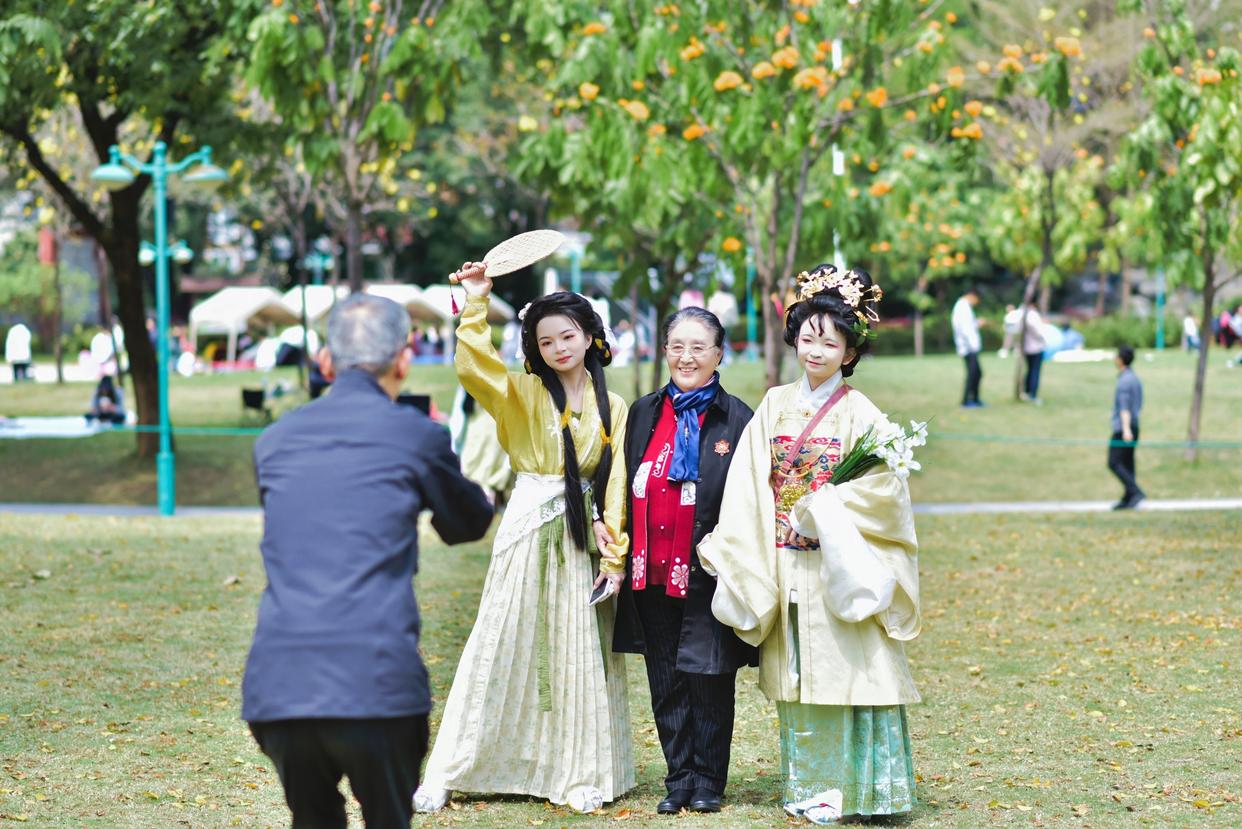
At the 2025 IAI International Creative Festival in Beijing, Li Zhiyao, Deputy County Governor of Caoxian, Shandong Province, unveiled staggering figures: Hanfu (traditional Chinese attire) sales in Caoxian surpassed 120 billion yuan ($16.6 billion) in 2024, capturing over 50% of China’s Hanfu market. Dubbed the “Universe Center” of China-chic, this once-obscure county now anchors a cultural-industrial revolution.
Caoxian’s journey began modestly in 2009, when villagers like Ren Qingsheng pivoted from making theatrical costumes to Hanfu, capitalizing on e-commerce platforms like Taobao . By 2021, the county’s Hanfu sales hit 19 billion yuan, driven by affordable designs that democratized access to traditional attire. Today, its 2,000+ enterprises form a "5-kilometer ecosystem" integrating design, fabric innovation, and AI-driven manufacturing, supported by 87,000 online stores and 21,000 livestream hosts.
Caoxian’s success lies in balancing tradition with modernity. While early products faced criticism for historical inaccuracies, the rise of "original Hanfu" — such as the viral Mamianqun (horse-face skirt) that generated 300 million yuan during 2024’s Spring Festival — reflects rigorous design upgrades. Local brands like Hu’s Hanfu Studio now hold 320 design patents, blending Ming Dynasty silhouettes with contemporary fabrics. Collaborations with historical dramas and scenic spots further embed Hanfu into daily life.
The industry employs 100,000 locals, reversing rural brain drain . Villages like Dinglou, once plagued by poverty, have become "Taobao Villages," with per capita incomes doubling since 2019. Internationally, Caoxian exports to Southeast Asia and showcased designs at Osaka’s 2024 Mid-Autumn Festival, amplifying Hanfu’s global appeal.
Despite dominance, Caoxian faces hurdles: counterfeits, uneven quality, and debates over cultural authenticity. Yet, investments in IP protection and high-end collections (some exceeding 10,000 yuan) signal maturation. As Li noted, “Hanfu isn’t just clothing—it’s a vessel for China’s cultural confidence.” With projections of a 190 billion yuan national market by 2025, Caoxian’s story epitomizes how tradition, when woven with innovation, can redefine a nation’s identity.