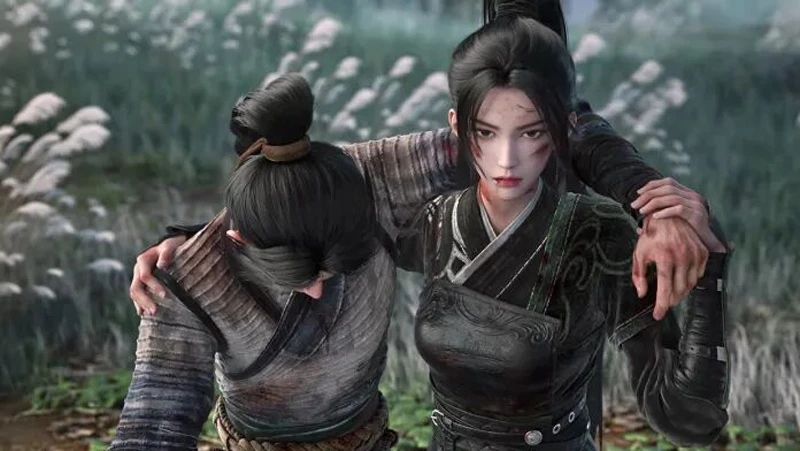
The upcoming live-action adaptation of Sword of Coming (剑来) has already sparked heated discussions online. With Wu Lei (吴磊) and Li Wanda (李宛妲) stepping into the roles of Chen Ping’an (陈平安) and Ning Yao (宁姚), fans are comparing every still frame to the beloved animated version. One particular image has stolen the spotlight: Li Wanda’s (李宛妲) Ning Yao carrying Wu Lei’s Chen Ping’an on her back. It looks almost identical to a key moment from the animation. But beyond this nostalgic scene lies a deeper conversation about makeup, authenticity, and whether live-action dramas can ever escape the shadow of their animated predecessors.
Carrying a Legacy
That back-carrying shot isn’t just fan service. In both the original novel and the animation, Chen Ping’an is wounded or exhausted, and Ning Yao—his fierce and loyal companion—hoists him up without hesitation. The live-action version mirrors the animation’s framing, costumes, and even makeup styles. Wu Lei’s dark-skinned Chen Ping’an looks relieved and secretly delighted. After all, he has fallen for Ning Yao by this point. Being carried by the girl he loves? That’s a win.

But the buzz isn’t only about the leads. He Rundong (何润东), who plays the character Song Changjing (宋长镜), has unexpectedly surged in popularity again. He built his career playing unstoppable warriors—the kind who dominate every battlefield. Yet Song Changjing in Sword of Coming isn’t exactly a top-tier fighter. Some fans joke that He Rundong took a losing deal. Others argue the opposite. In an era where TV dramas coat male leads in thick foundation, He Rundong’s weathered, rugged face feels refreshingly real.
His recent rise also ties to a viral meme: the “foundation liquid general.” Viewers have grown tired of actors who look airbrushed even in muddy war scenes. He Rundong’s natural, scarred, sweat-drenched soldier stands as a silent rebuke. And that contrast—between his authentic toughness and the polished, plastic look of many younger stars—has made his Song Changjing oddly compelling. Maybe playing a less powerful character is exactly what he needed.
Skin Deep
Chen Ping’an in the novel and animation has one unmistakable trait: dark skin. He’s a blacksmith’s apprentice who works under the sun. Wu Lei’s makeup in the leaked stills honors that detail. He isn’t whitened or filtered into oblivion. In an industry obsessed with “perfect” porcelain faces, this small choice feels like a rebellion. No heavy foundation. No digital smoothing. Just a young man who looks like he actually swings a hammer.
Li Wanda’s Ning Yao, by contrast, has fair, almost luminous skin. The two stand side by side like yin and yang. That visual contrast isn’t accidental. It echoes their personalities—Chen Ping’an grounded and cautious, Ning Yao sharp and otherworldly. But more importantly, their unpolished appearances reject a dangerous trend. Too many Chinese dramas now brighten every face until they look like wax figures. This pursuit of “beauty” kills believability. If every character glows like a K-pop idol, where is the dirt? Where is the sweat? Where is the story?
Actors from earlier generations weren’t afraid to look ugly on screen. They wore scars, bruises, and messy hair. That rawness made their emotions hit harder. Today’s over-correcting makeup doesn’t make a drama more exquisite; it makes it fake. As one online comment put it: “If you want flawless faces that badly, just use AI and fire the actors.” Harsh, but not wrong. Sword of Coming might remind producers that authenticity sells better than plastic perfection.
Animation’s Shadow

The animated Sword of Coming remains hugely popular. Its fluid fight scenes, atmospheric landscapes, and faithful character designs won over a massive fanbase. That success is a double-edged sword for the live-action version. On one hand, the existing buzz guarantees an audience. On the other, every deviation will be magnified. Every changed line, every different camera angle, every actor who doesn’t match the voice actor’s tone—all will be dissected.
Yet pressure can also push a production to improve. The live-action team clearly studied the animation closely. The back-carrying scene proves that. Costumes, hair, and even the angle of Ning Yao’s sword resemble the animated original. But imitation alone isn’t enough. A live-action drama has tools animation lacks: real chemistry between actors, unscripted micro-expressions, and the weight of actual bodies moving through real locations. If the show leans into those strengths, it could stand on its own.
Fans of the novel and animation will always compare. That’s natural. But as the saying goes, “the book is the book, the film is the film.” The same applies here. Some will love the live-action’s raw texture. Others will stay loyal to the animation’s stylized perfection. Neither is wrong. What matters is that both versions come from the same source—a story about growth, loyalty, and a boy who learns to carry his own weight, even if sometimes a girl carries him first.