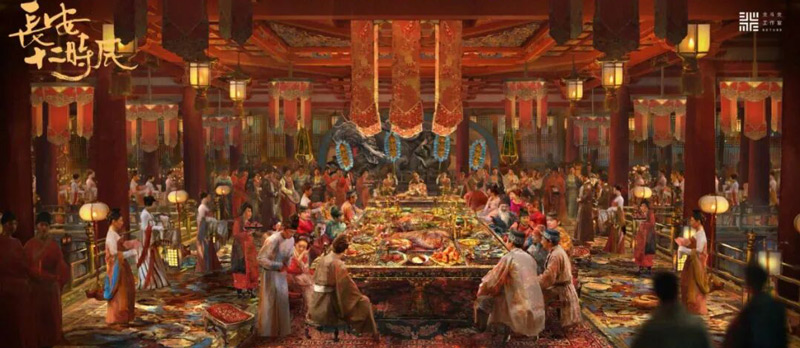
Scroll through any Chinese historical drama today, and you will spot a strange mix: flowing silks that belong on a fantasy poster, collars copied from European ballgowns, and colors that scream modern dye vats. Audiences have grown tired of this mess. Yet one drama, The Longest Day in Chang’an (长安十二时辰), which dropped several years ago, still stands as a quiet masterclass. Set in the Tang dynasty’s capital Chang’an, it did not just tell a thrilling story about a plot to destroy the city. It showed us what happens when a production team actually studies Hanfu—the traditional clothing of the Han Chinese.
The colors alone were a revelation: rich reds, deep blues, earthy yellows, pure whites, and blacks. These five primary hues, sometimes brightened with accents, formed the backbone of ancient Chinese dressing. And The Longest Day in Chang’an used them with care, not as decoration but as storytelling. Here is a look at three periods of Hanfu restoration that this drama—and a few others—have quietly championed, starting with the Wei-Jin era.
Wei-Jin (魏晋)
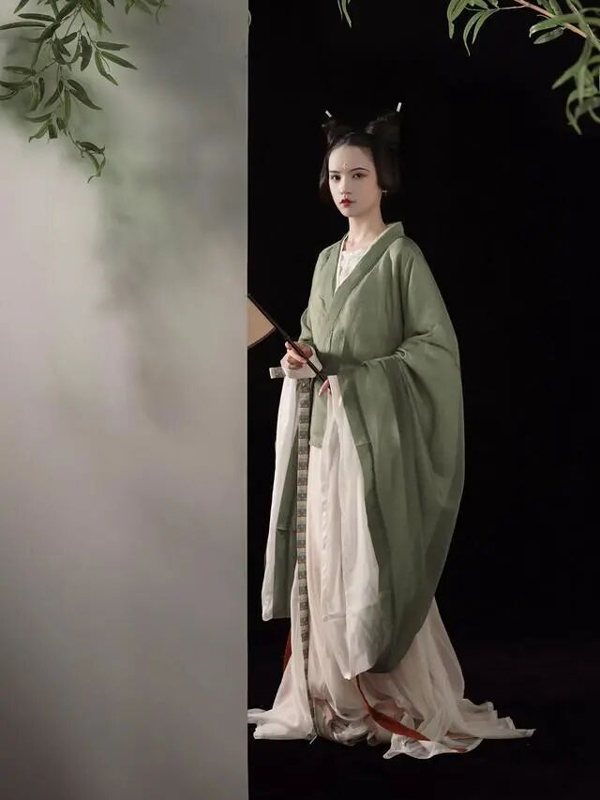
The Wei-Jin period inherited much from the Qin and Han dynasties that came before. But it also absorbed elements from nomadic cultures, creating a unique hybrid. Women of this time wore an upper garment called a Shan (衫) or Ru (襦), paired with a jiaoyu (交嵛) skirt underneath. Inside, they added a liangdang (裲裆)—a kind of sleeveless vest. The silhouette was striking: tight and fitted around the upper body, then exploding into wide, dramatic sleeves. Skirts were made from multiple panels of cloth sewn together, trailing long on the ground with a loose, airy hem. This created an effect of effortless elegance, almost as if the wearer was floating.
Why did this style work so well? It balanced restraint with freedom. The narrow bodice held the shape, while the oversized sleeves and sweeping skirt gave movement. When a woman walked, the fabric rippled like water. In modern dramas, you often see actresses drowning in stiff, over-embroidered gowns that look more like cosplay than history. But the Wei-Jin approach was smarter: it used volume sparingly, letting the cut do the work. The result was not just beautiful but practical. Women could move, gesture, and even run if needed. This is the kind of detail that The Longest Day in Chang’an understood deeply.
Another feature worth noting: the color palette remained restrained. Wei-Jin clothing favored natural, muted tones alongside the five primary colors. You would not find neon pinks or electric blues. Instead, the dyes came from plants and minerals, yielding soft indigos, faded ochres, and dusty cinnamons. This subtlety gave the era its poetic reputation. When you see a Wei-Jin dress on screen, it should whisper, not shout. Sadly, many productions miss this point, piling on bright satins and gold thread. The real beauty of Wei-Jin Hanfu lies in its quiet confidence—a lesson that historical dramas are only beginning to learn.
Tang (唐)
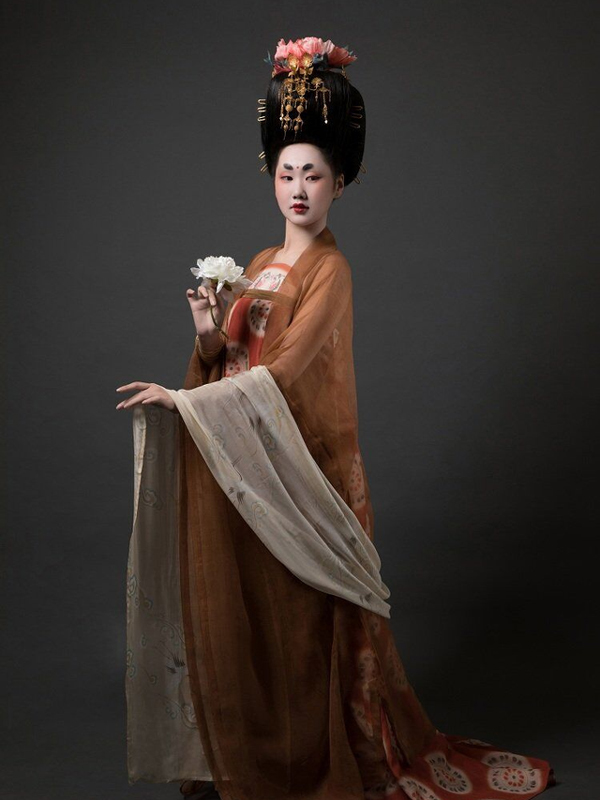
The Tang dynasty represents the golden age of Chinese clothing. No other period matched its richness, its daring, or its sheer variety. The Longest Day in Chang’an captured this perfectly. The standard outfit for Tang women was the Shanqun (衫裙): a short blouse paired with a long skirt. Skirt colors ran from red and purple to yellow and green, but red was the undisputed favorite. Over the shoulders, women draped a Pei Bo (帔帛)—a long scarf that could hang loosely or wrap around the arms. Some added a half-sleeve jacket called a Ban Bi (半臂). On their feet, they wore phoenix-head silk shoes or simple thread shoes. The overall look was luxurious yet wearable, designed for a society that loved parties, poetry, and performance.
What made Tang fashion truly revolutionary was its attitude. Early in the dynasty, sleeves were narrow and fitted. But by the mid-Tang period, they grew wider and wider until they almost touched the ground. And then came the most shocking innovation: the Tanling Duanru (袒领短襦), a short jacket with a neckline that exposed the upper chest. This was not a hidden secret or a private garment. Women wore it openly in public, and it became a signature of the High Tang era. Paired with a Jian Se Qun (间色裙)—a skirt made of alternating colored stripes—it created a bold, confident silhouette. For modern audiences, this level of skin might seem surprising. But the Tang court was cosmopolitan, connected to the Silk Road, and open to influences from Persia, India, and Central Asia. Women also loved wearing men’s clothing as a playful, rebellious statement. This trend peaked during the Kaiyuan (开元) and Tianbao (天宝) years (713–756 CE), when, as one historical record notes, “wives of scholars wore husbands’ boots, shirts, and whips, both inside and outside the home.”
Archaeological finds back up this image. Painted wooden figurines and silk-clad wooden figurines unearthed from the Astana Tombs in Turpan (the 206th tomb group) show Tang women in all their finery. Their skirts are full, their scarves flutter, and their expressions are lively. The Longest Day in Chang’an recreated these figures with painstaking accuracy. Watch any episode, and you will see the short blouses, the long striped skirts, the scarves that seem to dance in the wind. The production team did not just copy paintings—they studied actual garments, dyes, and weaving techniques. That is why the drama still holds up years later. It understood that Tang Hanfu was not about rigid rules but about joyful expression. When a costume designer gets this right, the characters feel alive. When they get it wrong, the whole drama feels fake.
Song (宋)
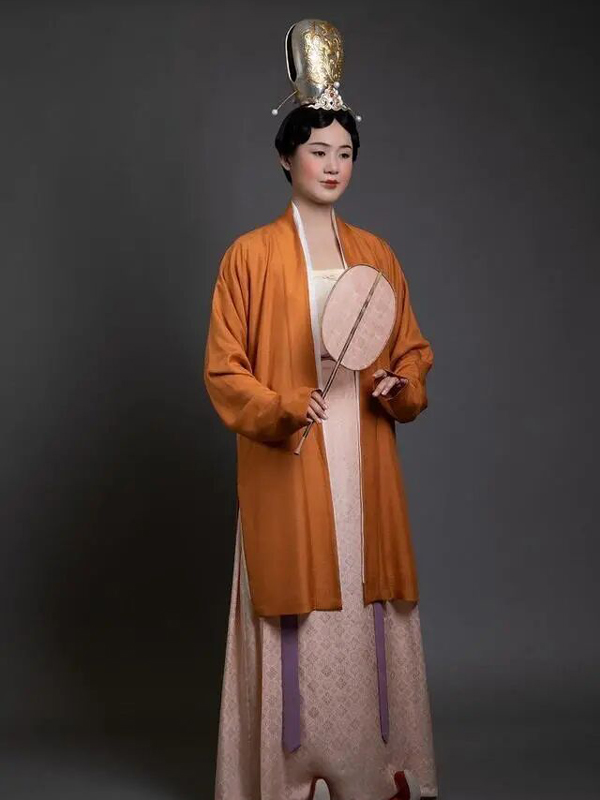
By the time the Song dynasty arrived, Chinese aesthetics had shifted. The wild exuberance of the Tang gave way to a quieter, more introspective beauty. People valued simplicity, elegance, and everyday wearability. The dominant garment for women became the Beizi (褙子), a long, straight jacket with a parallel collar and open front. It could be short or long, worn over a blouse and skirt. Excavated tombs have revealed many examples of Shan—single-layer jackets—all featuring the same straight-collar, open-front design. This was not a coincidence. The Song court promoted frugality and refinement, and fashion followed suit. Colors softened, embroidery became more delicate, and the overall silhouette grew slimmer and more vertical.
Hair and headwear also changed dramatically. Song women adored flower crowns, known as Hua Guan (花冠), which they decorated with fresh or artificial flowers. Some crowns were small and subtle; others were towering structures covered in blossoms, pearls, and gold ornaments. One particularly famous style was the Shankou guan (山口冠), or “mountain-pass crown,” which featured a jagged upper edge resembling mountain peaks. This crown appears repeatedly in Song dynasty paintings, worn by noblewomen and ladies-in-waiting. The Longest Day in Chang’an focused on the Tang, but a hypothetical Song drama could take major inspiration from these artifacts. The key is restraint. Song Hanfu does not scream for attention. It draws you in with quiet details: the precise angle of a collar, the weight of a fabric, the way a sleeve falls against the arm.
Many modern costume designers struggle with the Song aesthetic because it is so easy to overdo. They add too many ribbons, too much gold thread, or overly bright colors. But the real Song style was almost minimalist. It trusted the material and the cut to create beauty. The Beizi, for example, looks simple, but its proportions are carefully calculated. Too tight, and it feels restrictive. Too loose, and it loses its shape. The best historical dramas understand this balance. They know that Hanfu is not a costume—it is a language. Each dynasty speaks differently. The Wei-Jin period speaks of wandering poets and bamboo groves.
The Tang speaks of Silk Road caravans and palace banquets. The Song speaks of tea ceremonies and quiet gardens. When a drama gets the language right, you do not just watch the story. You live inside it. And that is why The Longest Day in Chang’an remains a benchmark. It proved that with enough care, Hanfu can stop being a museum piece and become a living, breathing part of cinema.