When a mythical warrior loses his head, does he also lose his reason to fight? Yao-Chinese Folktales 2 (中国奇谭2) offers a stunning answer with its latest short, Xingtian (刑天). This episode reimagines the ancient god of war not as a power-hungry deity, but as a husband and soon-to-be father. It strips away the grand, cosmic battles of legend and grounds the story in raw, primitive soil.
The result is a surprisingly tender tale about a man who transforms into a monster, yet whose sole mission becomes protecting the family he can no longer hold. This is not the Xingtian of classical texts; this is a being driven by paternal instinct, a hulking protector whose severed head cannot sever his emotional bonds. The narrative proves that sometimes, the most powerful force in the universe isn’t a divine weapon, but the promise made to a child never born.
From Divine Ambition to Primal Love
The original myth, found in the ancient classic Shan Hai Jing (山海经) depicts Xingtian as a symbol of undying defiance. He fought the Yellow Emperor for supremacy and, after being decapitated, fought on using his nipples as eyes and his navel as a mouth. It is a story of sheer, unyielding will against the gods. The new adaptation cleverly uses this as a starting point but pivots to a more intimate motivation.
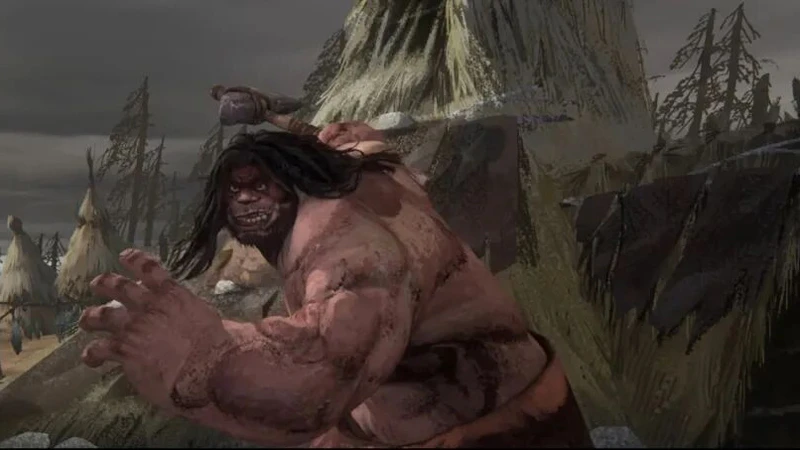
Here, he is a beloved tribal chief, strong and brave, but his world centers on his pregnant wife. Their love is visualized in a simple but powerful image: he paints the silhouettes of himself, his wife, and their unborn child on their tent. This domestic bliss is shattered by the call to war. When he is struck down by a lightning bolt from the legendary Huangdi ( 黄帝), his head is gone, but his body stirs. It is not the lust for power that wakes him, but a desperate, visceral need to return to his family.
A Silent Odyssey Through a World of Monsters
Director Zhang Yang (张扬) makes the bold choice to tell this story without a single line of dialogue. This absence of speech forces the audience to focus purely on visuals and emotion. As the headless Xingtian stumbles back towards his tribe, he travels through a landscape ripped from the pages of the Shan Hai Jing. Fantastic beasts and demons cross his path, emphasizing his journey through a world that no longer recognizes him as human.
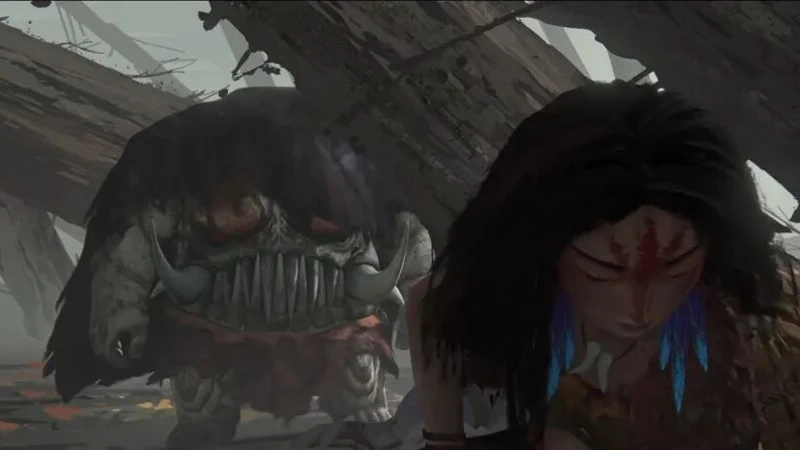
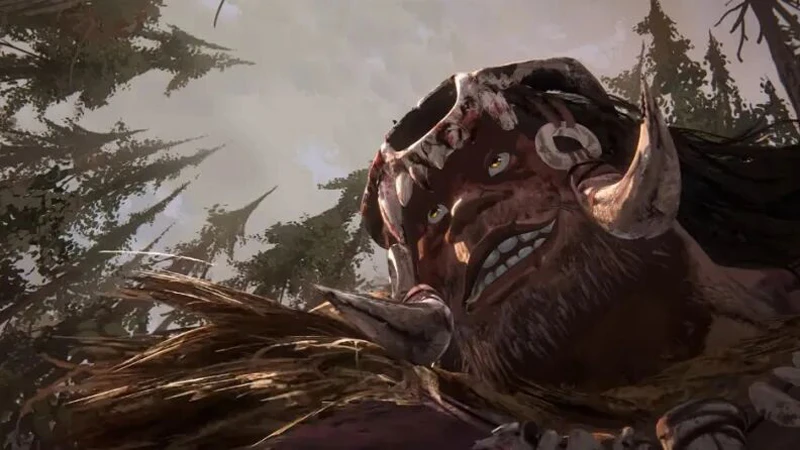
In a visually horrifying transformation, his chest becomes blood-red eyes, and his navel splits open to form a jagged, fanged mouth. He is no longer the returning hero. To the women and children left in the village, he is just another terrifying invader. They attack him, and in a moment of blind rage, he fights back, almost killing his own wife. It is only when he sees her face up close that a spark of recognition cuts through the monster’s fury. He flees, realizing that his protective presence has become a terrifying threat.
The Indelible Handprint of a Father
The most poignant element of the film is the use of touch and memory. Before leaving for battle, Xingtian placed his hand on his wife’s pregnant belly, leaving a mark in paint. This simple gesture becomes the story’s emotional anchor. After being driven away, he doesn’t abandon them. He lurks in the shadows, hunting deer and leaving the food where his wife can find it, a silent guardian watching from afar. The climax arrives when a rival tribe attacks. As his wife and infant son are cornered, Xingtian steps forward. He picks up his stone axe and stands defiantly against the enemy, buying his family precious seconds to escape. It is only when he swings that familiar axe—a motion his wife knows by heart—that she finally understands.
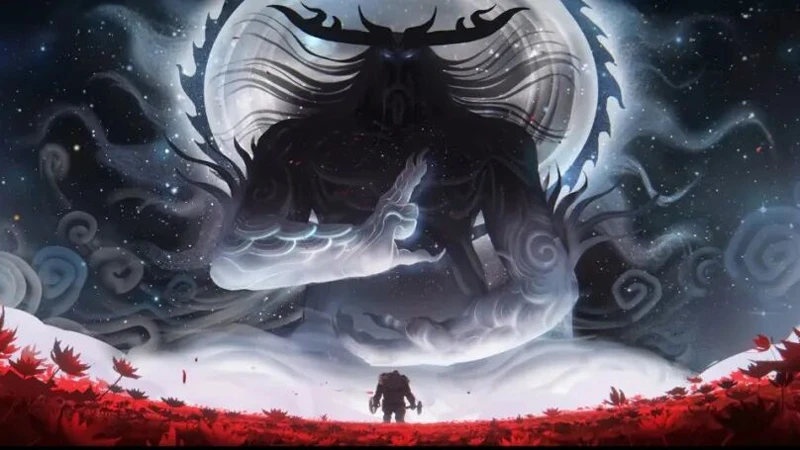
The monster is her husband. In a final, heart-wrenching moment, the baby, held in its mother’s arms as she flees on a cart, reaches out. The baby recognizes the feeling of the hand that once touched him through the womb. The ancient poem says, “Xingtian wields axe and shield; his fierce will is forever fixed.” This version redefines that “will.” It is not a will to conquer a kingdom, but to save a single family, proving that humanity can survive even when the head is lost.