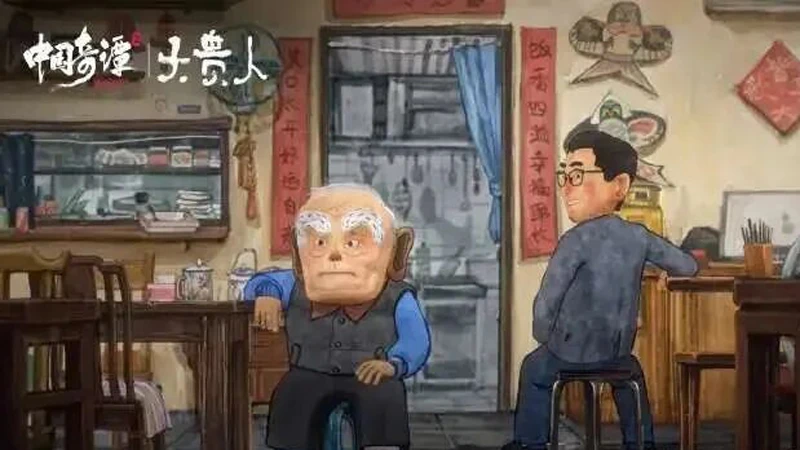
What happens when a grown son loses his job but cannot bring himself to tell his father? In the bustling, rapidly transforming city of Beijing, this silent crisis forms the emotional core of Da Gui Ren (大贵人), the ninth episode of the animated series Yao-Chinese Folktales 2 (中国奇谭 2). This is not a story of flashy heroes or epic quests. Instead, it is a quiet, magical realist portrait of two men living in a narrow Hutong (胡同) alley, separated by pride and connected by an unspoken love. The film uses magic not as a spectacle, but as a gentle lens to magnify the everyday dramas of dignity, memory, and the people who shape our lives without us even realizing it. It asks us to look beyond the surface, to find the “noble person” hiding in plain sight.
Magic as a Silent Language
The father in Da Gui Ren senses his son’s shame. Every morning, the son puts on a suit and leaves for a job he no longer has, spending his days wandering the city instead. The father, an old man running a small shop in their aging Hutong, cannot bridge this gap with words. Chinese culture often leaves deep affections unspoken, a hesitation this film captures beautifully. The father’s solution is a clove of magic garlic. When rubbed, it allows him to become invisible, to move through Beijing unseen and slip money into his son’s empty wallet.
This act of magical kindness transforms the vast, modern city into a playground for a father’s love. Beijing, with its ancient history clashing against sleek skyscrapers, becomes a character itself. The disappearing Hutongs, like the one they live in, are pockets of the past struggling to exist in the present. The father’s magic lets him navigate this new world to care for his son. It is a lonely magic, born from the solitude of not being able to communicate directly.
The Beauty in Disguise
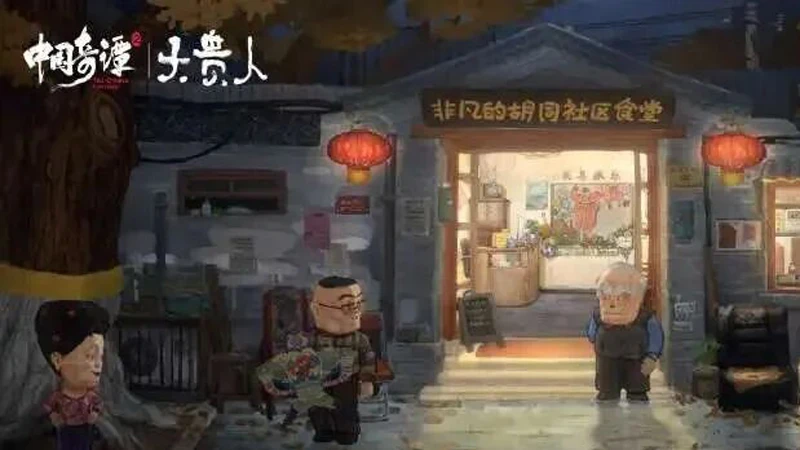
The visuals in Da Gui Ren embrace an intentional ugliness. The father is drawn with wrinkles and a weary posture. The Hutong is cramped and cluttered. The magical creatures that briefly flicker into existence are strange, not cute. This roughness symbolizes the past itself—old, worn down, and easily overlooked in favor of the city’s shiny new glass towers. We are taught that beauty is new and polished, but this film argues that profound beauty resides in the old, the awkward, and the forgotten. The cramped Hutong holds a lifetime of love that a modern apartment complex cannot replicate.
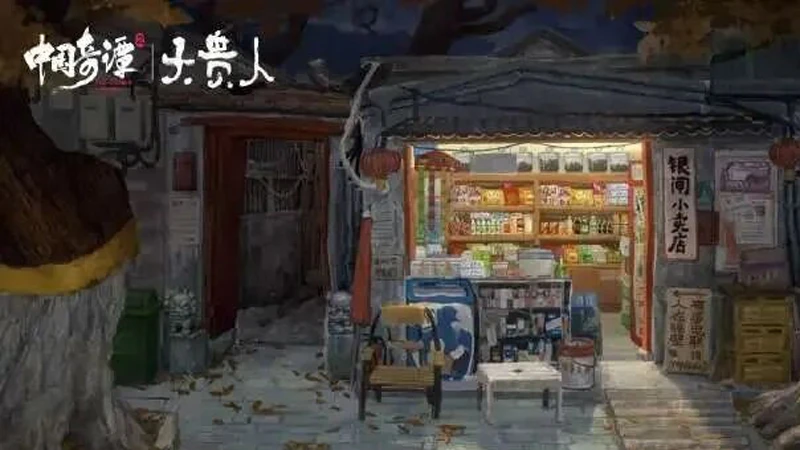
The title, Da Gui Ren, translates to “The Great Noble Person.” In Chinese culture, a “guiren” is someone who appears in your life at a critical moment and changes your destiny for the better. We often search for this a noble helper in powerful mentors or lucky encounters. The film’s quiet genius is revealing that the true “great noble person” for the son is his own father. He is the one silently altering his son’s fate, disguised by his mundane appearance and old-fashioned ways. The magic garlic is just a seasoning; the real magic is the father’s unwavering, invisible support. The story is a meditation on how we must slow down to recognize these people, whose value is not in grand gestures, but in their constant, quiet presence in our lives.