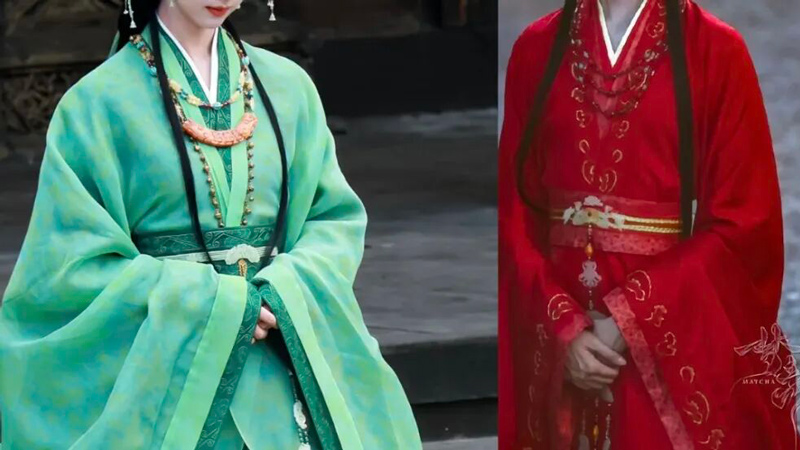
Open any historical or fantasy costume drama today, and you will likely spot a recurring sartorial trend: a character's robe is first cinched by a broad waist wrapper, only to be topped with an additional, often decorative, belt. This layered look, adorned with jade pendants and tassels, has become a visual shorthand for ancient elegance.
Yet, this ubiquitous combination is almost entirely a modern invention, a creative liberty taken by costume designers that conflates two distinct historical garments. The Yao Fu (腰袱), or waist wrapper, and the traditional belt served different purposes, stemmed from different needs, and were rarely worn together in the manner now popularized on screen.
The Practical Waist Wrapper
Far from being a mere accessory, the Yao Fu was a fundamental component of daily dress, rooted in utility. Traditional Hanfu, with its deep robes and broad sleeves, was inherently loose. A narrow belt alone could not secure such voluminous clothing for work or swift movement. The Yao Fu solved this. Typically a wide strip of cloth, sometimes over twenty centimeters across, it was wrapped firmly around the torso to anchor the layers of fabric beneath. For laborers, it provided back support and protected garments from wear; some even featured small sewn-in pockets.
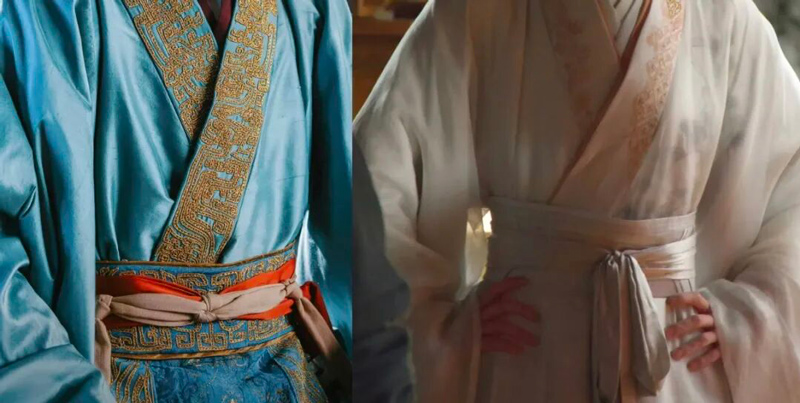
This concept evolved beyond fabric. A sturdier variant, the Ge Dai (革带) or leather belt, emerged. Made from hardened hide, it offered a more rigid and secure fit, eventually becoming standard with military armor and formal court attire as clothing silhouettes became less bulky. Another innovation was the Diexie Dai (蹀躞带), a belt influenced by Central Asian styles popular during the Tang Dynasty. Used primarily with round-collar robes, it featured hanging straps for carrying small items and was part of everyday wear.
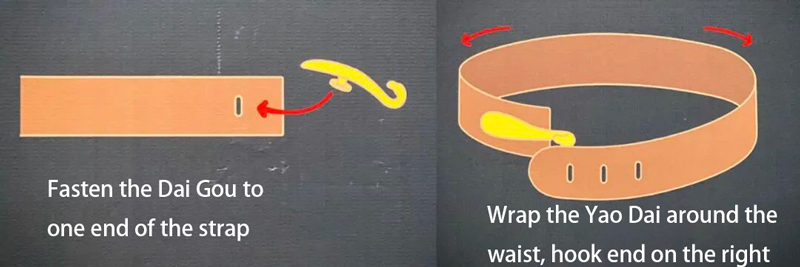
The closure for a Yao Fu or a leather belt was the Dai Gou (带钩), a hook-shaped fastener. One end was fixed to the belt or wrapper, while the curved hook latched onto a loop or the material itself. This mechanism allowed for quick fastening and removal. These hooks were also status symbols, crafted from bronze or iron for commoners, and from jade, gold, or silver for the elite, often intricately carved with animal motifs.
Belts and Cords
Separate from the waist wrapper was the true belt, known as a Tao Dai (绦带) or a woven cord. This was the narrow, functional strip used by nearly everyone, from emperors to peasants. Its defining characteristic was its simplicity. Commoners used cords of hemp, rattan, or twisted fabric remnants, typically just one to two centimeters wide, devoid of ornamentation. They were tools for tying clothes or securing objects, a clear marker of social standing through their plainness.
For the scholar-official and aristocratic classes, the Tao Dai could be an expression of refined taste. Made from fine silk, it was often tied in an elegant knot with the ends left to drape gracefully at the side. This knotted style, requiring no metal fastener, was a pervasive and classic look across dynasties. Another type was the Qun Dai (裙带), a strip attached directly to a skirt's waistband, used specifically for fastening it closed.
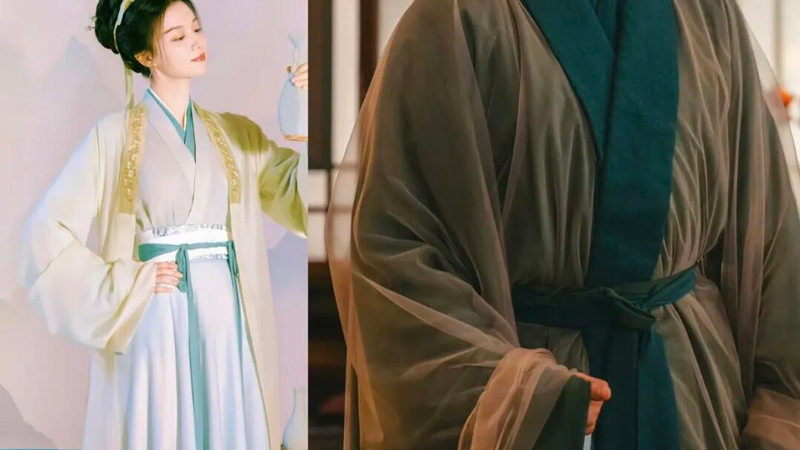
While often simply knotted, these cords could also employ a Dai Gou. This was practical for fine silks that might fray with repeated tying, or for activities like horseback riding where a secure, quick-release fastening was necessary. The hook would connect to a metal ring sewn into the cord or latch directly onto the woven material. Thus, the same fastener served both the broad waist wrapper and the slender cord, but in completely different sartorial contexts.
Modern Adaptation, Historical Divergence
The layered "waist wrapper plus belt" seen in shows like The Untamed or Story of Yanxi Palace is a deliberate aesthetic choice for the camera. Designers layer textures, colors, and accessories to create visual interest and define a character's silhouette against the backdrop. The extra belt often functions as a anchor for hanging prop jewels or tassels, enhancing the character's wealth or otherworldly aura. This is contemporary stylization, not historical reconstruction.
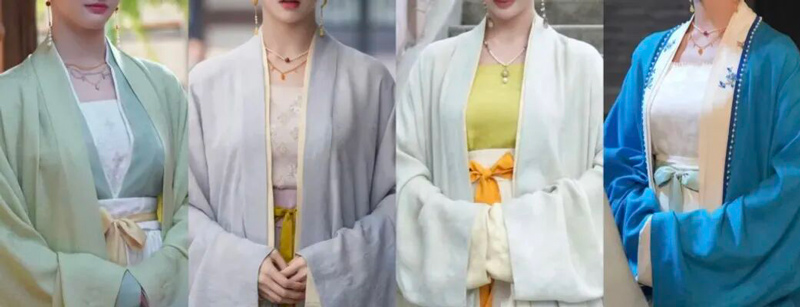
This creative liberty creates a widespread misconception. Audiences now often believe the layered look is authentic, which overshadows the intelligent, need-based design of actual historical garments. The ancient approach was fundamentally pragmatic: the wide Yao Fu for securing robes, the simple cord for basic fastening, and the leather Ge Dai for armor or formal wear. Each had a defined role. Adding a dangling belt over a tightly wrapped Yao Fu would have been seen as redundant and impractical.
Understanding this distinction enriches the viewing experience. It allows audiences to appreciate accurate costume design when it appears and to recognize artistic interpretation. It also connects us to the lived reality of the past, where clothing was an interface with the world—for labor, for battle, for ceremony. The elegance of ancient attire lay not in excessive decoration, but in solutions tailored to the necessities of life and station. Next time you watch a historical drama, look closely at the waist. You might just spot where centuries-old practicality has been swapped for modern flair.