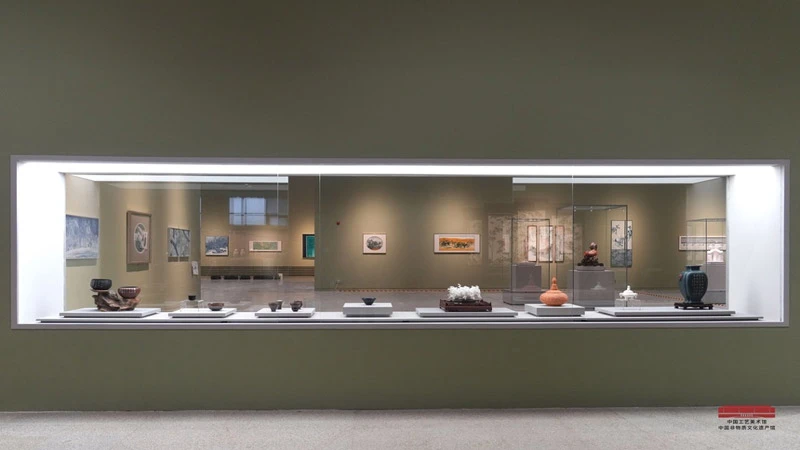
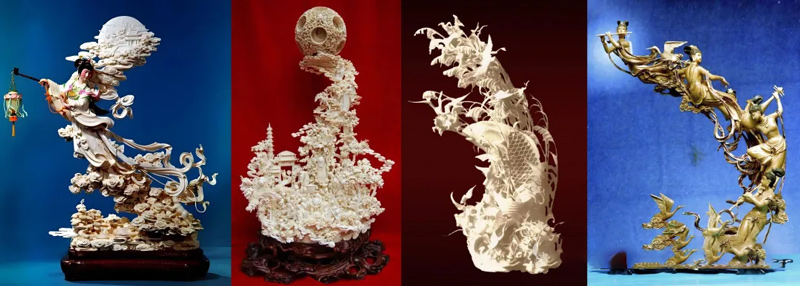
Chinese ivory carving, with its profound historical evolution, is renowned for its exquisite craftsmanship, diverse categories, distinctive ethnic charm, and strong regional characteristics. The introduction of the "Double Hundred" in the 1950s further stimulated the flourishing development of China's arts and crafts, significantly refining and consolidating the unique regional styles of ivory carving.
From the 1950s to the 1980s, ivory products became one of the major exports in China's craft sector, with specialized art factories across the country nurturing talents and advancing creative techniques. This era not only contributed substantially to socio-economic and cultural development but also gave rise to recognized regional schools, most notably the "Four Major Ivory Carvings" from Beijing, Guangzhou, Shanghai, and Nanjing, sometimes expanded to include Fuzhou. Many other regions also developed their own traditions, leaving behind a rich cultural legacy and artistic heritage for future generations.

1. Beijing Ivory Carving: Millennia in the Making
For over two thousand years, Beijing has been a pivotal center for ivory carving, an art form deeply intertwined with Chinese cultural identity. Evidence from a Warring States period tomb at Huangtupo (黄土坡), Beijing, yielded an ancient ivory comb, marking its early roots. Flourishing particularly during the Ming and Qing dynasties, the city drew the nation's most exceptional artisans. Concentrated within imperial workshops, their skills propelled Beijing to the forefront of this intricate craft. Its legacy continues, defined by exquisite artistry and historical significance.
1.1 Human Figures in Motion
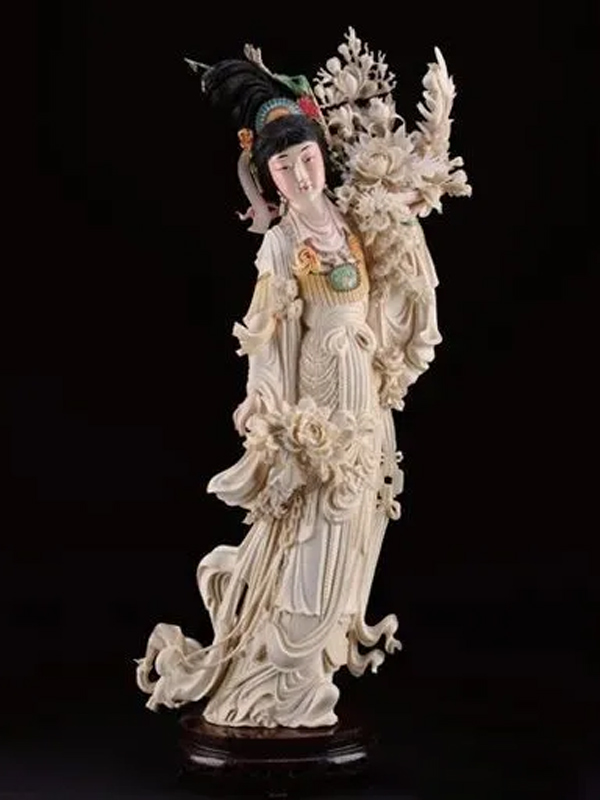
Beijing carving excels in depicting the human form. Masters create figures with remarkable grace, lifelike expressions, and precise proportions. The rendering of clothing is a particular hallmark. Artisans meticulously carve flowing robes and draped sleeves, achieving elegant lines that convey movement and texture with astonishing simplicity and fluidity. This focus on drapery elevates the figures beyond mere representation into dynamic artistry.
Early works often featured single, somewhat static figures colloquially called "stick people." Over centuries, techniques evolved dramatically. By the Qing era, artisans mastered complex compositions, crafting intricate group scenes and narratives. They skillfully blended round carving, relief work, and openwork techniques. This technical fusion allowed for richer storytelling and more elaborate depictions.
Subjects span Chinese mythology, folklore, and history. Deities, celestial maidens like Chang'e (嫦娥), revered Buddhist figures, and valiant warriors stand alongside elegant court ladies and scholarly gentlemen. Each piece showcases not only technical mastery but also a profound understanding of posture, expression, and cultural context. The figures capture moments of drama, serenity, or contemplation.
1.2 Nature's Miniature
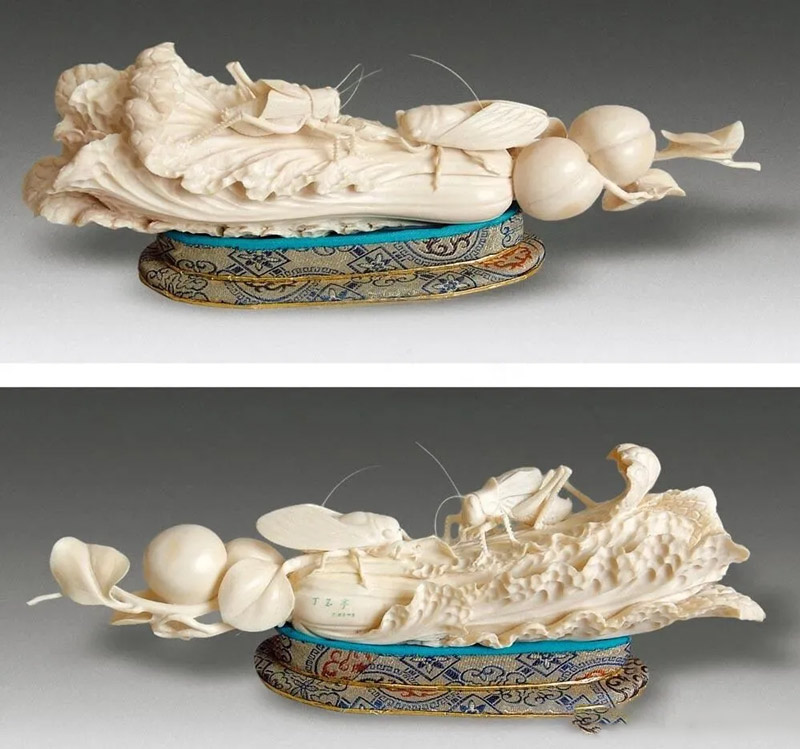
Beyond figures, artisans transform ivory into stunning botanical worlds. Flowers bloom in two distinct styles: relief work adorning practical objects like brush washers, plates, and wrist rests; and fully three-dimensional pieces such as vases, baskets, and miniature landscapes. These bonsai gardens in ivory are marvels of delicate replication.
The most captivating nature studies often incorporate intricate details of the living world. A meticulously carved cabbage might host a lifelike katydid poised on its leaf. Blossoming branches attract finely wrought butterflies or tiny insects. This inclusion of fauna injects vibrant energy and a touch of whimsy into the serene floral compositions, showcasing the carver's keen observation.
Particularly famous is the depiction known colloquially as the "cabbage with katydids." This piece exemplifies the genre, capturing the crisp texture of vegetable leaves and the delicate form of insects with breathtaking realism. It symbolizes prosperity and agricultural bounty, a beloved theme rendered in enduring ivory.
1.3 Diplomacy in Ivory
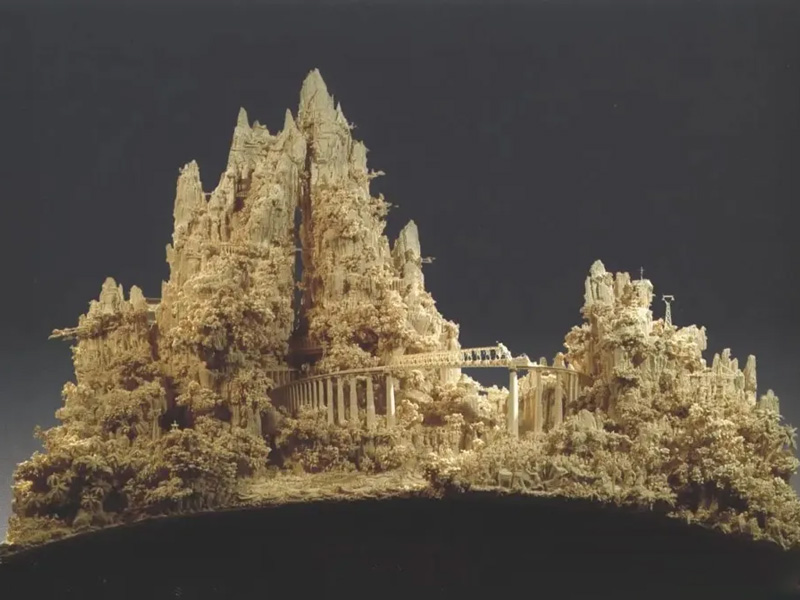
The founding of the Beijing Ivory Carving Factory elevated the craft, merging traditional imperial techniques with new creative ambitions. This era produced masterpieces that transcended national borders, becoming potent symbols of cultural diplomacy and statecraft. These works carried the weight of history and the pinnacle of Chinese artistry onto the world stage.
Numerous significant carvings were chosen as prestigious state gifts. In 1972, a piece depicting the Chang'e Flying to the Moon was presented to U.S. President Richard Nixon during his historic visit. In 1977, a large-scale carving titled Mangyongdae (depicting a significant Korean site) was gifted to North Korean leader Kim Il Sung. Another panoramic masterpiece, Beihai Park Panorama, found its home in the Soviet Union.
Beyond diplomatic gifts, many exceptional works entered China's national collections as cultural treasures. Pieces like The Glow of the Zunyi Conference (遵义会议照前程) and The Leaping Dragon Boat represent the zenith of 20th-century carving. They stand as enduring testaments to the skill and vision of Beijing's master artisans, preserving the legacy for future generations.

2. Guangzhou Ivory Carving: Artistry Beyond Time
For over two millennia, Guangzhou has cultivated an astonishing tradition of transforming ivory into objects of breathtaking intricacy. From delicate spheres nested like cosmic puzzles to majestic ceremonial barges, these creations embody a unique fusion of technical mastery and artistic vision. This legacy, born in China's southern gateway, continues to captivate with its precision and ingenuity, adapting to modern constraints while preserving ancient skills.
2.1 Roots in Trade and Craft
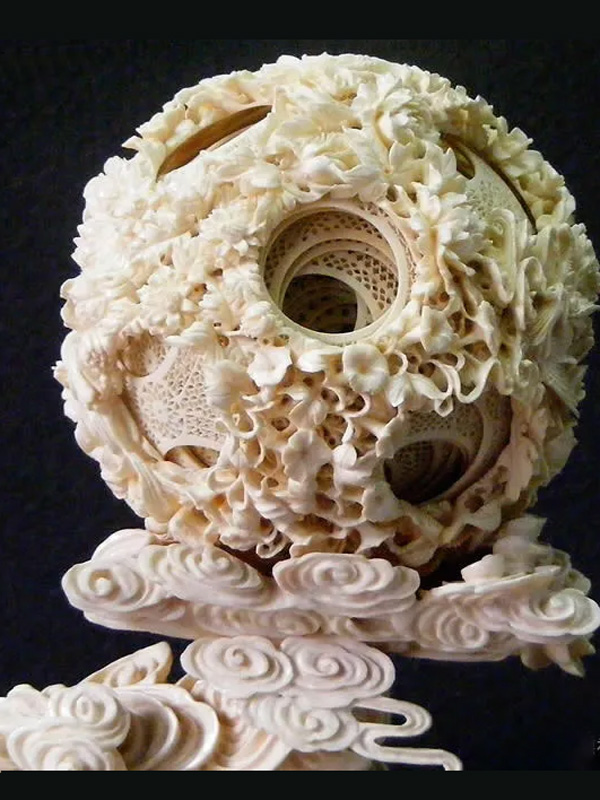
Guangzhou's position as a vital port since the Han Dynasty fueled its ivory carving prominence. Merchants brought tusks from distant lands, providing abundant raw material for local workshops. The city's warm, humid climate proved ideal for working the material, keeping it pliable for the demanding techniques artisans developed. By the Song Dynasty, distinctive layered ivory spheres emerged, showcasing an unprecedented level of miniature engineering.
During the Qing Dynasty, as Guangzhou became China's sole official trade port, its ivory crafts gained global fame. Elaborate carvings became prized exports and diplomatic gifts, admired for their complexity. Workshops flourished, particularly along Daxin (大新) Street, evolving signature styles characterized by astonishing openness and fine detail. This era cemented Guangzhou's reputation for producing works of unparalleled delicacy.
Historical evidence, like artifacts from the Nanyue King's tomb, confirms the craft's ancient origins. Texts from the Jin Dynasty mention intricate woven ivory mats, indicating sophisticated early techniques. The city's deep connection to maritime trade routes provided not just materials but also exposure to diverse influences, shaping a distinct artistic identity focused on openness and technical flourish.
2.2 Engineering the Impossible
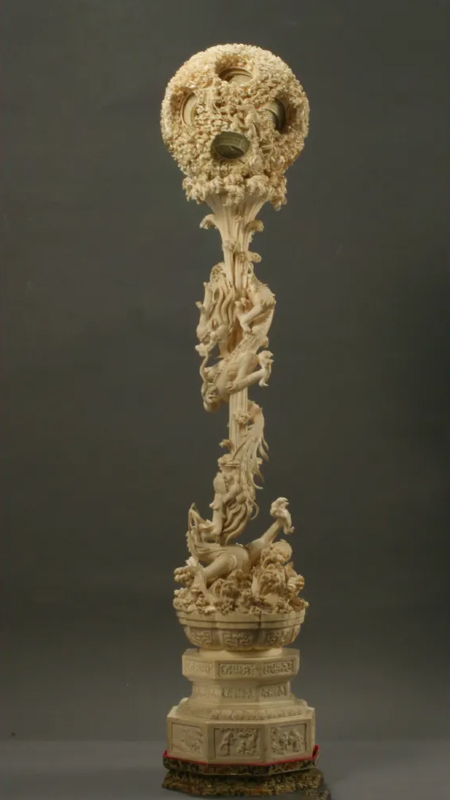
The layered sphere, often called a "demon's craft ball", remains Guangzhou's most iconic achievement. Carved from a single solid tusk, craftsmen painstakingly hollow out concentric layers, each thinner than 2mm, all rotating freely within one another. Intricate patterns adorn every surface. Achieving this requires exceptional skill and specialized tools, some finer than sewing needles, guided largely by touch and sound.
Another marvel is the ceremonial barge. Crafted from hollowed root sections, these multi-storied vessels feature pavilions, movable windows, tiny figures, and rigging – all rendered in astonishing detail from a single piece or seamlessly joined segments. The interlocking technique ensures structures appear flawlessly whole, hiding thousands of joins.
A landmark moment came in 1915 at the Panama-Pacific International Exposition. Master Weng Shao's (翁绍) 26-layer sphere was challenged by a Japanese entry with more layers. When tested in boiling water, the Japanese sphere, held by glue, disintegrated, while Weng's single-piece marvel endured, winning the supreme prize and solidifying Guangzhou's technical supremacy. This victory highlighted the irreplaceable value of true craftsmanship over mere assembly.
3. Shanghai Ivory Carving: Craft Beyond Borders
Shanghai, a city without native ivory resources, transformed imported tusks into extraordinary art. Dependent entirely on foreign materials, its early ivory carving development was slow. Yet this craft blossomed against historical currents, evolving from small utilitarian items into intricate sculptural marvels. Shanghai’s artisans turned material scarcity into creative abundance, weaving technical skill with artistic vision across generations. Their journey reflects resilience and innovation within China’s cultural landscape.
3.1 Roots in Mobility
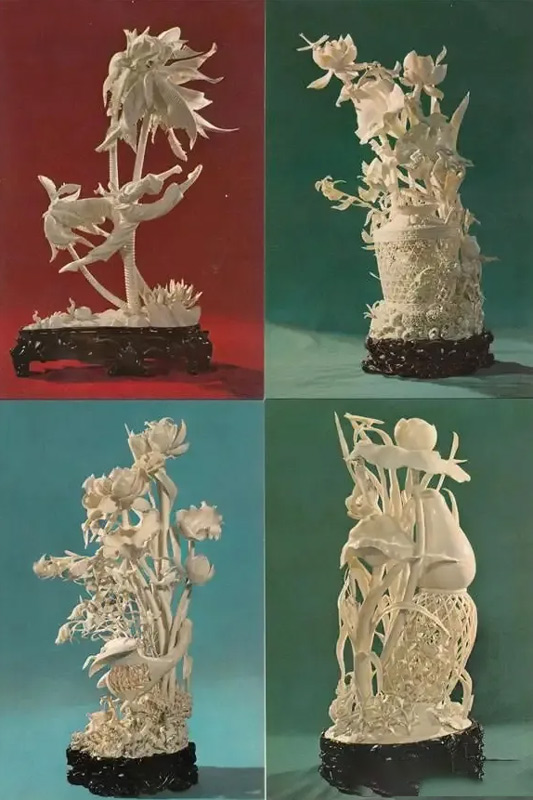
In the late 18th century, Wang Shou'an (王守安), a woodcarver from Suzhou, arrived in Shanghai. His shift to ivory initiated the city's first dedicated workshops. These early craftspeople laid the foundation, training apprentices who rapidly expanded the craft through independent studios. By the mid-19th century, spurred by increased trade following the Opium Wars, Shanghai’s ivory carving diversified significantly. Simple ornaments gave way to elaborate free-standing figures, multi-layered mountain landscapes, intricate openwork, and antique-inspired display pieces. Production scaled quickly, feeding growing demand domestically and internationally.
The craft’s horizontal expansion relied on master-apprentice transmission. Each new studio developed subtle variations, enriching the local style. This period saw a shift from replication to artistic interpretation, setting Shanghai apart. Workshops clustered, fostering both competition and shared technique refinement. Ivory became a canvas for expressing regional identity.
3.2 State Craft Revival
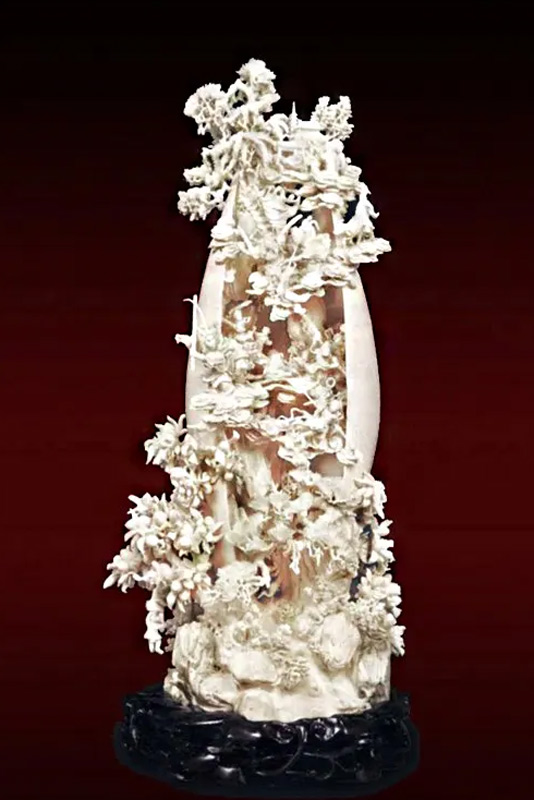
Post-1949, artisans responded to the state’s call for production cooperatives. In 1958, a pivotal merger established the Shanghai Jade and Ivory Carving Factory. This state-led consolidation provided stable resources and improved working conditions. It became the crucible for defining modern Shanghai ivory carving. Third and fourth-generation masters honed distinct local characteristics within this framework. Protected from market volatility, they pursued technical excellence and stylistic coherence.
The factory system enabled larger, more complex projects and systematic training. Artisans collaborated, pooling knowledge previously guarded within family workshops. This environment nurtured signature approaches. Formal recognition followed, solidifying Shanghai’s position within China’s craft hierarchy. State support shielded the delicate craft during turbulent times.
3.3 Signature Openwork Technique
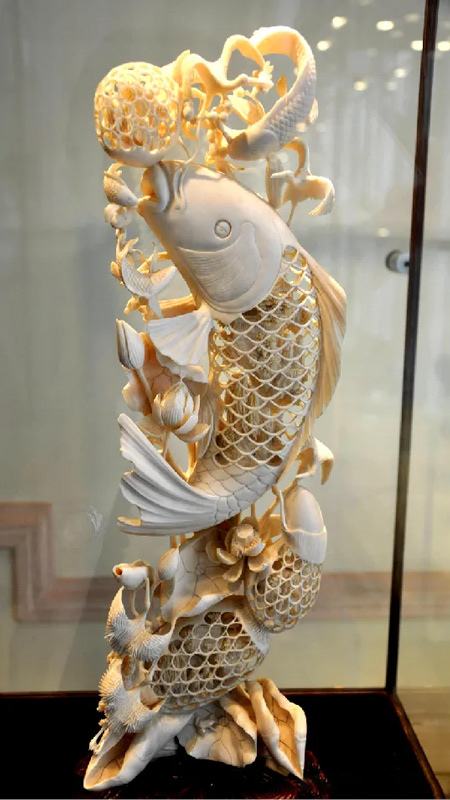
Shanghai ivory carving is renowned for three main styles: openwork carving, clam shell scenes, and figurines. Among these, openwork emerged as the definitive Shanghai style in the late 1950s. Masters exploited ivory’s unique properties – its fine grain and surprising pliability. They pioneered techniques carving deep into the material, creating astonishingly detailed, layered scenes within a single tusk. Subjects ranged from boats and lanterns to intricate landscapes teeming with flora and fauna.
The most celebrated motifs involve aquatic life: fish, crabs, and lotus ponds. Artisans meticulously sculpted mesh-like patterns forming outer shapes – a fish’s scales or a bird’s feathers. Within these delicate frameworks, deeper layers revealed miniature worlds: figures, landscapes, or additional creatures. This produced the hallmark effect of scenes nested within scenes, objects contained within objects – a breathtaking testament to patience and spatial ingenuity. Light passing through the translucent ivory further animated these intricate tableaux.
This openwork style demanded supreme technical control. A single slip could shatter weeks of labor. Masters developed specialized tools and methods for undercutting and piercing deep into the tusk without compromising structural integrity. The resulting pieces possess an ethereal lightness belying their dense complexity, embodying the pinnacle of Shanghai’s artistic contribution to this demanding craft.

4. Nanjing Ivory Carving: Ancient Craft Revived Through Time
Nanjing ivory carving blends history with innovation. Originating in Ming and Qing dynasties, this art thrived amid cultural exchanges. Artists used rare materials to create pieces resembling antiques. Today, it survives through fossilized mammoth tusks, offering a legal alternative to banned elephant ivory. This shift preserves a legacy once near extinction.
4.1 Historical Roots
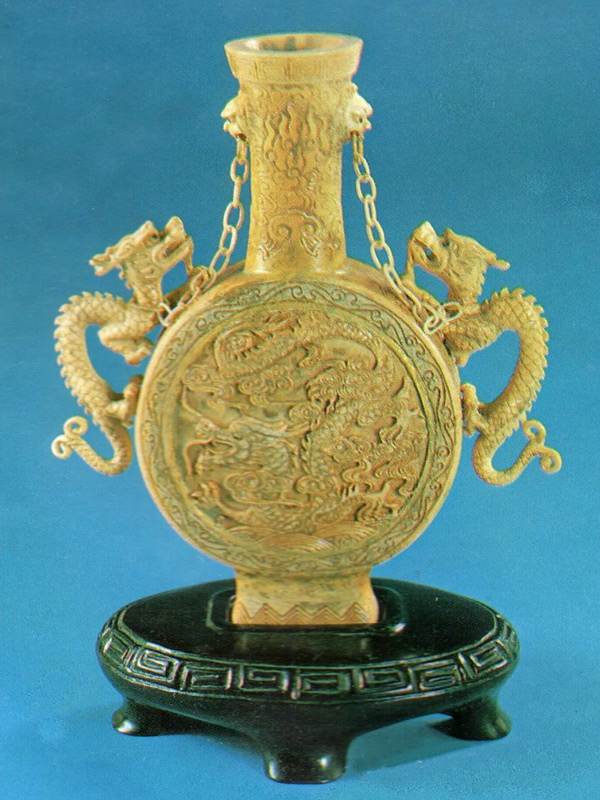
The craft emerged from Nanjing's vibrant trade hubs. Skilled artisans traveled between Shanghai and Nanjing, repairing damaged works. By the 1950s, pioneers like Sun Yuxiang (孙遇祥) formed the Nanjing Ivory Carving Society. They developed unique aging techniques under expert Chen Xinmin (陈新民). Their methods imitated ancient hues and cracks, making pieces prized globally.
In 1978, a large piece depicting Princess Wencheng's (文成) journey to Tibet gained national fame. It showcased Nanjing's rise among China's top carving centers. Works like this combined bold compositions with dynamic energy, breaking spatial norms. They earned awards, cementing the region's reputation.
Later decades saw grand group creations, such as Dragon Boat Festival scenes. These captured historical moments with dramatic flair. Each piece reflected the city's artistic spirit, adapting to changing times while honoring tradition.
4.2 Artistic Techniques
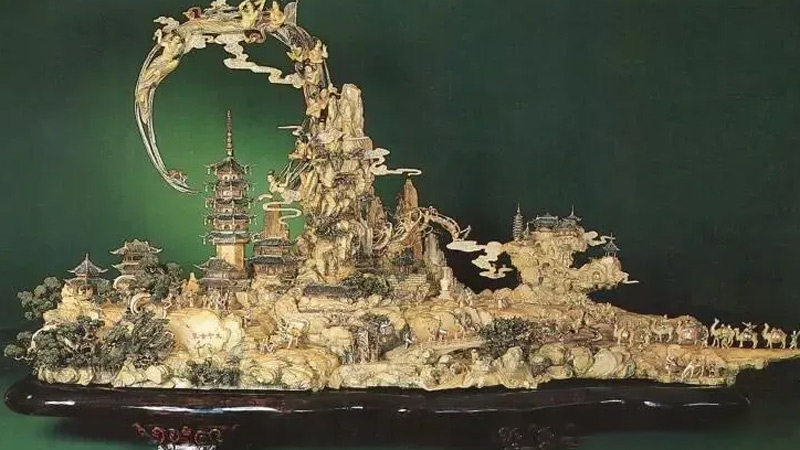
Key methods include imitation aging and large-scale assembly. Carvers start with raw material selection, focusing on maximizing precious ivory. Steps involve rough shaping, detailing, polishing, and artificial aging.
Distinctive features include asymmetrical layouts. For example, Night Consultation uses tilted angles to convey urgency. This style avoids realism, favoring emotional impact. Such approaches set Nanjing apart from other schools.
Materials evolved due to ivory bans. In the 1980s, artists turned to bone substitutes. Mammoth tusks, unearthed from Siberian permafrost, later provided authentic texture. This resource allowed carvings to regain their luminous quality without ethical concerns.

Final Words
The evolution of ivory carving artistry in China since the founding of New China stands as a powerful testament to both cultural continuity and creative innovation. From individual pieces to grand composite works, and from traditional techniques to modern expressive forms, this art form has dynamically adapted while preserving its deep cultural roots. Understanding the distinct regional styles and the profound cultural essence embedded within these exquisite works not only enriches our appreciation but also reinforces their significance as a precious intangible cultural heritage.
As we move forward, it is crucial to continue safeguarding, studying, and transmitting this exceptional art. By doing so, we ensure that the legacy of Chinese ivory carving is respected and celebrated for generations to come, fostering a deeper connection to China’s rich artistic traditions in a contemporary global context.