
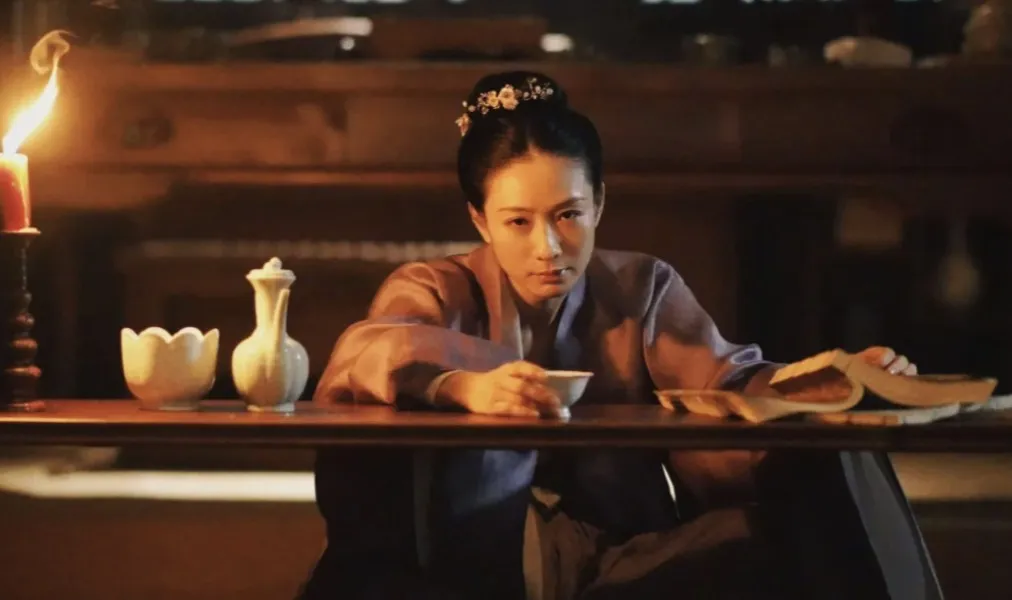
In the documentary "Phoenix: Her Legend", Tao Xinran (陶昕然), who previously played the role of 'An Lingrong', portrayed Li Qingzhao (李清照).
To start with, Li Qingzhao lived around the transition between the Northern and Southern Song Dynasties, so the clothing style at that time was somewhat grand and elegant, leaning towards the Northern Song style. The Northern Song still retained the legacy of the Five Dynasties, so compared with the Southern Song, there was still the beauty of layering and wide sleeves. Influenced by Neo - Confucianism, the makeup and dressing of women in the Northern Song tended to be reserved and simple, adhering to the aesthetic philosophy of 'A light touch is always appropriate, and charm comes naturally'. In the Northern Song's 'Dongjing Meng Hua Lu', it was described that 'Gold and jade glistened, and silk wafted fragrance.' In the Southern Song's 'Wu Lin Jiu Shi', it said, 'Women and children were dressed gorgeously and walked around in crowds.'

In the Huang Sheng Tomb and the De'an Zhou's Tomb, the style of wide - sleeved clothing, which was the dressing style of noble women, can still be seen. The prevalence of the shirt - skirt combination reached its peak in the Tang and Song Dynasties, which was a common daily - wear and inner - wear style for women. The upper part of the shirt - skirt came in cross - collared, front - buttoned, and shallow - cross - collared styles. The lower skirt was usually a split skirt or a pleated skirt. Simply put, changing the fabric and color of the upper and lower parts meant a new set of clothes. For example, the common attire of ladies in the Northern Song was a cross - collared upper shirt paired with a pleated skirt, along with a shawl, which showed the elegance and reserve of a gentlewoman.
In clothing matching, the principle of 'light on top and bright on the bottom/bright on top and light on the bottom' was skillfully applied. Through the gradient of the same color or similar colors from light to dark, such as the combination of brown and light yellow, the fresh combination of light greenish - white and blue - green, and the gentle transition between light pink and pomegranate red, and with floral patterns as decoration, this color - matching method demonstrated a timeless fashion sense in clothing.
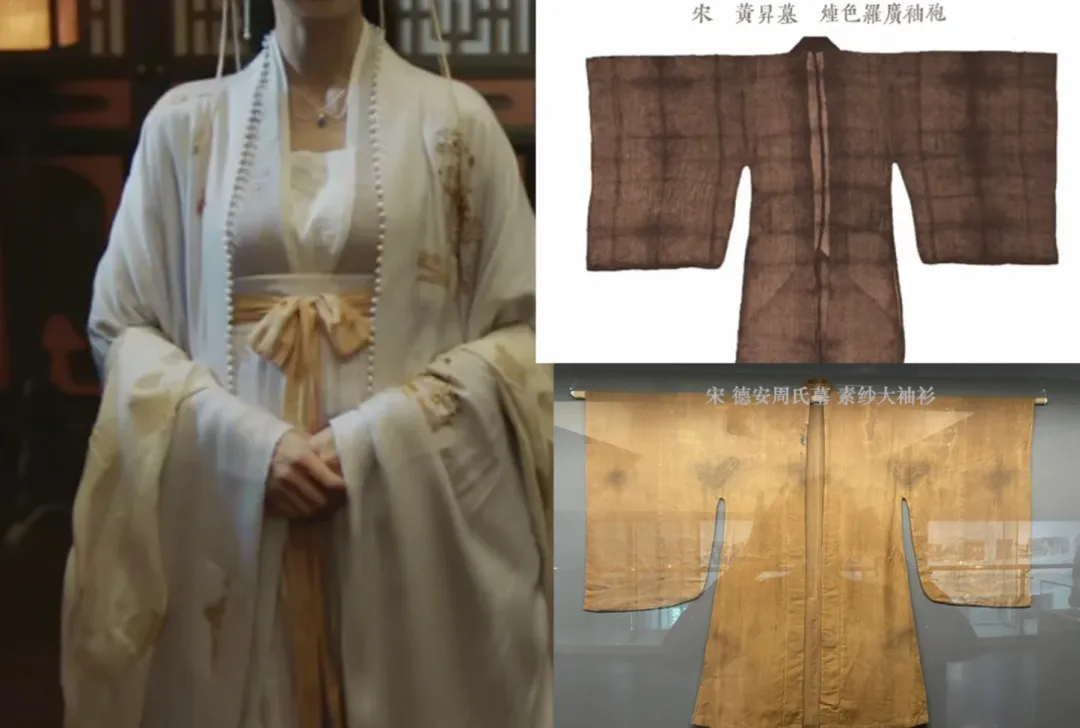
In the Southern Song, the outer shirts of women generally tended to be narrow - sleeved beizi, which could even reach the feet. There were also more options for women's clothing. Just in terms of Hanfu styles, there were at least dozens of matchable styles unearthed from the Huang Sheng Tomb, including sleeveless vests, long and short shirts, two - piece skirts, wraps, pants, capes, and bags.
In terms of hairstyles, Song - style hair buns were more elegant. As can be seen in the paintings of ladies, the hair buns were not as exaggerated as those in the Tang Dynasty. They were mostly decorated with simple buns and pearl hairpins, which complemented the relatively elegant clothing. In the 1980s movies (the right picture above), the Song - style hair buns tended to be more complex ring - shaped buns. In current film and television works (the left picture above), they tend to be simpler, making the Song - style more elegant.

In the documentary, to show Li Qingzhao's unique character, the overall clothing and makeup seemed to be more in a cold - toned style. However, from Li Qingzhao's own works, we can see that she could be a shy young girl as described in 'Slipping out in socks, with a hairpin falling, running away shyly, then looking back at the door while smelling the green plum', or a cold and beautiful woman in 'Drinking wine by the chrysanthemum fence at dusk, with a faint fragrance filling the sleeves. Don't say it doesn't break one's heart. When the west wind rolls up the curtain, one is thinner than the yellow chrysanthemums'. Li Qingzhao's sufferings began with the shackles of the era and ended with the stubbornness of her soul. Such a gentle - looking but strong - willed woman lived a life worthy of respect. Some people describe her as stubborn, persistent, slender, and firm. So for thousands of years, our interpretation and imagination of Li Qingzhao's image have never stopped. What's your impression of Li Qingzhao?
