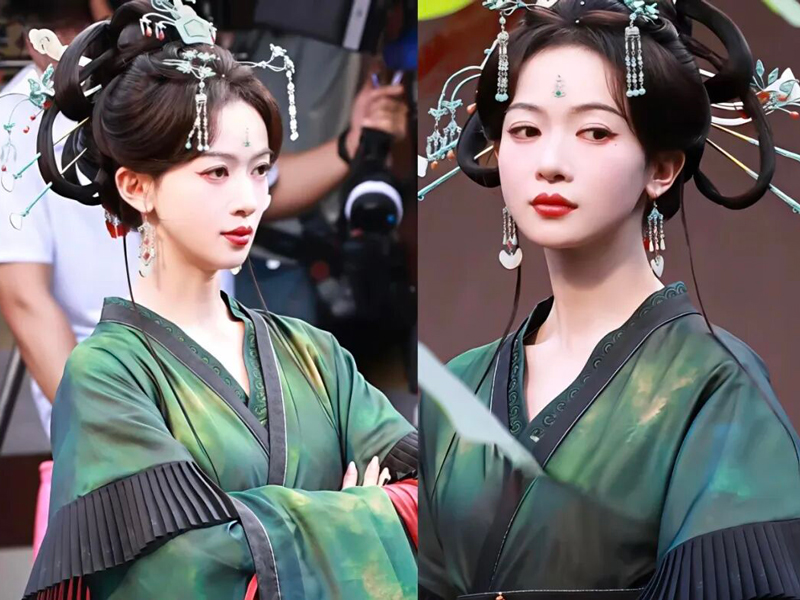
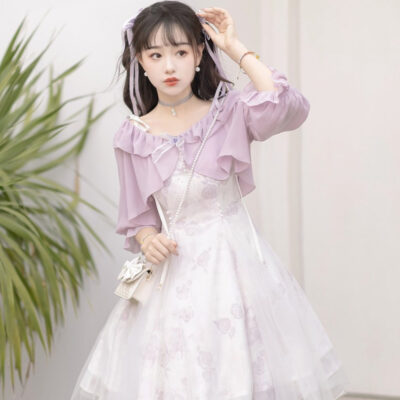
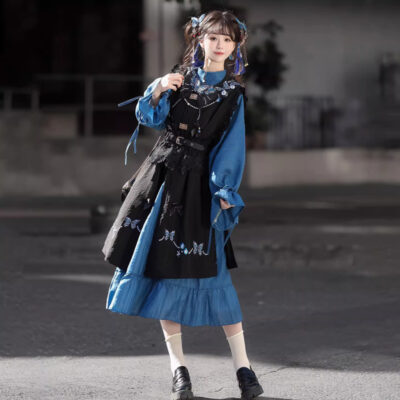
Have you noticed the ruffled edges on Wu Jinyan’s (吴谨言) costumes in the recent set photos from the historical drama Feng Bu Qi (凤不栖)? They flare from her cuffs and cascade along her skirt hem, looking almost like something off a modern runway. Some viewers have wondered: isn’t this a contemporary design choice? After all, such playful frills seem rare in other costume dramas.
But here’s the surprise – those delicate waves are not a recent invention. They trace back to the Hanfu of the Wei-Jin (魏晋) period, over 1,600 years ago. Far from being a foreign fashion import, this ruffle detail was a signature element of daily wear during the Eastern Han through the Sui and Tang dynasties, peaking specifically in the Wei-Jin era. It appeared most frequently on half-sleeve garments, creating a look that was both airy and structured. So, when you see Wu Jinyan’s character floating across the screen, you are actually witnessing a forgotten chapter of Chinese sartorial history – one that connects ancient elegance to our present-day curiosity.
Ancient Origins
Why did Wei-Jin women love these ruffled hems so much? The answer lies in their pursuit of freedom. After the fall of the Han dynasty, social norms loosened, and clothing followed suit. The famous “broad robe and loose belt” style became a symbol of intellectual escapism. Ruffles – or what we call “lotus leaf edges” – naturally fit this aesthetic. They were not stiff or symmetrical. Instead, they rippled like water ripples, moving with the wearer’s body.
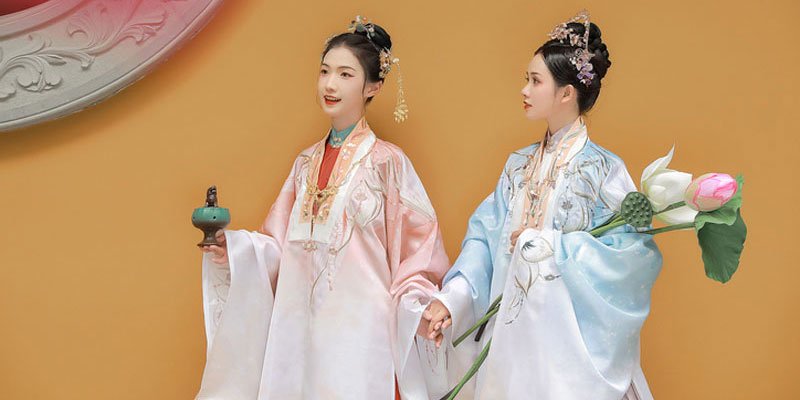
Most examples survive on half-sleeves, a type of short-sleeved outer layer worn over longer undergarments. Historical records and excavated murals show that these ruffles were often clustered at the cuff openings and along the bottom hems of ru (襦) skirts. One can imagine a noblewoman strolling through a Wei-Jin garden, her sleeves swaying like layered petals – no modern designer needed.
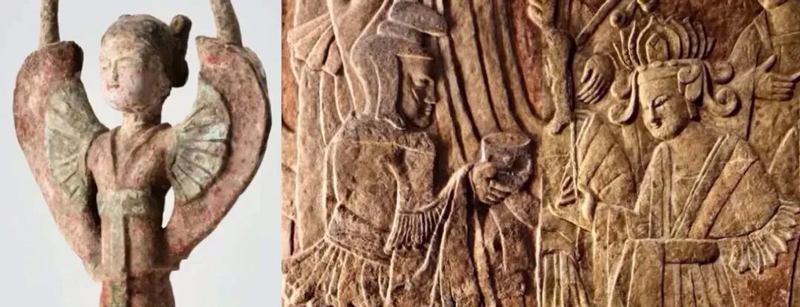
But here is the technical twist. Archaeologists have identified two possible constructions for this ruffle effect. The first is a detachable Yuxiu (羽袖) – literally “feather sleeve” – a separate accessory tied onto the main sleeve with ribbons. Several tombs from the period have yielded fabric fragments matching this description (see Figure 3 in the original Chinese source). The second method was more permanent: the ruffle was directly sewn onto the sleeve’s edge, becoming one continuous piece with the garment. Both approaches produced that soft, undulating silhouette. Yet neither was random. The placement was remarkably consistent: half-sleeve cuffs, ru skirt hems, and the lower edges of short jackets. This suggests a codified fashion system, not an occasional whim. The Wei-Jin people had rules for their ruffles – they just happened to look effortlessly spontaneous.
Silk Road Fusion
Where did this idea come from? Was it purely homegrown? Not exactly. The Chinese article points to evidence from the Western Regions, specifically a Loulan (楼兰) artifact found in the Tarim Basin. That excavated garment shows ruffles sewn directly onto sleeves, indicating a potential transmission of style along the Silk Road. As traders and travelers moved between Central Asia and the Central Plains, textile techniques and decorative tastes mingled.
The Wei-Jin court, despite political fragmentation, remained open to these exotic influences. So, the ruffle might be an early example of “fusion fashion” – a blend of native Han love for flowing drapery and foreign border decorations from Sogdian or Kushan cultures. It makes perfect sense: the Silk Road did not just carry silk; it carried the very idea of what a beautiful edge should look like.
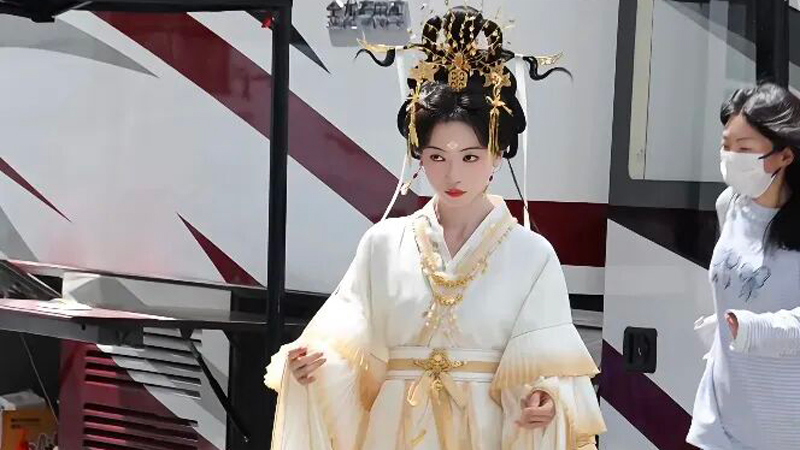
This hybrid origin also explains why the ruffles felt so dynamic. Contemporary texts describe how a woman in motion would create a “floating fairy” impression. The layered folds caught light and shadow, while the narrow attachment points (either tied or stitched) allowed maximum movement. Compare this to the later, more rigid borders of Song and Ming clothing – the difference is night and day. Historical documents like the New Book of Tang (新唐书) confirm that such half-sleeve ru skirts with ruffled edges were standard attire for the court ladies of the Eastern Palace. One passage states: “The half-sleeve ru skirt is the regular serving garment of the Eastern Palace’s female historians.” So, these frills were not marginal or eccentric. They were official, widespread, and deeply connected to cross-cultural exchange. The Wei-Jin woman wearing a ruffle-edged Yuxiu was making a statement: she was simultaneously traditional and cosmopolitan.
Lost Then Found
After the Tang dynasty, however, the ruffle vanished from mainstream Chinese clothing. Why? The aesthetic pendulum swung toward restraint. The Song and Ming dynasties favored clean lines, modest silhouettes, and subdued decorations. Flamboyant edges were seen as frivolous, even improper for Confucian orthodoxy. Court dress codes became stricter, and everyday fashion followed suit. By the Ming era, you would hardly find a lotus leaf edge on any respectable garment.
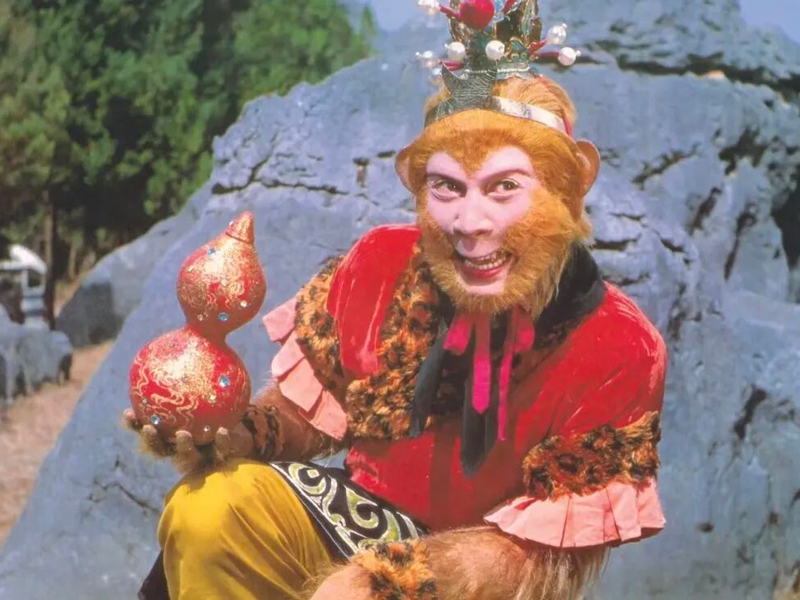
The ruffle did not disappear because it was ugly – it disappeared because tastes changed. It retreated into the margins, surviving only in a few niche contexts. One of those contexts was traditional opera. Theatrical costumes, especially those for martial or supernatural roles, kept the ruffle alive for its visual drama. When you see a Peking Opera performer twirling their sleeves, those fluttering edges are a direct echo of the Wei-Jin yuxiu.
Fast forward to today, and the ruffle is experiencing a comeback. Historical drama creators, including the costume team behind Feng Bu Qi, have rediscovered these ancient patterns. They are not inventing something new; they are reviving something old. Even some contemporary fashion brands have incorporated lotus leaf edges into summer dresses and blouses. Online, sharp-eyed viewers have pointed out that even the Monkey King from traditional opera wears similar ruffled sleeves – a delightful cultural Easter egg. So, the next time you see Wu Jinyan’s character on screen, do not dismiss those ruffles as an anachronism. They are a quiet reminder: our ancestors were trendsetters too. The question is not whether ancient Chinese fashion was “ahead of its time.” The question is: why did we ever stop wearing it? Would you let those flowing edges back into your wardrobe?