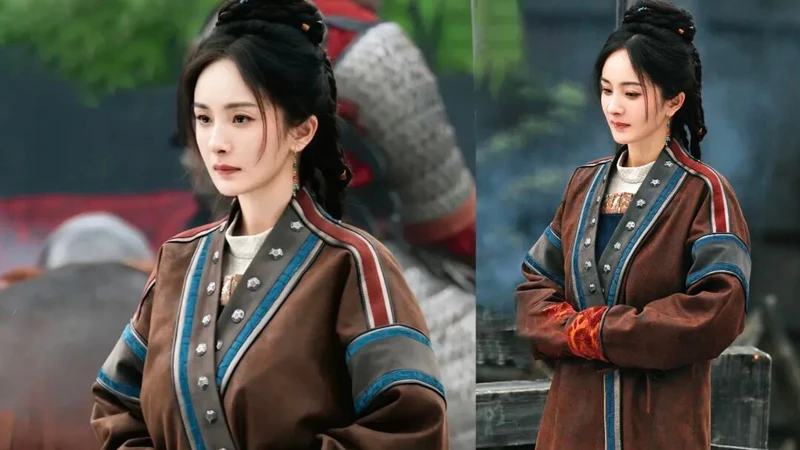
When Yang Mi (杨幂) appeared in the first stills from her upcoming historical drama Jiangshan Datong (江山大同), viewers immediately noticed something unusual about her robe. The garment featured multiple parallel bands of colored trim running along the collar, sleeves, and shoulders—a design that looked strikingly modern, almost like something off a contemporary runway.
Netizens asked: Did ancient people really invent this layered, striped look? The answer is yes, but with a twist. The robe also displays a Zuo Ren (左衽, left-crossed collar), which differs from the traditional Hanfu You Ren (右衽, right-crossed) style. That left lapel signals Xian Bei (鲜卑) nomadic influence, as the Xian Bei people favored this cut for horse riding and archery. So what looks like a modern fashion statement is actually a clever fusion of ancient practicality, ethnic identity, and artistic expression—all stitched into one garment.
Ancient Stitching Secrets
The technique of adding multiple layered trims—what we might call “banded appliqué”—did not begin with Jiangshan Datong. Archaeologists have found clear evidence from the Wei-Jin (魏晋) period, roughly the third to fifth centuries. Two key discoveries stand out. The first is a Jin Ru (晋襦, a short jacket from the Jin dynasty) unearthed at the Huahai Tomb (花海墓) in Gansu Province. The second is a similar short Ru from the ancient kingdom of Lou Lan (楼兰), near the dried-up Lop Nur in Xinjiang. Both garments show multiple sewn-in strips of contrasting fabric running along the sleeve seams and hem. These were not random decorations. They were structural inserts placed exactly where the sleeves joined the body and where the lower panels split.
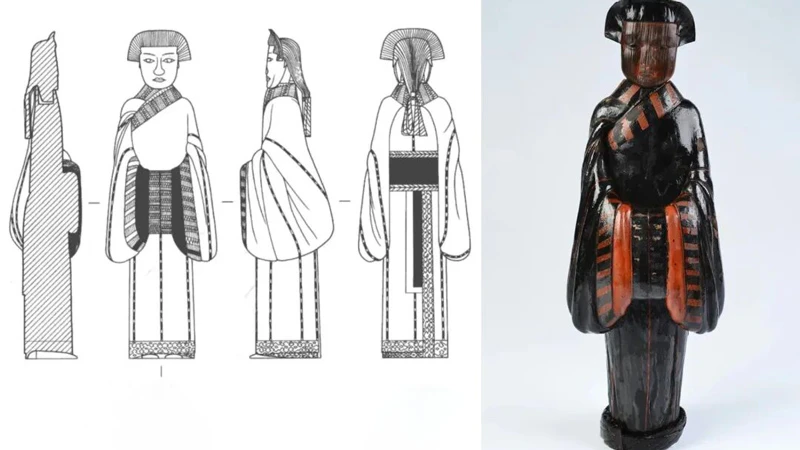
Even earlier examples exist. At the Shayang Huangxie (沙洋黄歇) site in Hubei Province—the legendary resting place of Chunshen Jun (春申君), a noble from the Warring States period—excavators recovered a painted lacquer figurine from a Warring States tomb. On that tiny wooden figure, you can see identical insert strips at the sleeve joints and along the lower hem splits. The pattern is unmistakable: a narrow band of different color or weave inserted into the seam. So the idea of breaking up a garment’s surface with striped inserts is at least 2,300 years old. It was not a foreign import but a homegrown Chinese tailoring trick that later mingled with steppe traditions.
More Than Decoration
Why did ancient sewers go to all that trouble? Two reasons stand out. The first is pure thrift. Weaving cloth was labor-intensive, and fabric was precious. After cutting out the main pieces of a robe, a tailor would be left with odd-shaped scraps—long thin triangles, curved offcuts, frayed edges. Instead of throwing these away, they sewed them into long strips and inserted them into the seams. The result was a zero-waste design that also created unique, often irregular stripe patterns. Some minority groups in southwest China still use this method today, turning leftover fragments into signature decorative bands that no factory can replicate.
The second reason is hard-wearing practicality. For nomadic herders on the Mongolian Plateau—ancestors of the Xian Bei—clothing had to survive daily abuse. The collar, cuffs, and front placket take the worst beating: rubbed by saddle leather, snagged by brush, stiffened by wind-blown dust. A thin silk or hemp robe would shred within weeks. But if you added a thick, tight-weave wool or leather strip along those high-friction zones, the robe lasted for seasons. Think of it as the ancient equivalent of putting anti-scuff patches on a backpack’s corners. The insert strip took the damage, while the main fabric stayed intact. It also kept the garment’s shape from sagging—a stiffer edge prevented the collar from flopping open or the sleeves from bagging out at the elbows.
Colors of the Silk Road
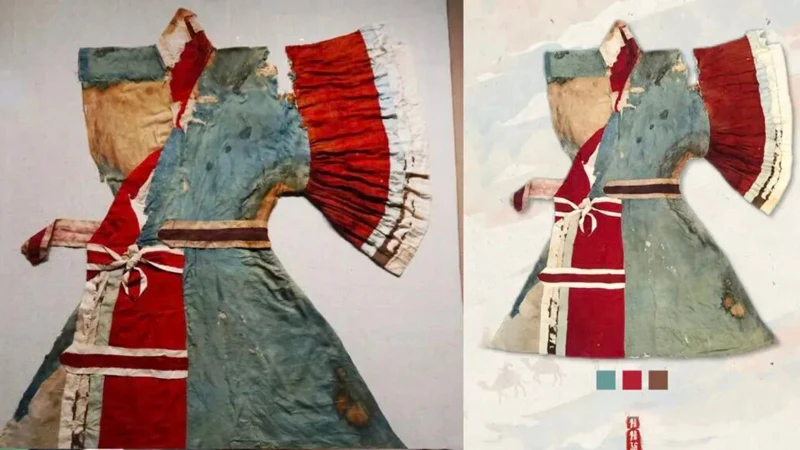
Yang Mi’s costume in Jiangshan Datong uses a brown leather robe with blue, red, and gray trims. That exact palette appears on a famous Lou Lan brocade garment—a red-blue-white striped silk jacket recovered by Aurel Stein a century ago. The Lou Lan piece uses multiple narrow bands of different colors woven together, then cut and reapplied as edging. So the drama’s design team did not invent this color scheme. They borrowed it directly from a Silk Road tomb. The Hexi (河西) Corridor, through which Lou Lan once traded, was where Central Plains silk met Western Regions wool and felt. That meeting ground produced a hybrid aesthetic: the fitted cut of nomadic coats combined with the colorful layered bands of oasis-city weaving.
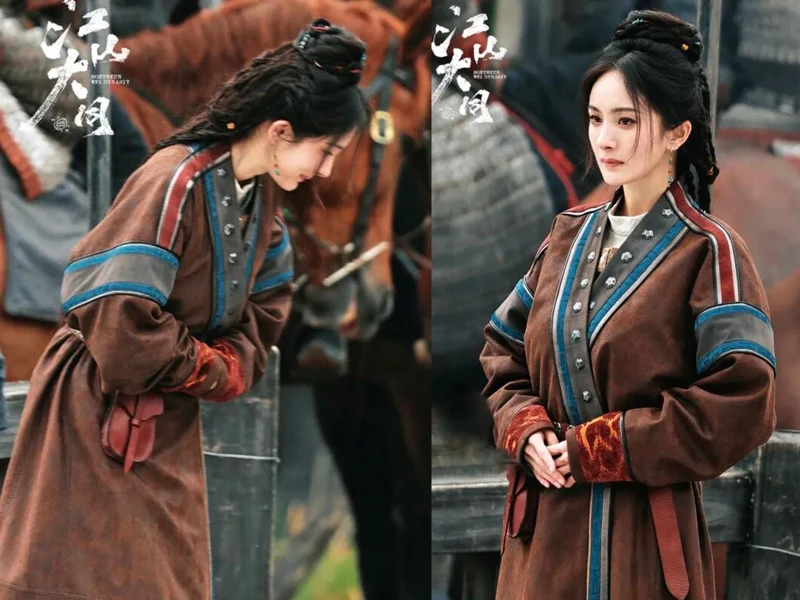
The Xian Bei, as a nomadic people, originally wore fur robes and coarse wool garments—a tradition they shared with other steppe groups from the Altai Mountains to the Black Sea. But when they moved south into northern China during the Sixteen Kingdoms period, they encountered the sophisticated seamwork of the Jin dynasty tailors. The result was a wardrobe upgrade: they kept their practical left-crossed collars and leather materials, but added the multi-strip insert technique from the agricultural south. Yang Mi’s brown robe in the drama is exactly that hybrid—a Xian Bei silhouette with Wei-Jin surface detailing. The bands are not just pretty lines. They are the stitching together of two worlds: one that rode horses and one that farmed millet, both trying to protect their clothes from falling apart.