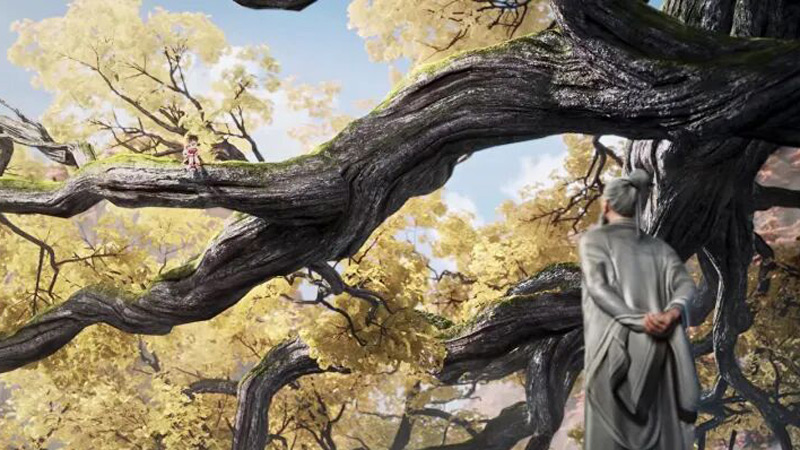
Li Baoping (李宝瓶) met her new teacher at Shanya Academy (山崖书院) and immediately decided he was not as smart as her previous ones. She then climbed a tree to prove her point. What does a nine-year-old’s act of rebellion tell us about the nature of learning, the art of aging gracefully, and the unconventional paths to becoming a true master? This story from the Sword of Coming (剑来) animation reveals that wisdom often hides in the least expected places—and sometimes, it’s found perched on a tree branch.
A Master’s Age Is Not His Wisdom
When Li Baoping arrived at the Shanya Academy in the Sui Dynasty, she carried a letter from her little uncle, Chen Ping’an (陈平安). This letter was not just paper and ink; it was a treasure she read daily, a testament to the deep bond they shared. Her first impression of her new instructor, Mao Xiaodong (茅小冬), was not formed in the classroom. It was formed from a tree. Perched on a branch, she surveyed the academy grounds, a place that felt far less magical than the world she had left behind with her previous mentor, Qi Jingchun (齐静春).
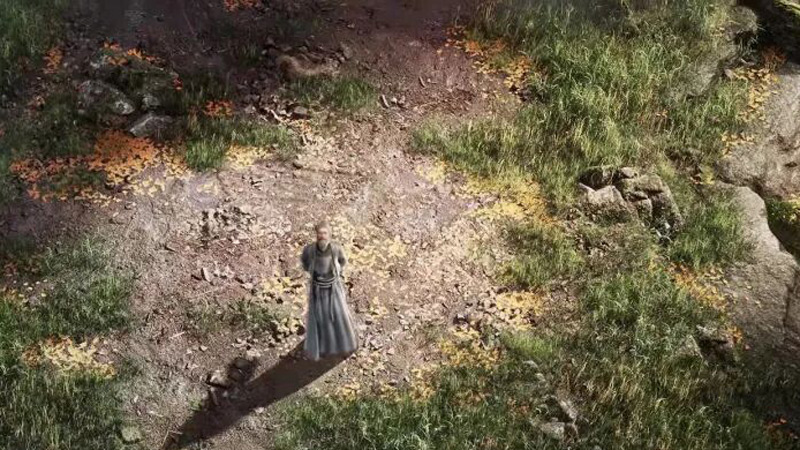
Mao Xiaodong caught her in the act. Instead of scolding her, he was met with a peculiar invitation: she asked him to join her in the tree. He refused, of course, pointing out the absurdity of the situation. He saw her game. If he climbed up, he would be admitting that he, too, was above the rules. Their interaction was sharp, playful, and revealing. Li Baoping looked at this man and concluded he was old—much older than the refined Mr. Qi. The irony, however, was that Qi Jingchun was the senior in years. He just happened to be exceptionally good at taking care of himself.
This moment plants a crucial seed. It suggests that a teacher’s true age is not measured in years but in the spirit of their teaching. Qi Jingchun had a timeless quality, a youthful energy that made his lessons feel alive. Mao Xiaodong, burdened by the weight of the academy’s establishment, seemed older in contrast. Li Baoping’s childish judgment cuts to a profound truth: the most effective teachers often defy the conventional image of an educator. They are not defined by how long they have lived, but by how vibrantly they engage with the world and their students.
Learning Beyond the Confucian Canon
Li Baoping was not the only student at Shanya Academy who struggled to conform. Lin Shou spent his days skipping class, immersing himself solely in Daoist texts while refusing to touch a single Confucian book. Li Huai (李槐), on the other hand, appeared to be doing nothing at all, sleeping through the day. To the traditional academic, this would be a disaster. To a keen observer, it is a rebellion against a system that tries to force everyone into the same mold. The academy represented a structured, rigid form of learning, but these children instinctively sought knowledge in ways that resonated with their own natures.
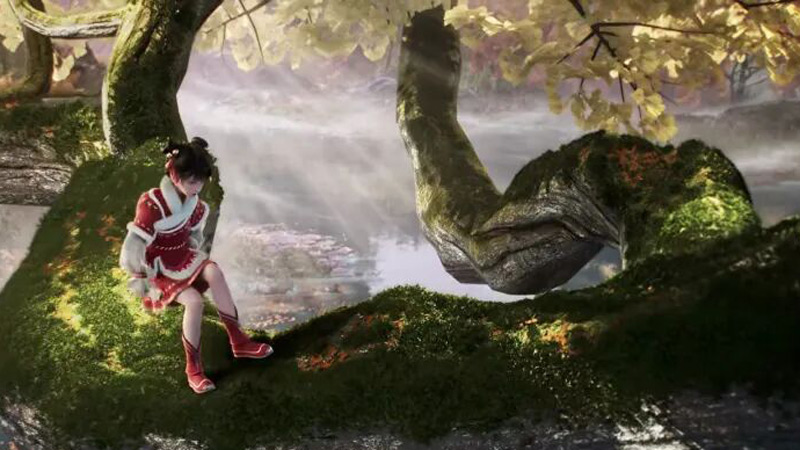
Mao Xiaodong, for all his sternness, had a history of breaking molds himself. He had founded Shanya Academy alongside Qi Jingchun, a partnership of equals in vision, even if not in scholarly repute. His experience was deep, and his understanding of human nature was sharp. This is why, when Cui Dongshan (崔东山) arrived, Mao Xiaodong’s reaction was so visceral. His immediate hostility towards Cui Chan’s (崔瀺) incarnation was not petty jealousy. It was the reaction of a principled man who had likely seen the destructive side of ruthless ambition. He was not afraid of a confrontation, as later shown when he supported Li Er’s explosive visit to the Sui imperial palace. He understood that sometimes, true education involves standing up against power, not just reciting ancient texts.
The story subtly champions a pluralistic view of education. Qi Jingchun’s elegant teaching style, Chen Ping’an’s raw, unlettered wisdom, and Mao Xiaodong’s stubborn integrity all represent different paths. Li Baoping, in her heart, compared them all and found her “little uncle” supreme. She declared to Mao Xiaodong that his knowledge was inferior to Qi Jingchun’s, and far inferior to Chen Ping’an’s. She added a cheeky caveat: if her little uncle could just learn to read a few more characters, his superiority would be absolute. This is the judgment of a child who values heart, courage, and genuine connection over formal credentials and accumulated years.
An Unlikely Path to Mastery
Chen Ping’an’s own journey to becoming a master was anything but conventional. His initial encounter with Cui Dongshan was marked by lethal intent. He gave him two sword-qi haircuts, a permanent reminder of the threat he posed. Cui Dongshan’s personality was grating, and Chen Ping’an, a man who barely knew his own characters, felt it was absurd to take on a disciple. He was a swordsman, a man of action, not a traditional scholar. The idea of teaching was foreign to him, born from necessity and a deep-seated desire to protect.
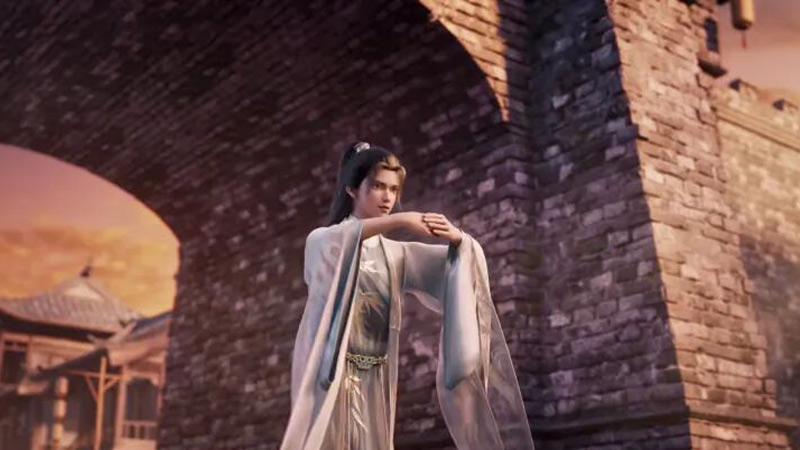
The turning point came not from a scholarly debate but from an act of responsibility. Cui Dongshan promised to return to the Sui Dynasty and look after Li Baoping, Lin Shou, and Li Huai. This simple promise was the key. It was a gesture that proved his loyalty and demonstrated an understanding of what Chen Ping’an valued most: the safety and well-being of those he loved. At that moment, the dynamic shifted. Chen Ping’an saw not just a scheming reincarnation, but a potential ally, someone who could be trusted with a sacred duty. This act of trust finally unlocked Chen Ping’an’s acceptance of Cui Dongshan as his student.
This final piece of the puzzle redefines mastery. Chen Ping’an did not seek out a disciple; the disciple was earned through loyalty and a shared purpose. His reluctance, his rough edges, and his unconventional background became his strengths. He was not a polished academic like Qi Jingchun, but he possessed a moral clarity and a protective instinct that proved far more valuable to his charges. In a world obsessed with titles, formal education, and appearances, Li Baoping’s tree-top perspective and Chen Ping’an’s sword-sharpened integrity remind us that true wisdom often grows in the wild, untamed places, far from the orderly halls of an academy.
