
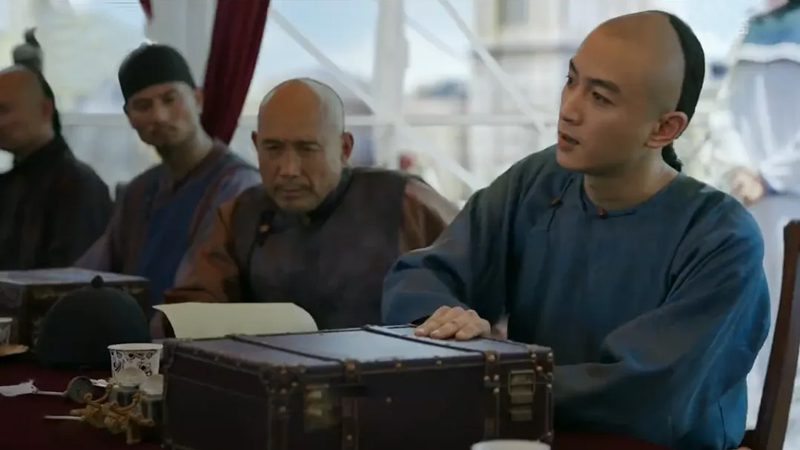
In the bustling port cities of late Qing Dynasty China, where merchants jostled for influence and survival was a daily calculus, a new television drama has captured the nation's imagination. CCTV's hit series, Legend of the Magnate (大生意人), follows the tumultuous journey of Gu Pingyuan (古平原), a scholar-turned-convict who rises from utter destitution to become a commercial titan. His story is more than a tale of personal triumph; it is a masterclass in resourcefulness.
Against the backdrop of social upheaval and fierce competition in places like Shanxi and Nanjing, Gu demonstrates that the greatest capital isn't silver, but strategy. His entire philosophy can be distilled into three powerful principles: leveraging strength, borrowing wisdom, and riding the momentum of the times.
Leveraging Strength
The first lesson Gu Pingyuan masters is the art of leverage. Alone, he is a fugitive with nothing. His true power lies in his ability to identify and utilize the resources of others to achieve his goals. Early in his escape, he is recruited by the wealthy merchant Wang Tiangui (王天贵), who needs help reclaiming control of his pawnshop, Taiyufeng (泰裕丰). The shop is effectively run by three experienced stewards who have sidelined the owner.

Understanding that a direct confrontation would fail, Gu Pingyuan looks outward. He approaches Li Qin (李钦), the owner of a rival pawnshop called Wanyuan Pawn (万源当). Gu proposes an alliance: Li Qin provides the capital, and Gu devises innovative new pawn models like "city-gate pawning" and "doorstep pawning." Their flexible, high-value service quickly attracts the entire city's business, draining Taiyufeng of its customers and rendering the stewards powerless. They resign, and Wang Tiangui regains control. Gu's reputation is made.
This maneuver illustrates a fundamental truth: trying to do everything alone is a path to limitation. Success often hinges on turning other people's strengths—their capital, networks, or influence—into instruments for your own objectives. It is not about what you have, but what you can orchestrate. A solitary thread cannot form a rope; a single tree does not make a forest. Recognizing this transforms impossible tasks into achievable ones.
Borrowing Wisdom
No one is an island of knowledge. Gu Pingyuan’s second principle involves tapping into the accumulated wisdom of those who came before him. When faced with a novel crisis, he does not rely solely on his own ingenuity. Instead, he finds parallels in history. A critical test comes in postwar Nanjing. The city's economy is shattered, and tens of thousands of unpaid, restless soldiers camp outside its walls, threatening rebellion.

Tasked with reviving the economy to fund the soldiers' pay, Gu recalls a strategy used by the ancient statesman Guan Zhong (管仲): using entertainment to stimulate commerce. He focuses on the historically famous Qinhuai River (秦淮河) district. To restart its economic engine, he needs to attract patrons. In a bold move, he involves the reluctant Regional Viceroy, Rui Lin, in the restoration effort, even coaxing him to visit the restored pleasure boats. The viceroy’s visible, albeit awkward, participation becomes a powerful spectacle.
The "celebrity" endorsement works. Curiosity and business flood back to the Qinhuai River, money begins to circulate, and the crisis is averted. Gu’s action embodies the proverb, "Stones from other hills can polish jade." Stubbornly relying on one's own limited perspective is rarely the solution. Studying the successful strategies of others, whether historical figures or contemporary experts, provides a shortcut through complex problems. It allows one to stand on the shoulders of giants, seeing further and moving faster toward a solution.
Riding Momentum
The final and perhaps most potent principle is understanding and harnessing "Shi" (势), or the tide of the times. Personal effort and intelligence can achieve modest gains, but transformative success requires catching a powerful wave. Gu Pingyuan learns this through his village's tea business. Despite producing excellent tea, the farmers are exploited by a local tea guild that monopolizes trade and sets unfairly low prices.

Gu believes in the quality of their tea, known as Lanxue Tea (兰雪茶). He borrows money to buy the entire village's harvest, aiming to sell it independently. Yet, he is blocked at every turn within Anhui province due to the guild's influence. His breakthrough comes from looking beyond the local landscape. He learns of a prestigious "Ten Thousand Teas Convention" in the capital. This is the tide he needs.
At the convention, through a combination of luck and quality, his Lanxue Tea gains the favor of the Empress Dowager Cixi (慈禧), who proclaims it the "finest tea under heaven." Overnight, its status and demand skyrocket. The tea that no one would buy becomes priceless. Just as fish need water to swim and plants require the right season to grow, commercial endeavors need favorable conditions. Discerning the larger trends—technological shifts, cultural movements, or political changes—and positioning oneself within them is what turns small ventures into legendary successes. It is the difference between paddling upstream and sailing with the wind.
The enduring lesson of Legend of the Magnate is that Gu Pingyuan's clever strategies are always anchored by his integrity. He understands that business is ultimately about human relationships. Leveraging, borrowing, and riding waves must be done with a regard for shared benefit and a moral compass. As he states, temporary losses are acceptable if the final ledger shows a gain, not just in silver, but in reputation and trust. In the end, the drama argues that mastering the methods of wealth is crucial, but building character is what allows one to truly keep it.
