
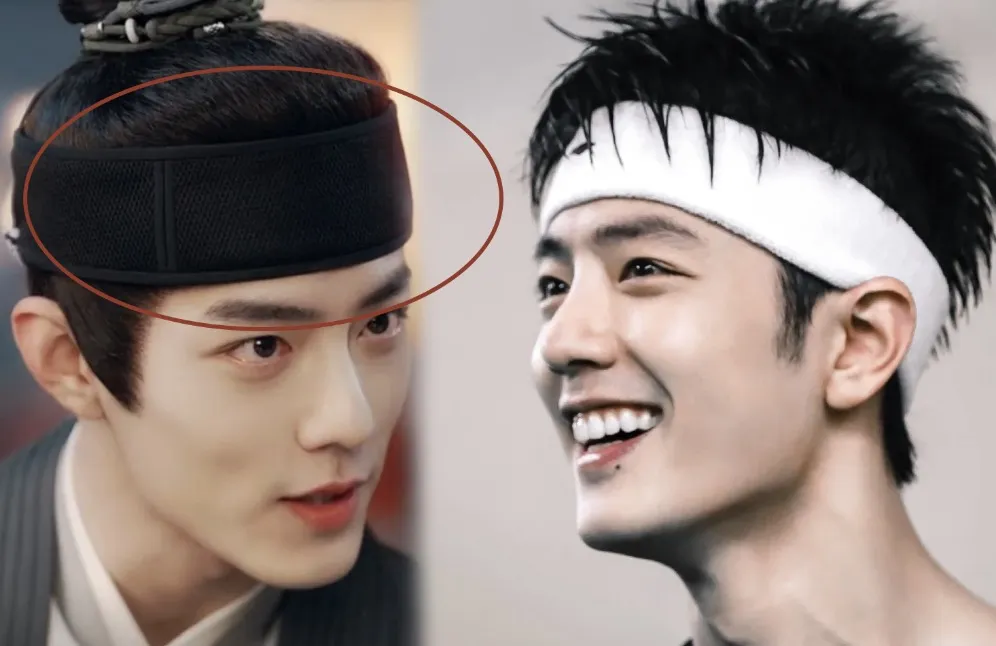
In the ancient costume cdrama The Legend of Zang Hai, when Xiao Zhan's character Zang Hai makes his appearance, he wears a similar 'hairband'. Netizens are saying, 'Isn't this the essential hairband for modern sportswear? Was it already around in the Ming Dynasty?' Let's start with the answer. It's a 'net cap' from the Ming Dynasty, more precisely, a simplified version of the Lazy Net Cap (懒收网巾) that was popular in the late Ming Dynasty.
The net cap was a net-like headdress used by adult men in Ming Dynasty China to tie up their hair and gather loose strands. It has the same function as modern 'hairbands'. It can not only gather loose hair but also prevent hats from slipping. It's actually quite practical. The net cap could be worn alone in daily life. In the Ming Dynasty, people of status had to wear a cap over the net cap when attending important occasions. However, for convenience in daily life or among common people, they often didn't need to wear other hats after putting on the net cap.

The popularity of the net cap can be attributed to Zhu Yuanzhang. It's said that one day, Zhu Yuanzhang visited the Shenleguan in plain clothes. There, he saw a Taoist priest weaving a net cap by the light. Out of curiosity, he asked the priest what it was for. The priest explained that it was used to fix and arrange hair. The next day, Zhu Yuanzhang immediately ordered a national announcement, requiring people of all ranks to wear it. He also wore the net cap in his regular clothes. These are all recorded. According to History of Ming Dynasty - Records of Clothing and Adornment, 'In the 24th year of Hongwu, the emperor went incognito to the Shenleguan and saw someone making a net cap. The next day, he ordered the net cap to be taken and shown to the thirteen provincial administrative commissions. Everyone, regardless of their status, wore the net cap. Thus, the emperor also often wore the net cap in his regular clothes.'
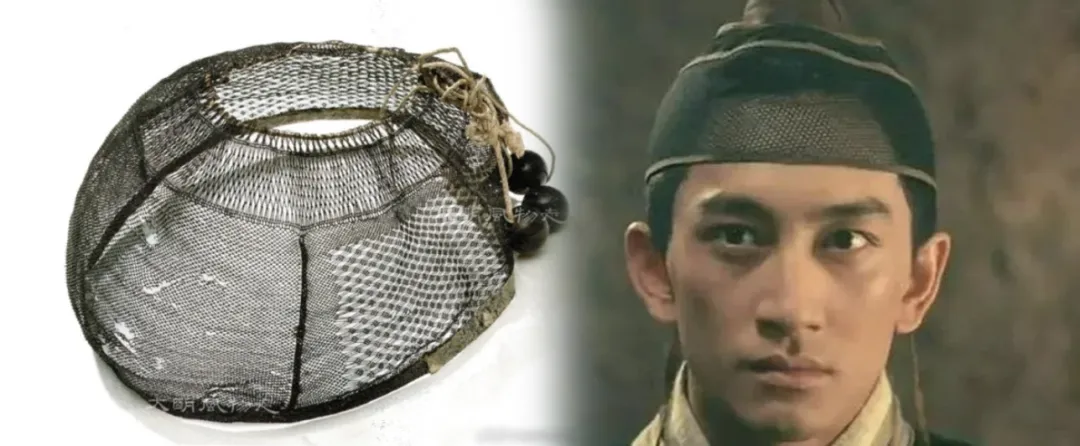
The net cap is 'tied on the head with the edge level with the eyebrows'. There is a drawstring at the top, and the part with the drawstring is called the 'net belt', which is tied at the topknot. There are also small strings at both ends of the bottom edge, which pass through two small jade or metal rings (the net cap rings) and are tied to fix it. The net cap is mostly woven from black strings, horsehair, or bristle silk. It can also be made of silk or hair. Generally, the net cap is in a net shape, hence the name.
In the late Ming Dynasty (note it's the late Ming Dynasty!), a style called the 'Lazy Net Cap' emerged. It's actually a simplified version of the net cap. Initially, the net belt was omitted, and only the small strings at the bottom edge were used to tie it. Later, the upper part of the net cap was also omitted, leaving only the lower half, mainly in a shape that is high (wide) in the front and low (narrow) in the back. According to Yin'an Suoyu, 'During the Tianqi period, prisoners found it difficult to remove the net cap in a hurry, so they cut off the net belt and only tied the lower part of the net, naming it the Lazy Net Cap for easy removal from the top. Some common people imitated it, but scholars and gentlemen looked down on it. When I was wearing a cap, I still regarded the Lazy Net Cap as a prisoner's cap and still used the net belt. In the past ten-odd years, everyone in the world has been wearing the Lazy Net Cap, and the system of the net belt has disappeared.'
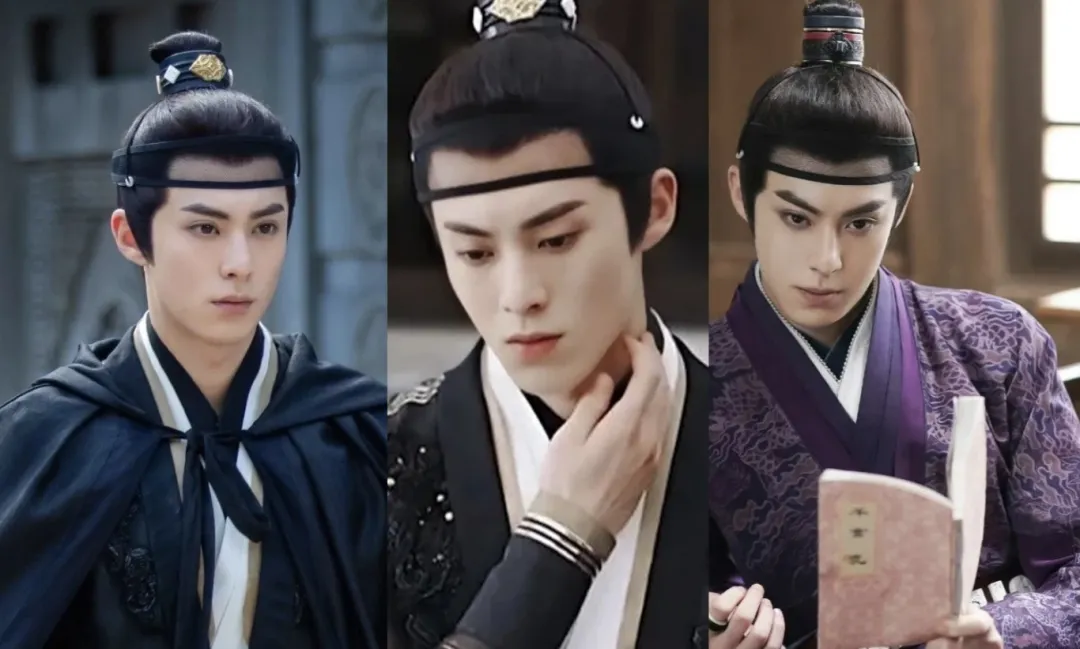
Do you think only men wear it? Actually, there was a similar accessory in the Tang Dynasty. It had a pointed arc at the front (the structure is unclear), and women also wore it. It's called 'Tou'e Luo'. It was mainly used by women to conveniently dress up as men and tie up their hair. In Yuan Zhen's poem 'To Liu Caichun' of the Tang Dynasty, it says, 'With a new and delicate makeup on her eyebrows, she casually wraps the Tou'e Luo from Changzhou.' This accessory symbolizes that women are wearing a futou and is usually paired with a round-collared robe.
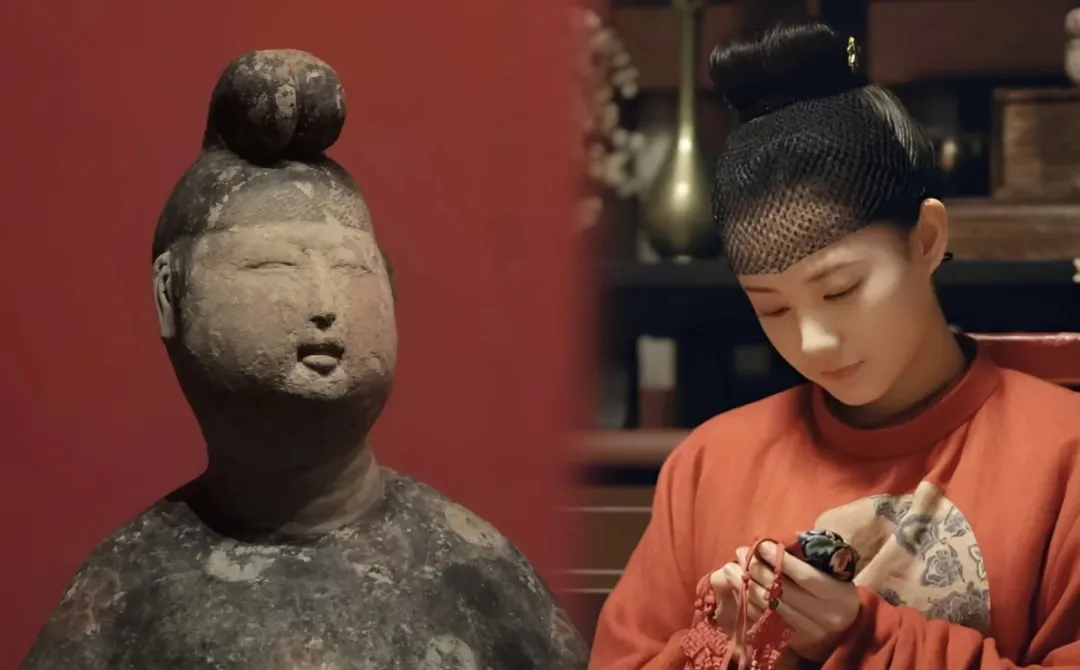
Many people mistake Chinese net cap styles for Korean ones. You should know that the late Ming Dynasty's Lazy Net Cap is high (wide) in the front and low (narrow) in the back, usually wide in the middle and narrow at the sides, without black cloth on the sides, and is a full-net structure. The net caps in Korea and Vietnam clearly learned from China. After understanding this, at least you won't make such a joke.
In conclusion, the net cap is a unique and practical headdress with a long - standing history in Chinese culture. Its evolution from the full - fledged net cap to the Lazy Net Cap reflects the changes in fashion and practical needs over time. And the fact that similar accessories were used by different genders in different dynasties shows its wide - spread influence and adaptability.

