-

Wear Hanfu, Enter Free at Guangzhou's Zhengxiandan Festival
On September 6 the 15th Zhengxiandan Culture Month opened at the hilltop square of Mingchun Valley (鸣春谷) on Baiyun Mountain in Guangzhou, and it runs through September 19 under the theme "Roam the Cloud Mountain, Pray for Wellness". The day's clearest invitation was aimed at Hanfu wearers: anyone entering in period dress through the South Gate between 9 a.m. and 6 p.m. skipped the admission fee, part of a program that folds intangible-heritage customs, forest wellness, Guochao (国潮) experiences and outdoor sports into one southern Guangdong celebration. Locals call the fete "Guangzhou's first birthday festival," a title earned over more than 1,600 years. It honors Zheng Anqi (郑安期), an alchemist-physician of the late Qin dynasty said to have gathered herbs on the mountain to heal the sick before ascending to immortality from its cliffs. The opening ceremony staged Aoyun Xianzong, an original play retelling the tale of Zheng gathering sweet flag to drive out plague, and premiered "Cloud Mountain Has Stories", a promotional song for Baiyun Mountain written by well-known Guangdong musicians. Guangdong TV's official platform Yue TV (粤TV) streamed the ceremony, drawing more than 200,000 online viewers. Beside the opening stage ran the Aotou wellness temple fair, laid out…- 0
- 0
- 9
-
Wangcheng's Farm Bounty Flows to Tongguanyao's Night Market
The argument for an evening at the Tongguan kiln begins with a single bite. Kiln-roasted preserved-plum peanuts, warm from the stall, crack open salty-sweet with a faint hint of smoke; beside them a cup of Chating blueberry wine finishes clean and round. That pairing, one snack and one pour, is the taste of the "Wangcheng Fine Goods: Water-and-Land Market", which opened on the evening of August 29 in the square of the Mingyue Tower restaurant at the Tongguanyao Guofeng Park (铜官窑国风乐园) in Wangcheng District, Changsha, launched by the district's Agriculture and Rural Affairs Bureau to bind local farm products to the scenic area's tourist traffic. Stalls run along the plaza walkways and down to the water's edge, a layout the organizers call "water and land" in one market. Tongguan fruit is crisp and sweet, Jinggang dried mushrooms snap with umami, Qiaoyi's sauced goose is hot and chewy, and Qiaokou fried fish fillets come out crisp outside and tender inside. Between the food tables, shadow puppetry and sugar painting keep the Tang-style setting company, and Hanfu-clad visitors stop to photograph the lantern-lit plaza. "Last weekend we set up 20 stalls and took more than 20,000 yuan in on-the-spot sales, and many…- 0
- 0
- 0
-
Guipei Wangu Qipao Show Unites 100 at Xiushui Village
A hundred people took the stage together on the night of August 22 at Xiushui Zhuangyuan Village (秀水状元村) in Fuchuan Yao Autonomous County, Guangxi: professional models and representatives of a hundred qipao associations performed side by side for the Guipei Wangu Qipao melody show. The show was the centerpiece of the "Top of the List, Victory at First Try" 2026 Zhuangyuan Culture and Tourism Season, a four-day program from August 21 to 24 that also ran a familiarization tour for a hundred travel agents through the county's core sights — the Ancient Ming City, Fairy Lake, the Shenjian Stone Forest, Chashan Village, Fuxi Village, the golden nanmu forest and Mao'er Mountain near Guilin. A Scholar's Village as the Backdrop Xiushui has long sold itself as a scholar's village. Founded in the Kaiyuan reign (开元) of the Tang dynasty more than 1,300 years ago, it is known across the Nanling Mountains (南岭) as the first Zhuangyuan-culture village of the range, its lanes lined with old buildings and stone archways from the exam era. The season used that heritage as the backdrop for Guangxi's own school of qipao tailoring, the Guipei Wangu style, and organizers wanted the brand's name to travel with…- 0
- 0
- 10
-
Xinzhou Qixi Fete Draws 150 Hanfu Fans
August 19, the seventh day of the seventh lunar month, saw the "Wholehearted Love in Xinfu" edition of the national "Our Festival: Qixi" event open at the central square of Qicun Town (奇村镇) in Xinfu District, Xinzhou (忻州市), Shanxi. The program began with a parade of 150 Hanfu enthusiasts organized into Tang-style, Song-style and Ming-style formations, which wound through the square and neighboring streets before a crowd of local residents and tourists. Spectators lined the route with phones raised, and the three formations became the most photographed sight of the day. Program Numbers Performances filled the main stage from 2:30 p.m. to 6:30 p.m. at the square's main stage. The folk music ensemble of Xinzhou No. 1 Vocational Secondary School opened with a combined instrumental piece, "Ascending the Spring Hill," and the program continued with roughly 16 more numbers: the dances "Ode to Rivers and Mountains," "Qixi Elegance," "Powder and Ink: An Age of Opera," "Ode to the Star River," "Hibiscus Like Brocade, Flowers Filling the City," "Rowing Through Misty Rain," "The Weaver Girl," "Ode to the Orange Tree" and "Grain in Ear"; the recited Song poem "Moon over the West River: Night Travel on the Yellow Sands Road"; the…- 0
- 0
- 0
-
77 Couples Wed in Hanfu at Yunxi's Qixi Ceremony
At nine on the morning of August 19, the Qixi Festival, a procession of Hanfu-clad couples began filling Shuiyun Square (水韵广场) in Yunxi County, Hubei. The occasion was the 2026 collective wedding ceremony under the banner "Tianhe Bears Witness, Hearts Settle in Yunxi", which paired 77 couples from Shandong, Heilongjiang, Zhejiang, Anhui, Guangdong, Hunan and Hubei with a full program of traditional wedding customs. Classical ensemble music began the rite. Facing each other in pairs, the couples made their vows, pledging mutual respect, a shared household and lifelong commitment, then recited a joint oath: "Through wind and rain, we will not part; knowing each other, we will build a harmonious family." The crowd behind the ropes answered with applause as the newlyweds exchanged clasped-hand bows in the older style. One pair stood out. Yan Guangfu (晏光富) had delayed his planned July 30 license date in Shanghai and traveled specially with his bride, Xie Danzhen (谢丹珍) of Zhuxi County (竹溪县), to take part. After the ceremony, Xie said the town had lived up to its billing: the Tianhe River (天河) — whose name also means the Milky Way — glittered with lights on both banks, and the Qixi Square, the magpie…- 0
- 0
- 7
-
70 Stalls Greet Shoppers at Wuhan's Street Market
Just before 17:30 on the opening afternoon, a troop of Hanfu-clad cosplayers stepped onto the paving stones of Changdi Street (长堤街) in Wuhan, and the crowd that had been working its way along the stalls turned to watch. The moment was part of the street market that opened on August 28 beside the Baoshou Bridge (保寿硚) on Hanzheng Street (汉正街), the old commercial spine the city once called the "living fossil" of its business history. The fair runs daily from 10:00 to 22:00 until September 3. The market lines up more than 70 vendor booths, and six in ten of the businesses are making their Wuhan debut. The stalls are grouped into four zones: the Hanzheng old-brand food quarter, a Hubei heritage-handcraft area, a college makers' zone and a trend-and-newcomer strip. Shoppers can eat local snacks, watch ICH craft demonstrations, browse student-designed products and try DIY workshops. The opening also doubled as the launch event of the 2026 Hanzheng Street International Fashion Week, making this the century-old street's first big showcase after a full upgrade. A Schedule of Street Performances Afternoon performances ran on a tight timetable. A Chinese-style band led the entertainment; then came three back-to-back passes of "Punk…- 0
- 0
- 6
-
Xiwangmu Peach Festival Opens With a 1,000-Seat Feast
At dusk on August 21, the two blocks of Yaochi Tianjie (瑶池天街) filled with tables placed end to end, and servers dressed as the fairies of the Jade Pool moved down the line with platters. The moment marked the opening of the 2026 Xiwangmu Yaochi Peach Festival (西王母瑶池蟠桃会) at the Tianshan Tianchi (天山天池) scenic area in Fukang, Changji Hui Autonomous Prefecture, Xinjiang. The event runs through August 28 across two venues, the lakeside scenic area and the Yaochi Tianjie pedestrian street, under the theme "Splendor of Tianshan, a Feast at Yaochi." An Opening Ceremony on the Lakeshore Opening ceremonies unfolded at the Haibei Platform (海北平台) by the lake, led by drum music titled "Drum Rhythms of Fukang." Liu Likun (刘力坤), a scholar of Xiwangmu culture and head of a research studio on Xiwangmu mythology named after her, argued in her keynote that Tianshan Tianchi has been regarded since antiquity as the place where the goddess Xiwangmu held her peach feasts. She cited the Classic of Mountains and Seas and the Mu Tianzi Zhuan (穆天子传), and noted that the Xiwangmu myth is now a national-level ICH item. The festival, she said, turns the myth in old books into a tangible celebration,…- 0
- 0
- 7
-
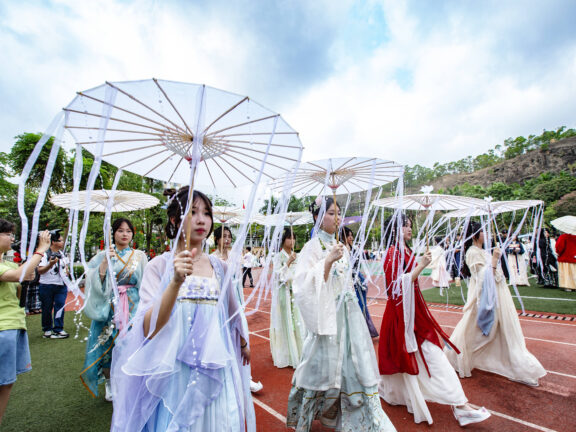
Zhuhai Guyuan Art Museum Launches Wei-Jin Hanfu Exhibition
At 14:30 on August 12, 2026, "Wei-Jin Hanfu: A Survey of Period Dress" — part of the museum's traditional-culture costume program — opened at Gallery 5 on the second floor of the Zhuhai Guyuan Art Museum. The exhibition runs from August 7 through 10:30 on the morning of August 16, anchoring the venue's summer programming around traditional Chinese dress and part of a wider regional push to weave traditional craft heritage into public exhibition calendars. It joins two other shows to form the August arts lineup, and the opening drew local heritage enthusiasts and Hanfu club members alike. The "Wei-Jin Hanfu" display focuses on Hanfu forms and dress aesthetics of the Wei-Jin period (220–420 CE), systematically presenting the wardrobe character of that historical stage and giving visitors a close look at traditional costume culture. The era followed the Han and preceded the Northern and Southern Dynasties, and its robe culture prized naturalness over rigid formality — a visible contrast with the tighter ritual dress of earlier courts. Wei-Jin attire is known for its loose, flowing silhouette: wide sleeves and ample hems (Baoyi Bo Dai) that mirrored the period's intellectual turn toward metaphysics and an unrestrained, self-expressive spirit. Lengths fell past…- 0
- 0
- 12
-
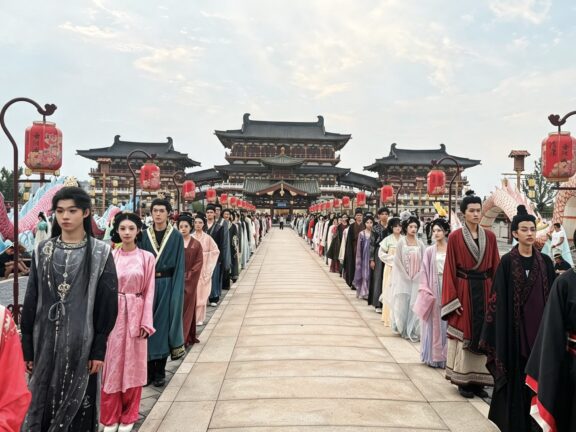
Luoyang Guofeng Show: 200 Models in Boundary-Free Hanfu Spectacle
At 17:30 on August 7, 2026, the "Yiguan Heluo · Luoyi Guofeng Cultural Gala" — a Hanfu culture and Guofeng fashion pageant — opened at Luoyi Ancient City in Luoyang. Jointly hosted by the Luoyang Hanfu Research Institute and the Model Professional Committee of the Henan Provincial Garment Industry Association, with multiple cultural-tourism, cultural-promotion and Hanfu-industry enterprises as co-organizers and supporters, the event draws on Luoyang's millennia-deep ancient-capital heritage and borrows the "boundary-free runway" format from avant-garde fashion tourism to build a fully immersive, borderless Guofeng experience. Luoyang, long called the divine capital of the Tang, positioned the gala as a city-branding move that blends heritage with youth-oriented tourism. The gala fielded an unprecedented lineup: 200 professional models alongside top-tier styling and imaging teams, using the old city's streets, bridges and pavilions as natural stages to create a "one scene, one runway; one step, one view" audiovisual experience that interprets the beauty of Chinese dress and the grace of Hua Xia ritual. The show broke the limits of a fixed T-stage, turning Jinchang Street, Liulin Street, Lide Bridge and Lide Court into open-air runways. Each setting — a stone bridge, a quiet court, a lantern-lit lane — became its own… -
Embroidered Pouch Exhibition Presents 170 Pieces in Shanghai
Why fill a hall with pouches? Because, the curators at Changning's heritage center argue, a Hebao (荷包) is a history of Chinese life folded into palm size. The show "Jinxiu Hebao" — a survey of fine embroidered pouches — opened on August 1, 2026, and runs free of charge through August 30. Set at the Bole Exhibition Hall (博乐展堂) on the second floor of the Changning District Intangible Cultural Heritage Protection Center at No. 95 Beiyu Road, it stays open daily from 9:00 to 16:30, and visitors walk in without tickets or reservations. On display are 170 selected pieces spanning the Qing dynasty to the modern era, drawn from folk collections that the center says had been "forgotten at the lapel and sleeve." A Small Object, a Wide Story The pouch was the everyday pendant of the robe, the girdle and the sleeve. Small enough to hold a lock of hair or a few coins, it was capacious in meaning: auspicious wishes accumulated across a thousand years, plus the habits of a dozen regions. The curators arranged the objects around four lenses — use, color, motif and feeling — each pouch carrying its own temperament, from tender affection to a…- 0
- 0
- 6
-
Guizhou Market Brings Miao Crafts to Beihai Park
An imperial garden in northern Beijing now smells faintly of Guizhou (贵州) pepper and boiling beef broth. The Guizhou Heritage Roots Market opened on August 22 along the lotus-lined east shore of Beihai Park and runs through August 31, an unusual pairing: the ethnic-minority crafts of the mountainous southwest staged inside a former imperial retreat that dates to the Yuan dynasty. The event, titled "Imperial Glow, Enduring Guizhou Flavors", is guided by the Beijing Office of the Guizhou Provincial People's Government and Guizhou Radio & Television Network Media Group, and organized by Jiayou Shopping Group (家有购物) together with the Beihai Park Administrative Office. The ten-day program straddles the last two weekends of the summer holiday and mixes heritage performances, craft workshops, costume try-ons, agricultural-product stalls and a food lane. For Guizhou's organizers it doubles as a window for the province's specialties and culture into the capital's consumer market. Opening day centered on a "Sound in Harmony" stage. Miao (苗族) dancers performed the Lusheng (芦笙) dance in full ethnic dress, the Dong (侗族) people's grand chorus layered unaccompanied voices across the courtyard, and an Anshun (安顺) ground opera troupe acted out classic scenes in carved wooden masks and armor. Between sets,…- 0
- 0
- 14
-
Luchou Silk Festival Returns to Gaoping for an 8th Year
Press a rubbing of a dragon-and-phoenix motif and the structure of Luchou silk (潞绸) becomes visible: warp threads packed so evenly that the woven pattern reads like a painting. That rubbing station, set up inside the Lu-Anfu (潞安府) Luchou Culture Park in Gaoping (高平), Shanxi, is where the eighth Luchou Dragon Phoenix Culture Festival opened on August 19, the evening of Qixi (七夕). The festival runs more than 40 days, until the end of September, under the theme "One Rite for Family and Nation, Splendor Across Mountains and Seas". Its opening event was pitched at young people: a lawn party for more than 60 university students from Gaoping who study elsewhere, including Renmin University of China, Beijing Institute of Technology, Beihang University and Taiyuan University of Technology. The students toured the Luchou Culture Museum, sewed Luchou silk sachets, watched an open-air film, and took part in a cross-generational "family precepts" round-table where elders told family stories alongside the meanings of Luchou's dragon-and-phoenix and five-blessings-around-longevity motifs. For many of the students it was the first time they had seen a loom up close. At the motif-rubbing area, they examined the silk's warp and weft and tried reproducing the dragon-and-phoenix design with…- 0
- 0
- 20
-
Guangzhou Qiqiao Festival: AI Robots Join the Hanfu Parade
Qixi begins long before the seventh night of the seventh lunar month in the villages around Guangzhou. In Zhucun (珠村), a neighborhood known as "China's first Qiqiao village," women have spent generations preparing the ba qiniang offering tables, arranging miniature palaces, embroidered slippers and hand-tied flowers on display stands that can run several meters wide. The practice, called ba qiniang (摆七娘), is the heart of the local Qiqiao festival, and this year it shares the calendar with something the village matriarchs never planned for: robots. The Weaving Maid's Week On August 13, the 2026 Zhuji Subdistrict Qiqiao Culture Week opened in Tianhe District under the slogan "Heritage Meets Guochao, Technology Meets Romance." A day later, on August 14, the "Qixi in Tianhe, Love in Guangzhou" festival formally launched at the Tianhe District Culture and Arts Center, guided by the district party publicity department and organized by the district culture and tourism bureau with the Zhuji Subdistrict office. The seven-day program folds two intangible heritage traditions, Zhucun's Qiqiao and Guangzhou's dragon boats, into segments covering performances, cultural study tours, folk processions, theater, light shows and technology interactions. Six sites across the district are running ba qiniang displays from August 13 to…- 0
- 0
- 18
-
21 Qiqiao Offerings Take the Stage at Dongguan
A Qiqiao (乞巧) offering display is not a painting you hang and walk past. It is a diorama built from grain, paper, bamboo and patience, and Wangniudun (望牛墩) put 21 of them, one from each village in the town, on show from the evening of August 18 at the Wangniudun Cultural Square in Dongguan. The "Gathering of Qixi" exhibition anchors the 2026 "Our Festival: Qixi" series, a 13-event program that runs through August 22 as part of the "Bay Area Weekend in Dongguan" campaign. Every offering follows a three-part structure that a curator would recognize as a fixed grammar. The front zone is the offering table: towers of grains, fresh fruit, traditional cakes and a neat set of tea vessels, laid out as they would be for worshipping the Seventh Sister (七姐). The middle zone is the craft stage, the section that carries the "qiaogong" (赛巧) competition tradition and tests the maker's hands most. The rear zone is the Magpie Bridge (鹊桥) tableau, with the bridge and auspicious clouds built entirely by hand and paired with lifelike figures of the Cowherd and the Weaver Maid, the two lovers whose reunion the holiday remembers. The level of finish varies by village,…- 0
- 0
- 8
-
Guangyuan Daughter Festival Recruits Hanfu Parade Walkers
If you have ever wanted to walk a riverside in a Tang robe and call it an assignment, this is the closest thing to a formal invitation. On August 11, the 38th Guangyuan Daughter Festival (广元女儿节) opened recruitment for "Poetry on the Shu Road" (诗行蜀道), a Hanfu parade that will run along 1.6 kilometers of the Jialing riverfront on August 31 — and anyone aged 18 to 45 with a proper-construction Hanfu or a Neo-Chinese qipao can apply, free of charge, until noon on August 19. Guangyuan, in northern Sichuan, claims a particular title: it is the hometown of Wu Zetian (武则天), China's only female emperor, and the Daughter Festival is the city's signature celebration, now in its 38th edition. This year's festival wraps the parade into a package of "girl-power" tourism — during the festival window, Guangyuan offers women visitors from anywhere in the world nine days of free admission to its attractions, a goodwill gesture the organizers say is the festival's biggest yet. The parade itself is a moving timeline of Chinese dress. Recruiters are looking for three categories of walkers — Tang-style, Song-style and Ming-style Hanfu enthusiasts, plus lovers of the Neo-Chinese qipao — who will process… -
Changzhi Heritage Carnival Opens at Zhangze Lake for 7 Days
The first sound visitors heard at Zhangze Lake National Urban Wetland Park on August 14 was not a ribbon being cut but the Shangdang Bayin Hui (上党八音会) — the region's eight-tone ensemble — filling the shore with drums, gongs and suona horns before a single stall had opened. The "See Changzhi" Intangible Heritage Carnival had begun its seven-day run, organized under the theme "Cool Changzhi, Beijing-Changzhi Together" by the city's Culture and Tourism Bureau, Agriculture and Rural Affairs Bureau, Commerce Bureau and Council for the Promotion of International Trade, with Sun Liulin, Zhang Mengmeng and Xing Zhangpeng, three municipal leaders, attending the opening. Peking opera and the local Shangdang Luozi opera shared the opening stage, the capital's measured melodies answering the county's earthy cadences. Then came the walk-through: a hundred-odd stalls lining the park road, and behind them seven themed sections covering performances, a temporary exhibition, heritage displays and hands-on workshops. The attached exhibition, "Jinghua Jinyun Hui Shangdang: A Joint Show of Heritage Masterworks from Three Regions", stays open free of charge until November 14, bringing together representative works from Beijing, Shanxi and Changzhi. Changzhi's own market drew the biggest crowds. More than 80 local heritage items were on hand…- 0
- 0
- 2
-
Xindeng Turns 1,800 With Hanfu Parade and Lotus Lanterns
On the night of August 18, a hundred young people in Hanfu walked from the Great East Gate of Xindeng Ancient Town (新登) to the Lisui Gate (利遂门) at its west end, their sleeves catching the light of the old city walls. When the parade ended at 6:30 p.m., the group carried lotus lanterns down to the riverbank by the west gate and set them afloat. The scene was the second night of a three-day celebration marking 1,800 years since Xindeng, in Hangzhou's Fuyang District (富阳), was established as a county seat. The series, titled "High-Quality Coordinated Development of the Gexi River Basin (葛溪) and the 1,800th Anniversary of Xindeng," runs from August 17 to 19. It is organized by the Fuyang district culture, radio, tourism, and sports bureau together with the six towns along the Gexi River — Xindeng, Luzhu (渌渚), Xukou (胥口), Yongchang (永昌), Wanshi (万市), and Dongqiao (洞桥) — with the district's converged media center and the Hangzhou Fuyang Culture Media Group handling production. Night one, "Folk Customs of the Gexi Source," opened the program with a stage of local acts: She ethnic group (畲族) song and dance from Xindeng, lion dancing from Luzhu, the Yongchang green…- 0
- 0
- 0
-

Qixi in Xinchang: Hanfu Parade and Peach-Blossom Sachets
"Every stitch of this peach-blossom sachet follows a rule — the blessing of Qixi and the life of the old town are sewn right into it," a visitor named Ms. Li said on the evening of August 16, threading a needle under the guidance of a heritage craft teacher at a pop-up stall in Xinchang Ancient Town (新场), Pudong New Area. Her words captured the mood of the 2026 "Love in Pudong: Qixi With Civility and Harmony" event, which opened that night and runs through August 19. Xinchang, a water town about 30 kilometers south of downtown Shanghai, is part of a joint application with other Jiangnan (江南) towns to have the region's canal settlements listed as a World Heritage site. The Qixi festival program leans into that push: performers in ancient-style dress walk the streets in Hanfu, explaining the Qiqiao (乞巧) customs — the traditional prayers and craft tests associated with the seventh day of the seventh lunar month — while leading visitors through hands-on activities. Along the town's south street, guests collect seven themed fan leaves and assemble their own Qixi folding fans; at the Salt Culture Museum, a blessing station lets visitors write wishes for family and…- 0
- 0
- 0
-
A Qipao Reading Club Takes Root at Xujiahui Academy
Books and the qipao now share a clubhouse in Shanghai. The Bookish Qipao Reading Club was inaugurated on the evening of August 17 at Xujiahui Academy (徐家汇书院), the library in Shanghai's Xuhui District, under the banner "Bookish Light, Qipao Bloom." It forms a centerpiece of the 2026 Xujiahui Academy "Seeking Light Night" Reading Carnival, co-organized by the Shanghai Haipai Qipao Promotion Association, the academy and the qipao brand Jingbo Qinhuan (镜泊秦汉). Guests Raise the Plaque Together Zhang Lili (张丽丽), former chairwoman of the Shanghai Municipal Women's Federation and founding president of the association, led the ceremony with three colleagues: Liu Shan (刘珊), the association's vice president; Shen Qian (沈茜), deputy curator of Xujiahui Academy; and Zhu Ying (朱盈), vice president of the association and founder and chairwoman of Jingbo Qinhuan. In her address, Zhang Lili framed the club around three kinds of light: the light of culture, in which books carry the Haipai lineage; the light of beauty, in which the qipao gives contemporary Oriental women an elegant, modern presence; and the light of fusion, in which reading and qipao aesthetics move toward each other. The result, she argued, is a platform where books are the medium and the qipao…- 0
- 0
- 0
-
Torch Festival Ignites Zhijin's Ancient Town Night Market
Oil sizzles across a round Luoguo griddle as slices of potato and cubes of tofu turn crisp at the edges, and at the stall run by Zhu Yaoping (朱幺萍) every seat is full by nine. The 2026 "Fortune Golden Fire" Wumeng Songs Torch Carnival (乌蒙欢歌) opened on August 14 in Pingyuan Ancient Town in Zhijin County (织金县), Bijie (毕节市), Guizhou Province, and the griddles are the surest sign of what the festival has done to the town's night economy. The carnival runs under the slogan "Naturally Cool, Burning Bijie," pairing a summer evening program with a full lineup of folk performances. An ethnic-style DJ night opens the festivities, mixing electronic beats with locally themed tracks, while a Guizhou Ethnic Costume Show puts Zhijin's layered garment traditions on stage, with free fitting sessions for visitors who want to try them on. A solemn fire-receiving ceremony, a fire-dragon parade through the old streets, and a bonfire gathering for thousands of people push the event to its peak each night. Numbers get loud at the food stalls. Zhu Yaoping, who runs the cold-noodle-and-Luoguo shop, said the festival has lifted customer flow by 20 to 30 percent. Tang Ji (唐记), another Luoguo house, has…- 0
- 0
- 12
-
Shenzhen's Park Unveils a Qixi Romantic Night
If you are in Shenzhen this month and want a Qixi (七夕) evening that costs nothing, Honghuashan Park (红花山公园) in Guangming District is the place to go. The Honghuashan Qixi Romantic Night opened on the evening of August 15 with a Hanfu parade, a Chinese-style market and a lawn concert, and it stays free to the public through August 31. 40 Hanfu Enthusiasts on Parade The parade stepped off at 6:30 p.m. from the archway at the main gate. More than 40 Hanfu wearers in Quju (曲裾), Ruqun (襦裙) and Mamianqun (马面裙) robes walked the central axis around the lawn, with quick classical dance and instrument performances breaking out along the route, so the crowd moved from scene to scene. Beside the parade route, a corner of the lawn re-creates a scene from the Tang dynasty collection Kaiyuan Tianbao Yishi (开元天宝遗事). The book describes spring outings in Chang'an: "The young women of the capital, strolling in the fields, met famous flowers and spread mats on the grass, hanging red skirts one after another to use as banquet canopies." The park restages that skirt-canopy banquet with red skirts as drapes and grass as mats; visitors sit and talk, those in Hanfu…- 0
- 0
- 0
-
26th Hohhot Zhaojun Festival Hosts Immersive Plays
The 26th Hohhot Zhaojun Culture Festival opened on August 15 and runs through August 30. Built around the theme "Millennium of Zhaojun Harmony, a Shared Rendezvous in the Green City," the festival links the Zhaojun Museum, the Chilechuan Grassland (敕勒川草原), Saishang Old Street (塞上老街) and several shopping districts into a single program of performances, night tours, specialty markets, grassland events and a consumption carnival. Since August 15, the Zhaojun Museum has run a 60-minute immersive walk-through live show on its outdoor grounds. The route combines waterproof laser projection and dynamic mist imaging into a 360-degree panoramic light loop, with costumed NPC interaction points set along the way to keep visitors moving "story by story." The museum runs a Twin Cities Fine Goods Market alongside the show, pairing products from Xingshan County in Hubei Province, the hometown of Wang Zhaojun (王昭君), with Hohhot's grassland-themed cultural goods. Free Nights at the Museum An August 17 promotional event laid out the festival's public-benefit program. "The festival stays affordable and open to everyone, and several major performances are free of charge," said Xiao Xiao (肖霄), who heads the external liaison office of the Hohhot Municipal Culture, Tourism, Radio and Television Bureau. On August 22…- 0
- 0
- 9
-
Jieyang Ancient City Draws Hanfu Travelers on a Film Trail
Jieyang (揭阳), a walled county seat in eastern Guangdong that local boosters describe as one of the province's best-preserved ancient cities, has spent this summer playing host to a season-long costume shoot of its own. The Jieyang Daily reported on August 11 that tourists now walk the old streets in wide-sleeved Hanfu while hired photographers trail behind, and the city has become one of the season's most talked-about destinations for Hanfu photos. From the drum tower at Jinxian Gate (进贤门) to the academy, the arcaded shopping street and the alleyways beyond, the crowds keep the cameras busy from morning to night. A Citywalk Through a Ming-Era County Seat The classic route starts at Jinxian Gate, a tower built in the first year of the Tianqi reign (1621); its name carries the wish that worthy men would rise through the county, and visitors still stop there for a photo under the lucky omen. A few hundred meters on stands the Jieyang Confucian Academy, its red walls and yellow tiles framed by old banyan trees. Through the holidays the academy runs daily classical-reading sessions and evening performances of intangible-heritage crafts, which makes it a fixed stop for study tours and family groups.…- 0
- 0
- 0
-
Hunan Folk Festival Kicks Off Qixi Wedding Robe Show
The Nanyueli (南岳里) temple-fair cultural food street in the Nanyue District (南岳区) of Hengyang, Hunan, has been a magnet for evening crowds since early August. On August 10 the 2026 summer folk festival opened its second chapter, "Sun-Drying Gathering: A Market Cooling Season," reconstructing local midsummer customs such as the old saying "on the sixth day of the sixth lunar month, dry the red and the green." The festival's third chapter, built around Qixi (七夕), the Chinese Valentine's Day, follows on August 19, with magpie-bridge scenes, a wedding robe show and local opera on the same streets. Drying Customs Turn the Street Into an Exhibit Under the eave-covered walkways, the street has set out tableaux of Hanfu hung out to air, herbs laid in the sun and books turned toward the light, re-creating how Nanyue households once dried clothes, books, medicines and grain under the midsummer heat. The displays carry the old hope of warding off damp and mildew and taking in sun and good fortune, and they have become the most photographed corners of the district. For younger visitors they also explain, in one glance, the seasonal logic that ran an agrarian calendar. The organizers built the chapter around…- 0
- 0
- 7
Travel China




Scan to open current page
-
$CouponsLimitation of use:Expired and UnavailableLimitation of use:
before
Limitation of use:Permanently validCoupon ID:×Available for the following products: Available for the following products categories: Unrestricted use:Available for all products and product types