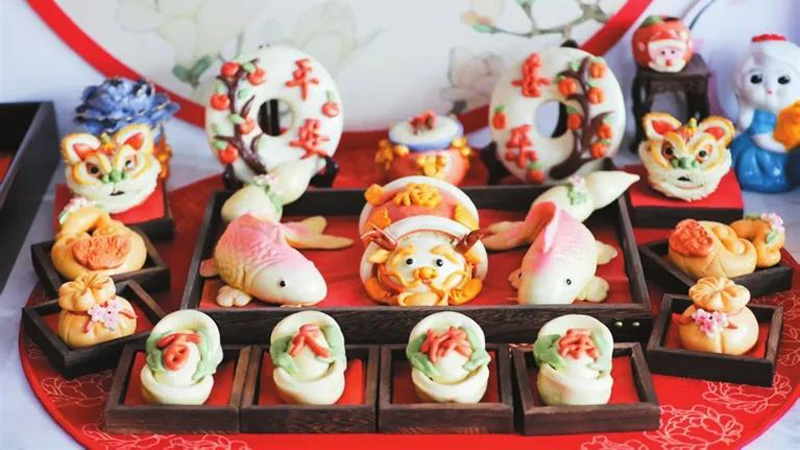
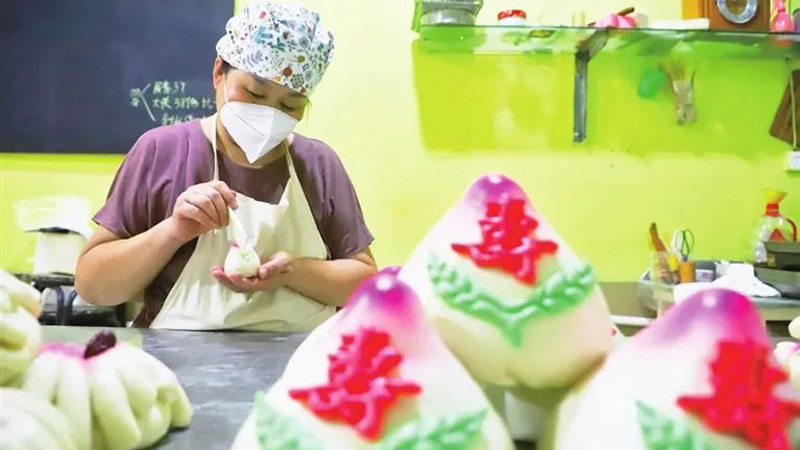
The air in Zhaojiashan (赵家山) Village hangs heavy with the sweet, earthy scent of steamed wheat. In Hao Qingling’s (郝庆玲) workshop, a cloud of steam erupts as she opens the lid of a massive bamboo steamer, revealing a stunning, intricately sculpted peach-shaped steamed bun, a traditional birthday offering. A few miles away, in another workshop, Wang Xiaoping’s (王小萍) fingers carefully shape a piece of dough into a lifelike koi fish, its scales meticulously defined, its tail fin poised as if ready to flick and swim away. This is Jinyang Hua Mo (晋阳花馍), an art form where dough becomes poetry, and two artisans are ensuring its thousand-year-old story continues, one delicate fold at a time.
The Language of Dough
To call Hua Mo merely a decorative snack is to miss the point entirely. In China’s northern Shanxi province, and specifically in the Jinyang (晋阳) region, these sculpted steamed buns are a vital language of ritual and respect. Recognized as a provincial-level intangible cultural heritage in 2011, their origins are ancient, tracing back to ceremonial bronze vessels.
“Our Jinyang Hua Mo isn’t just food for the stomach,” explains Yao Fusheng (姚富生), head of a local research association focused on folk culture, cradling a warm, freshly steamed peach bun. “It’s the ‘ritual vessel’ that’s essential in the big and small moments of our lives. A new baby calls for Xi Mo Mo’ (joy buns). An elder’s birthday demands this big peach. We offer lotus flowers and doll-shaped buns to honor our ancestors.” His eyes warm with the thought. “These buns carry the most heartfelt wishes of generations of Jinyang people.”
They are the highest form of a gift during festivals, a cherished token of affection between families and friends. “Hua Mo is the etiquette carved into the veins of Jinyang people,” Yao often says. “It’s a living culture you can hold in your hands, one that warms your heart.”
Two Paths, One Passion
In her workshop, 57-year-old Hao Qingling, a provincial-level inheritor of the craft, gently touches her latest creation with flour-dusted fingers. “The soul of a delicious bun comes from the old dough starter,” she states. Her authority is built on over twenty years of steadfast dedication to traditional methods.
She exclusively uses a natural, fermented “old dough” starter to leaven her creations. The critical step is balancing the alkalinity—a skill born purely of decades of experience. A little too much, and the bun turns bitter; too little, and it becomes unpleasantly sour. This, she calls the intangible “soul of the bun.” Her signature fragrant sesame rolls, glistening with golden oil, sell thousands of bags every year.
Her flawless technique has made her the local go-to “expert.” When a villager has a birthday, wedding, or a new child, ordering a set of symbolic buns from Master Hao is the customary thing to do. Orders, especially in the twelfth lunar month, flood in. “We have to work overtime,” she recalls. “We start at 5 a.m., using three to four sacks of flour a day.” At its peak, her workshop had to issue numbered tickets to manage demand, handing out over 40 in a single day.
Her most demanding task is creating a 1.8-meter-long coiling dragon offering for the annual Longtian Temple fair. “The head must be majestic, the body fluid, and the claws powerful,” she says, gesturing. The immense pressure comes from assembling separately steamed sections seamlessly. “One careless move and the seam shows. All that work would be for nothing.”
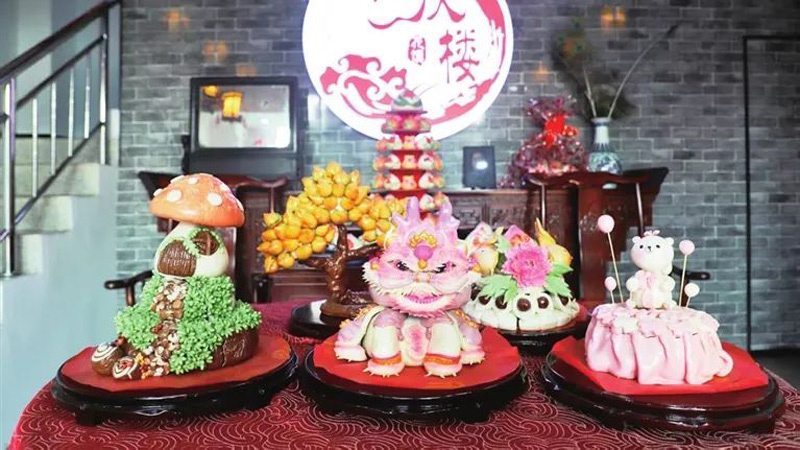
Meanwhile, in the Leqinglou workshop, Wang Xiaoping represents the new generation. The white steam from her steamers carries the rich aroma of wheat and a hint of milk. She gently touches a freshly steamed “Snake Coiling Around Rabbit” bun, its surface remarkably smooth and glossy—a technique she calls “water-light skin,” learned from a master in Beijing.
“My most precious childhood memory is watching my grandmother dye birthday peaches with red paper,” Wang says, her eyes soft yet determined.To refine her art, she traveled north to study and incorporate new ideas. She uses natural ingredients for color: spinach juice for green, pumpkin puree for a warm yellow, and dragon fruit powder for a soft pink.
She even innovates in fermentation, blending the traditional old dough starter with a milk-based yeast, achieving a bun that is both authentically chewy and surprisingly soft. Her eye-catching creations, from nine-layer birthday peach pagodas to awakening lion buns with manes clipped at the perfect moment, have found a new market through social media. Custom orders for exams, weddings, and more pour in. She holds a firm principle: “I’d rather accept fewer orders than ever add preservatives.” Now, she plans to teach workshops, hoping to share the joy of this craft. In her hands, the ancient dough finds a new voice.
A Flourishing Future
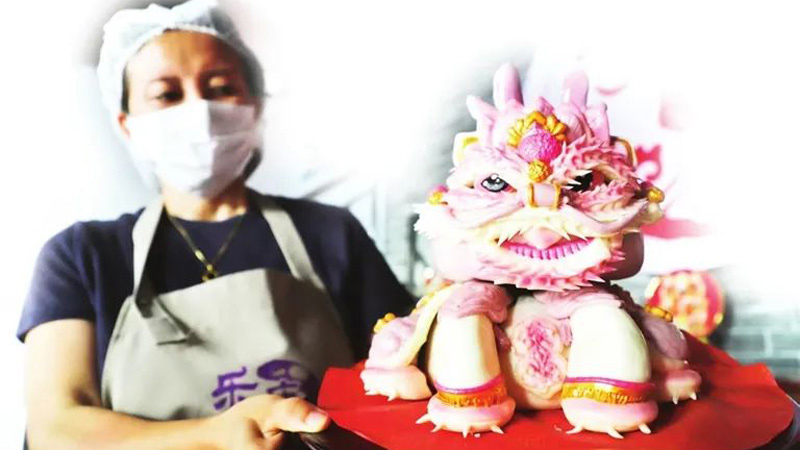
Today, the art of Jinyang Hua Mo is thriving in the balance between steadfast tradition and thoughtful innovation. The veteran artisan’s palm holds a birthday peach, heavy with the weight of a millennium of skill. The younger artist’s creative workshop sows the seeds for the next generation. With the scent of wheat as their guide, they are ensuring this doughy poetry continues to float far beyond the fields of Shanxi.