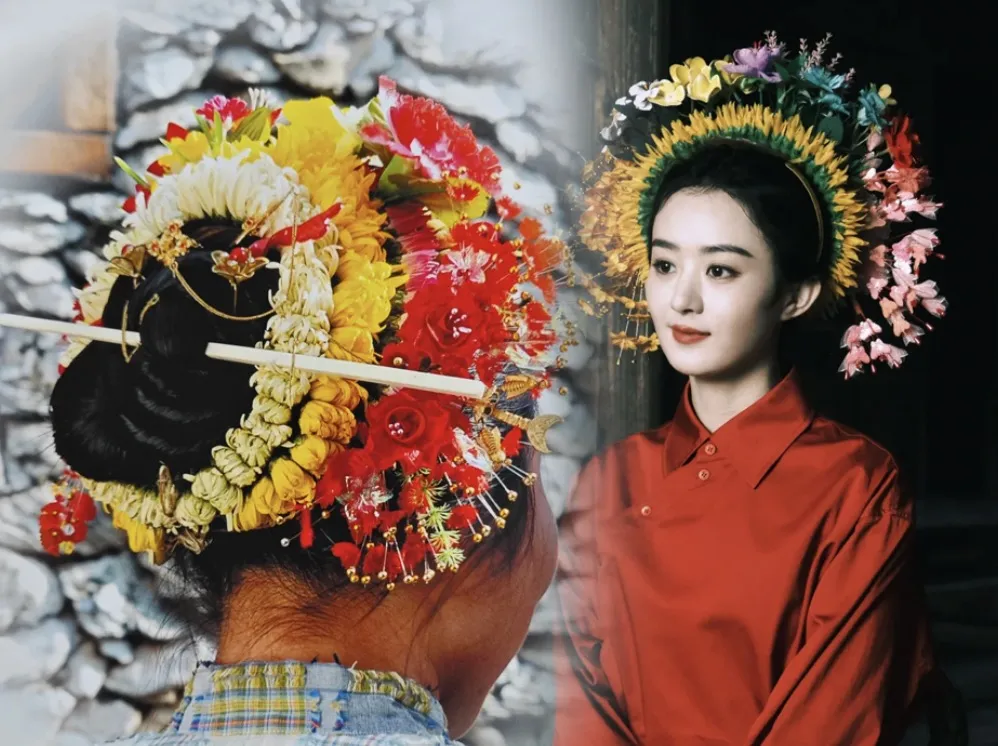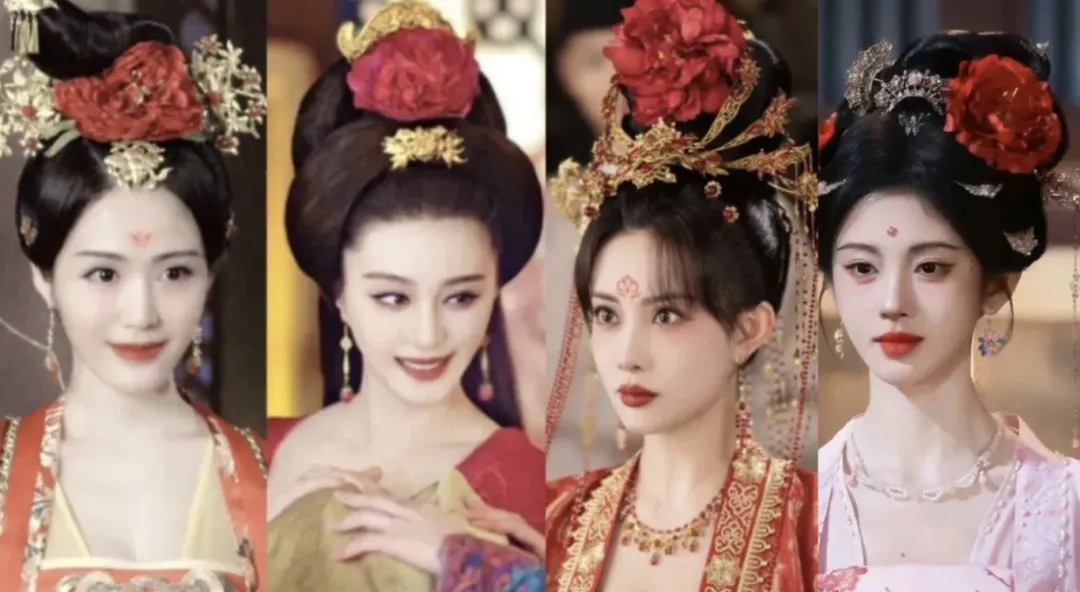
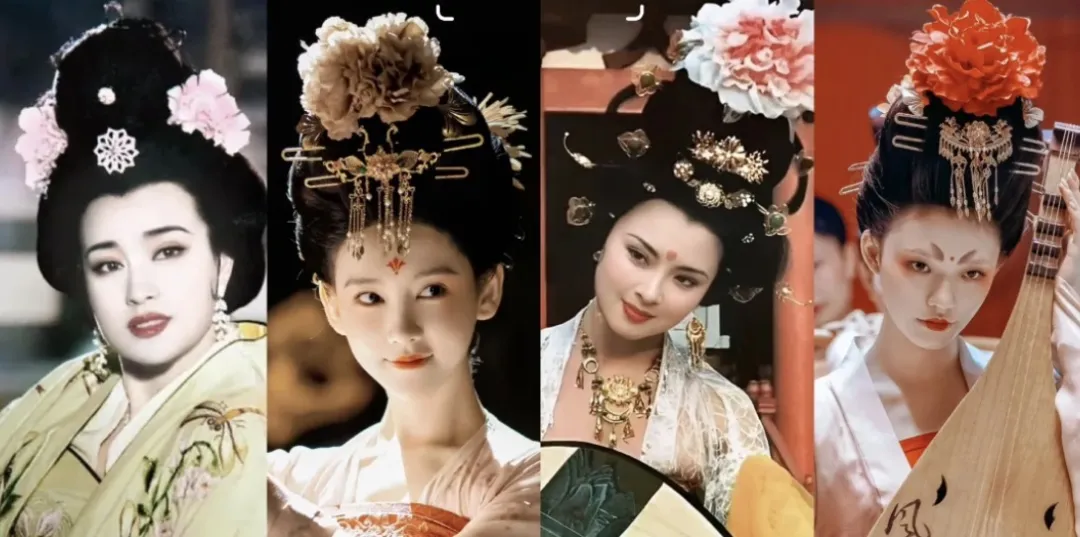
In early period cdramas, especially those with Tang-style costumes, this kind of big flower hairdo was often seen. But why is it less common today? Well, now there are more references from cultural relics, offering a wider range of options for hair and makeup styles. However, the association between the Tang Dynasty and wearing big flowers still persists as a stereotype in most people's minds.
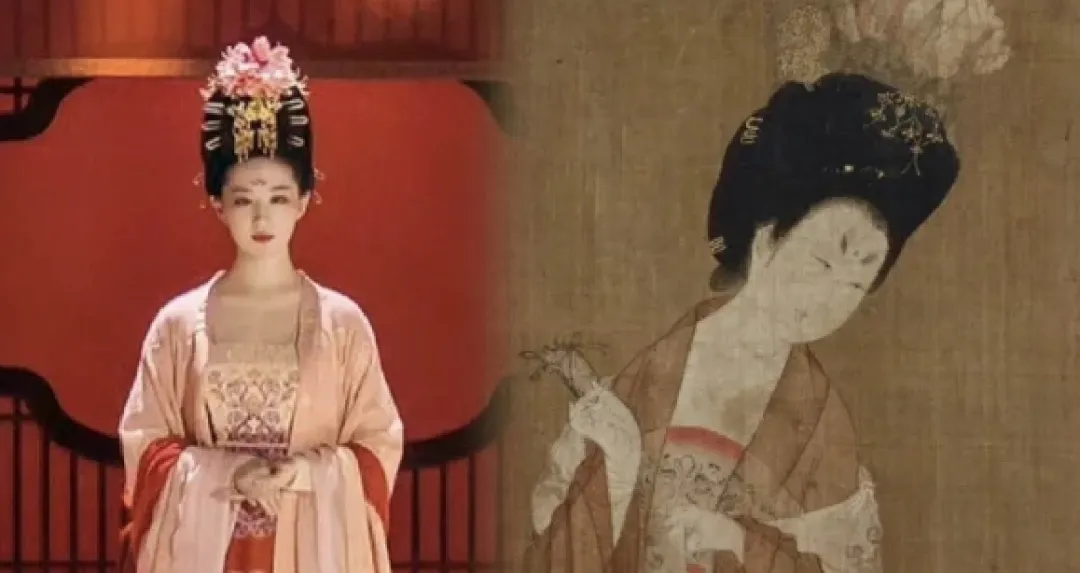
The Tang people's fondness for wearing peonies in their hair was closely linked to their love for these flowers. Peonies are so rich and magnificent, and some rare varieties are extremely precious. Only by wearing a whole peony could one show their status. Moreover, once a peony was worn, there was no room for other flowers, leading to the popular custom of wearing a single big flower on the head. Additionally, when the Tang people styled their hair in the 'big head style', there was some empty space on the head, so a big flower wouldn't look overly 'garish'. The most famous example is the Ladies with Head - flowers (簪花仕女图), which clearly shows this kind of adornment.
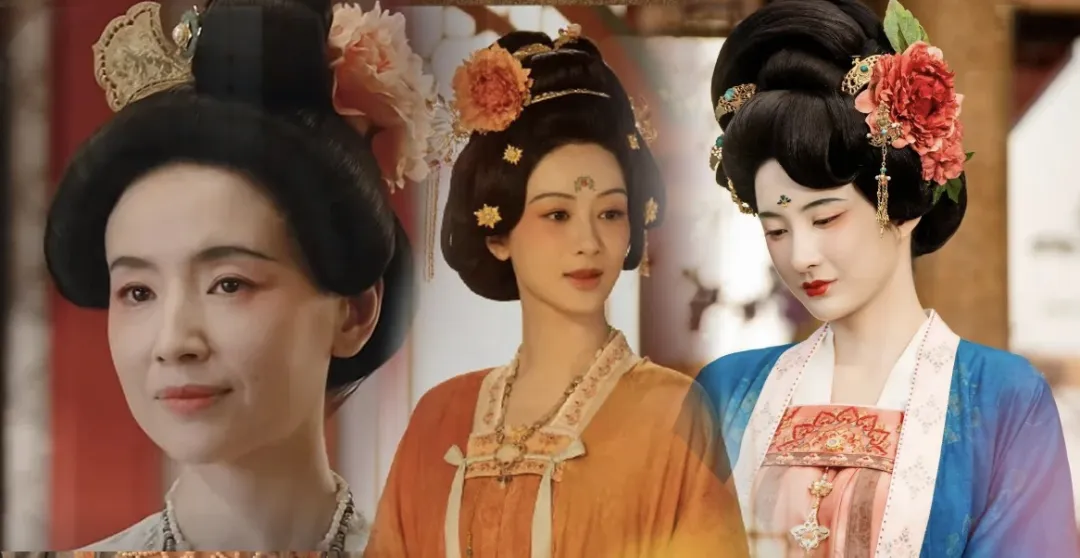
This hair - flower - wearing custom reached the peak of fashion in the prosperous Tang Dynasty. Since good peonies were hard to come by, women would also insert fresh flowers such as lotuses, crabapple flowers, gardenias, and Chinese herbaceous peonies into their hair buns or on their temples as a symbol of wealth. And it wasn't just women who wore flowers; men also did, usually on their futou hats. Some wore small, low - key decorative flowers, while others went for big, eye - catching ones.
How much did the Tang people love peonies? Every late spring, nobles would compete to buy peonies. Perhaps because of their love for peonies, it was common for rare varieties to be worth a fortune. According to the Records of the History of the Tang Dynasty (唐国史补), 'For more than thirty years, the noble people in the capital have been fond of peonies. Every late spring, people would go crazy over them. They would feel ashamed if they didn't indulge in admiring peonies. Some people would buy land outside the palace walls and in temples and monasteries to grow peonies for profit. One plant could be worth tens of thousands of coins.'
Why did the Tang people love peonies? Peonies are indeed beautiful, but among the many spring flowers, why did peonies stand out? It was mainly due to the influence of the aristocratic class. One theory is that sovereigns like Empress Wu Zetian and Emperor Xuanzong were very fond of peonies. Under their influence, the trend became more and more popular, from the royal family and nobles to ordinary people. Another theory is that peonies were expensive and came in many varieties, which represented the status of the aristocracy to some extent. Poets also played a role in promoting the popularity of peonies. They praised peonies highly: 'Clouds remind me of her robes and flowers of her face; In vernal breeze the jeweled balustrades with dew are graced' (Li Bai); 'Only the peony deserves the name of national beauty; When in bloom, it stirs the capital with elation' (Liu Yuxi); 'For twenty days they bloom and fade, and all the town goes wild' (Bai Juyi); 'It's praised as the matchless beauty under the sky, boasting the first fragrance in the mortal world' (Pi Rixiu). A poet would seem 'outdated' if they didn't write a poem about peonies.
It should be noted that it's really hard for ordinary people to tell the difference between peonies and Chinese herbaceous peonies. Simply put, the biggest difference is that peonies are woody plants, while Chinese herbaceous peonies are herbaceous. Peony branches are stiffer than those of Chinese herbaceous peonies, and their leaves are rounder. People who don't know well can easily confuse them. Of course, Chinese herbaceous peonies are also lovely. As the poem says, 'The herbaceous peony enjoys spring's favor. Why should it envy the peony?'
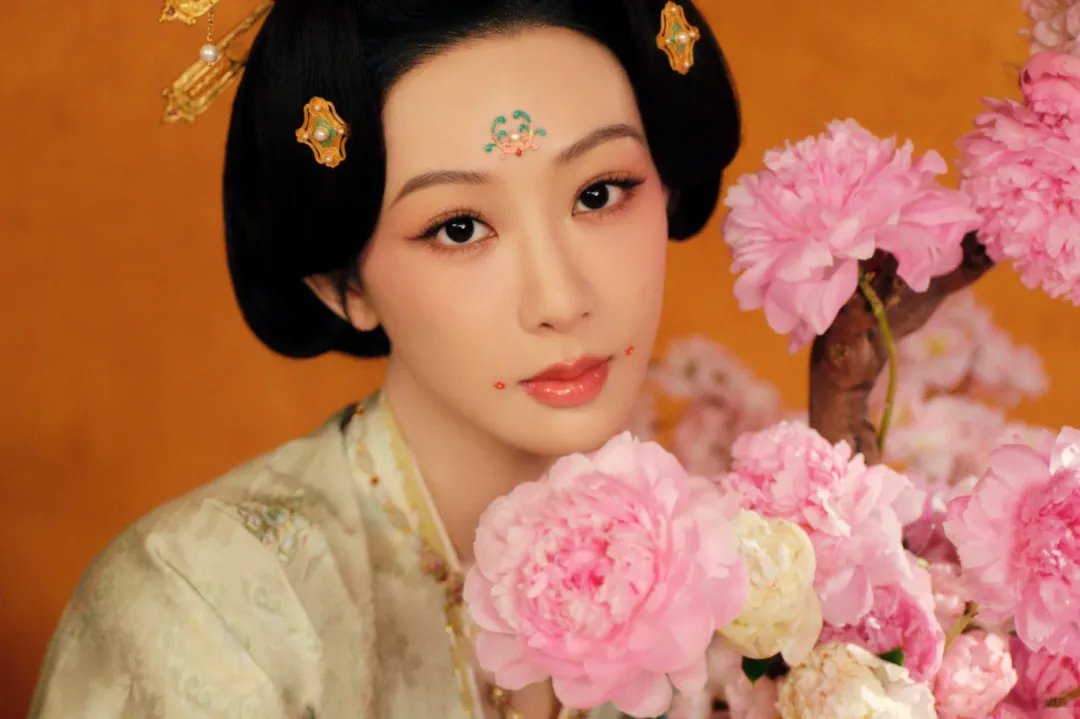
But peonies are fresh flowers and can't be worn all year round. So, did people stop wearing flowers in seasons when peonies were not in bloom? No! Our ancestors made peony - shaped flower crowns to wear on their heads. For example, in the Ladies Playing Musical Instruments (唐人宫乐图) and the Ladies with Fans (挥扇仕女图), the flower crowns worn by noble ladies were made of layers of flower petals, looking extremely gorgeous.
The custom of wearing flowers in the Tang Dynasty also influenced the Song Dynasty. However, in the Song Dynasty, people rarely wore large peonies but preferred to wear small, delicate flowers in combination. If the Tang style was magnificent, the Song style was elegant. Although the styles were different, both had their own fashions. Now, when we look at various flower - wearing customs and the 'flower - encircled head' (簪花围) popular in Fujian, we can still find the original fashion charm. So, learning fashion from our ancestors will never go out of style!