
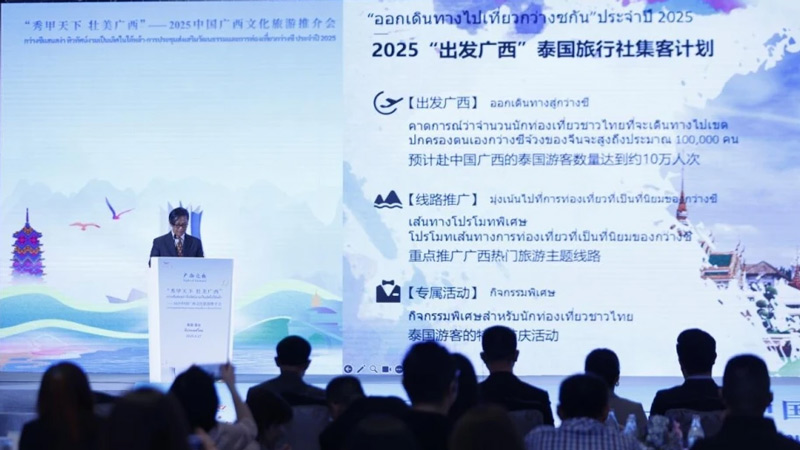
The humid Bangkok air buzzed with anticipation as Thailand’s cultural and tourism elites gathered on July 27, 2025, for "Guangxi Night." Hosted by China’s Guangxi Zhuang Autonomous Region, this meticulously curated event transcended a mere tourism pitch—it was a strategic handshake between two ASEAN neighbors.
Against the backdrop of the 50th anniversary of Thailand-China diplomatic ties ("Golden Jubilee"), Guangxi Vice Chairman Hu Fan and Thailand’s Tourism & Sports Deputy Minister Jakkapong Damsuphakdi led 110 delegates in redefining cross-border travel. With Thai visitors to Guangxi surging 154% in 2024, the stage was set for a new era of exchange.
Forging Golden Pathways
Hu Fan’s (胡帆) keynote resonated with pragmatic optimism. "Guangxi isn’t just China’s ASEAN gateway," he declared, "it’s a living museum where karst mountains sculpt horizons and ethnic harmonies color traditions." His data-backed revelation—800+ cultural events slated for Guangxi’s 2025 Tourism Year—drew appreciative murmurs. The statistic wasn’t arbitrary; it answered Thailand’s post-pandemic wanderlust with precision.
Jakkapong’s response fused diplomacy with vision. "Our golden anniversary demands golden collaboration," he asserted, endorsing media alliances and co-branding to amplify tourism reach. The symbolism was palpable: two cultures leveraging proximity not for convenience, but for legacy.
Tangible momentum followed. Vibul Kamolthok, VP of Thailand’s Outbound Tourism Association, unveiled the2025 Guangxi Mission Toolkit—a distributor playbook born from Thai agencies’ exploratory trips to Nanning and Guilin. "We’re upgrading from sightseeing to soul-seeing," he vowed, referencing customized itineraries co-designed with Guangxi’s artisans and chefs.
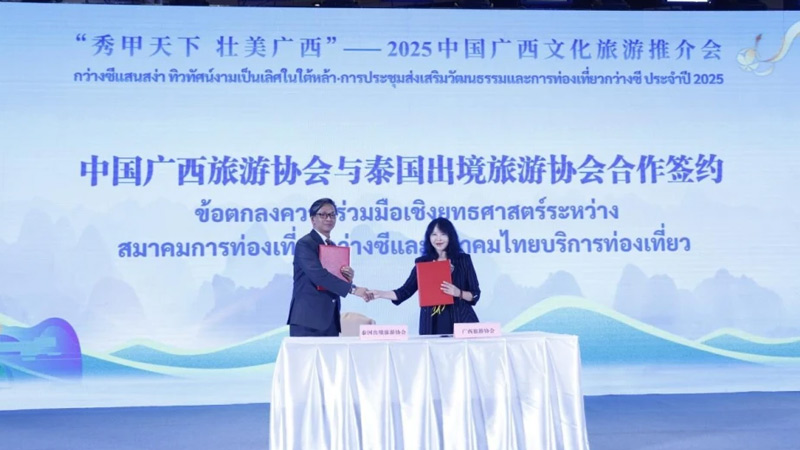
The crescendo arrived with ceremonial gravitas: Guangxi Tourism Association and its Thai counterpart inking a pact. No generic memorandum, this accord specified joint training for Thai-speaking Guangxi guides and dual-market digital campaigns—proof that "win-win" wasn’t rhetoric, but architecture.
Celebrating Heritage Unbounded
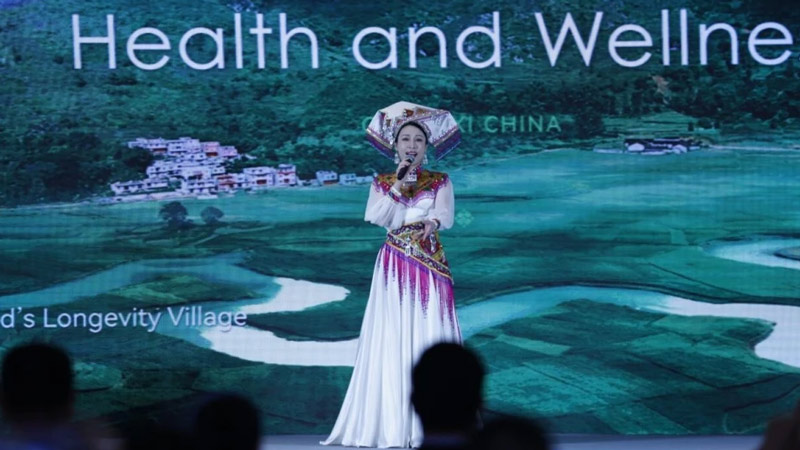
As dusk embraced the venue, Guangxi’s artists transformed diplomacy into sensory poetry. Silver Yuexi, the region’s cultural ambassador, ignited the stage with Guangxi Ni Di Ya (广西尼的呀) — a folk-pop anthem fusing Zhuang mountain refrains with electronic beats. Her embroidered indigo dress, a tapestry of Dong minority motifs, shimmered under lights as lyrics painted Li River mists and terraced rice fields.
Then came the strings. The Guangxi Ethnic Orchestra’s Beautiful Zhuang Brocade (美丽的壮锦) wove silk-thread melodies through erhu and pipa, each note a thread in the titular textile’s legend. Audience members swayed, recognizing shared Southeast Asian instrumental roots in the pluckedyanqin.
Modernity flirted with tradition in Third Sister’s Ballad (三姐的歌谣), a jazz-inflected remake of a Zhuang opera classic. Here, the lusheng (bamboo flute) soloist dueled playfully with a saxophonist—an auditory metaphor for Guangxi’s fusion ethos. "They made mist feel danceable," chuckled a Thai hotelier, misty-eyed.
Backstage, performers became cultural diplomats. A Zhuang dancer taught baihou (courtship gestures) to Thai journalists, while Thai choreographers discussed integrating Guangxi’s bronze-drum rhythms into Bangkok theater productions. Art, this night proved, needs no visa.
Charting Tomorrow’s Journeys
Beyond symbolism lay three meticulously crafted Thai-centric routes unveiled that evening."Escape Heat, Embrace Guangxi" targets Thailand’s scorching summers with misty Longsheng rice terraces and subterranean cool of Leye-Fengshan caves. "We’ll train Thai chefs in Guangxi sour-fish hotpots," promised a Nanning tour operator, "so flavors feel like home."
"Songkran in Sister Cities"reimagines Thailand’s water festival through Guangxi’s Sanyuesan Festival (March 3rd). Imagine water-splashing in Guilin’s crystal-clear lakes followed by Zhuang hilltop bonfires—a dual-celebration itinerary already endorsed by Thai influencers.
Most innovative was"Gastronomic Pilgrimage,"mapping Guangxi from wok to table. Thai foodies will hunt heirloom chili varieties in Baise’s markets, learn luosifen (river-snail noodle) secrets in Liuzhou, and sip Yao tribe honey wines in Hechi. "This isn’t eating," grinned a Bangkok restaurateur, "it’s edible anthropology."
Crucially, accessibility underpins vision. Direct Bangkok-Nanning flights will double by Q1 2026, while 144-hour visa-free transit extends to river cruise passengers. "We’re simplifying joy," summarized a Guangxi Tourism official, nodding to real-time translation apps for rural homestays.
As midnight approached, Thai and Guangxi CEOs exchanged WeChats over lychee-infused cocktails. Projections flashed collaborations: Thai wellness retreats embedding in Guangxi’s longevity villages (Bama County), Guangxi rock climbers guiding Thai adventurers on limestone cliffs. The statistics glowed—30% projected Thai visitor growth for 2026—but beyond numbers, a shared conviction crystallized: tourism, at its best, turns neighbors into family. Guangxi hadn’t just hosted a night; it lit a beacon.